


 CryptoSlate
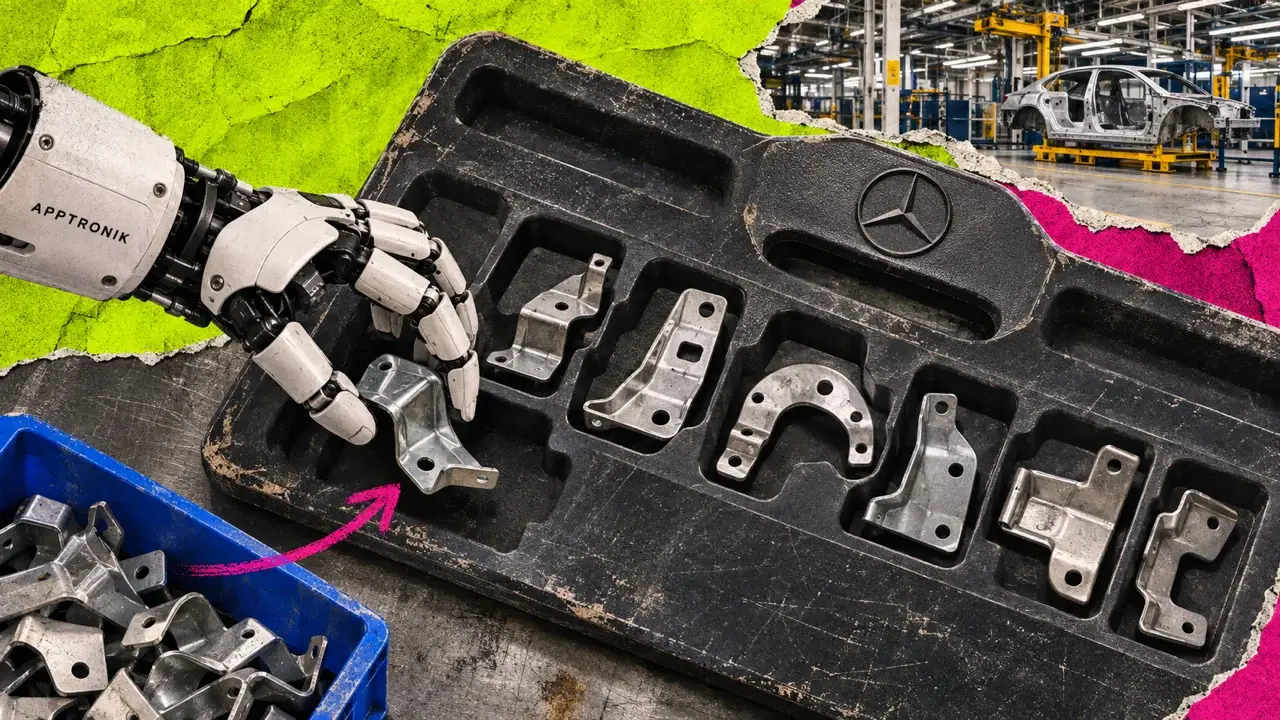
Google DeepMind says Apptronik's Apollo 2 humanoid robots achieved a 96% success rate sorting automotive parts on active Mercedes-Benz production lines. The proof of concept, disclosed on Nov. 10, tested AI-assisted assembly preparation at sites in Kecskemét, Hungary, and Sindelfingen, Germany. The company did not define the unit used to measure success or disclose the number of trials.
Why it matters
The robots performed automotive kitting: taking components from bulk bins and organizing them in the sequence needed for each vehicle. In one example, an Apollo 2 picked up metal brackets and placed them in sequencing containers for workers building cars.
Two AI models divided the task. Gemini Robotics ER tracked the workflow, while Gemini Robotics 2.5 controlled the robot's hands and arms. Apptronik CEO Jeff Cardenas said the models improved after a few weeks of post-training and transferred to Mercedes production with little performance drop-off.
Apptronik and Mercedes announced an agreement in March 2024 to explore uses for the original Apollo, including delivering assembly kits and inspecting components. The premise was that humanoids could tackle repetitive physical work in spaces designed for people, potentially avoiding a full factory redesign.
Market impact
The pilot gives investors a concrete example of AI robotics being tested on a production task rather than solely in a laboratory. But the 96% figure does not establish whether the robots can work productively for a full shift.
DeepMind did not disclose cycle times, uptime, operating costs, reset frequency or how often humans intervened. For factory operators, those measures are central to assessing how much work the robots can complete and the economics of deploying them.
Frequently asked questions
-
What task did the Apollo 2 robots perform at Mercedes?
The robots sorted parts from bulk bins and arranged them in the sequence needed for vehicle assembly, a task known as automotive kitting.
-
Where did the Mercedes factory pilot take place?
DeepMind identified sites in Kecskemét, Hungary, and Sindelfingen, Germany.
-
How did DeepMind's AI models divide the work?
Gemini Robotics ER tracked the workflow, while Gemini Robotics 2.5 controlled the robots' hands and arms.
-
What does the 96% success rate leave unclear?
DeepMind did not define the unit used to measure success or disclose the number of trials, cycle times, uptime, costs or human-intervention rates.
-
When did Apptronik and Mercedes begin exploring Apollo's factory uses?
They announced an agreement in March 2024 to explore uses for the original Apollo, including delivering assembly kits and inspecting components.
 CoinDesk
 Lookonchain
 WuBlockchain
 Crypto News
 CoinTelegraph
 TheBlock
 WatcherGuru