








 CoinDesk
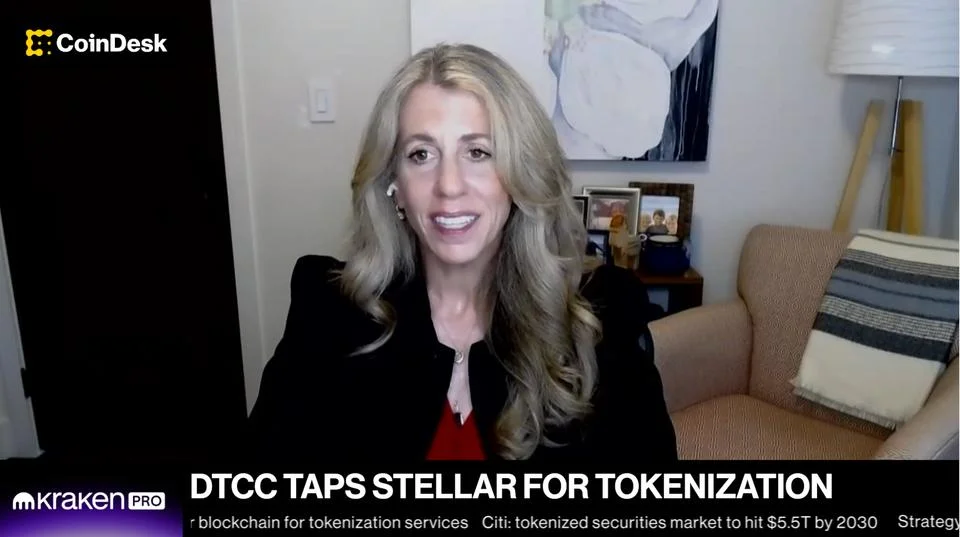


Stellar Development Foundation CEO Denelle Dixon told CoinDesk's Public Keys that DTCC's selection of Stellar as the first public blockchain connected to its upcoming tokenized securities settlement platform marks the moment the network was built for. The Depository Trust & Clearing Corporation processed $4.7 quadrillion in securities transactions last year, a scale that makes this the first real test of whether on-chain settlement can absorb institutional volumes.
Stellar has crossed $3 billion in tokenized real-world assets after passing $1 billion in December, Dixon said — a five-month tripling that landed just as the platform was being vetted for DTCC's institutional pipeline. Franklin Templeton is already running a money market fund on Stellar, she noted, citing it as proof that major asset managers have been building on-chain products well before recent US legislation clarified the rules.
Why it matters
The GENIUS Act gave institutions confidence that the US government intends to support the industry through a clearer regulatory framework, according to Dixon, and the pending Clarity Act would help further. But she argued tokenization adoption is unlikely to be derailed if the bill stalls — the institutional pipeline is already running on the GENIUS Act's foundation and on the compliance architecture Stellar spent more than a decade building.
That compliance-first positioning is now being measured. Stellar reports 99.9999% uptime and processes billions of transactions per quarter, with native issuance tools designed to remove the need for custom smart contracts. The DTCC pick signals that those operational metrics — not headline regulation — were the gating factor for institutional deployment.
Market impact
Dixon rejected the idea that one blockchain will dominate all institutional tokenization activity. She expects a handful of networks to capture most real-world asset issuance based on technical strengths, and argued that open public blockchains will ultimately outperform closed alternatives because they evolve faster through global developer participation.

Frequently asked questions
-
What did DTCC actually announce about Stellar?
DTCC selected Stellar as the first public blockchain to connect to its upcoming tokenized securities settlement platform. DTCC processed $4.7 quadrillion in securities transactions last year, making this the first real test of whether on-chain settlement can absorb that scale.
-
How much has Stellar grown in tokenized real-world assets?
Stellar surpassed $1 billion in tokenized real-world assets in December 2025 and has roughly tripled to about $3 billion in the five months since, according to Stellar Development Foundation CEO Denelle Dixon.
-
Does the Clarity Act matter for tokenization adoption?
Dixon said passage of the Clarity Act would benefit the industry, but argued tokenization adoption is unlikely to be derailed if the bill stalls. Institutions are already moving on the foundation of the GENIUS Act and on existing compliance infrastructure.
-
What gives Stellar an edge for institutional tokenization?
Stellar reports 99.9999% uptime, processes billions of transactions per quarter, and embeds compliance tools directly into the network architecture — reducing the need for custom smart contracts to issue assets.
-
Will one blockchain dominate institutional tokenization?
Dixon rejected that idea. She expects a handful of networks to capture most real-world asset issuance based on their technical strengths, and argued open public blockchains will ultimately outperform closed alternatives through faster global developer-led evolution.
 WatcherGuru
 CoinTelegraph
 WuBlockchain
 Altcoin Daily
 TheBlock