


 CoinDesk

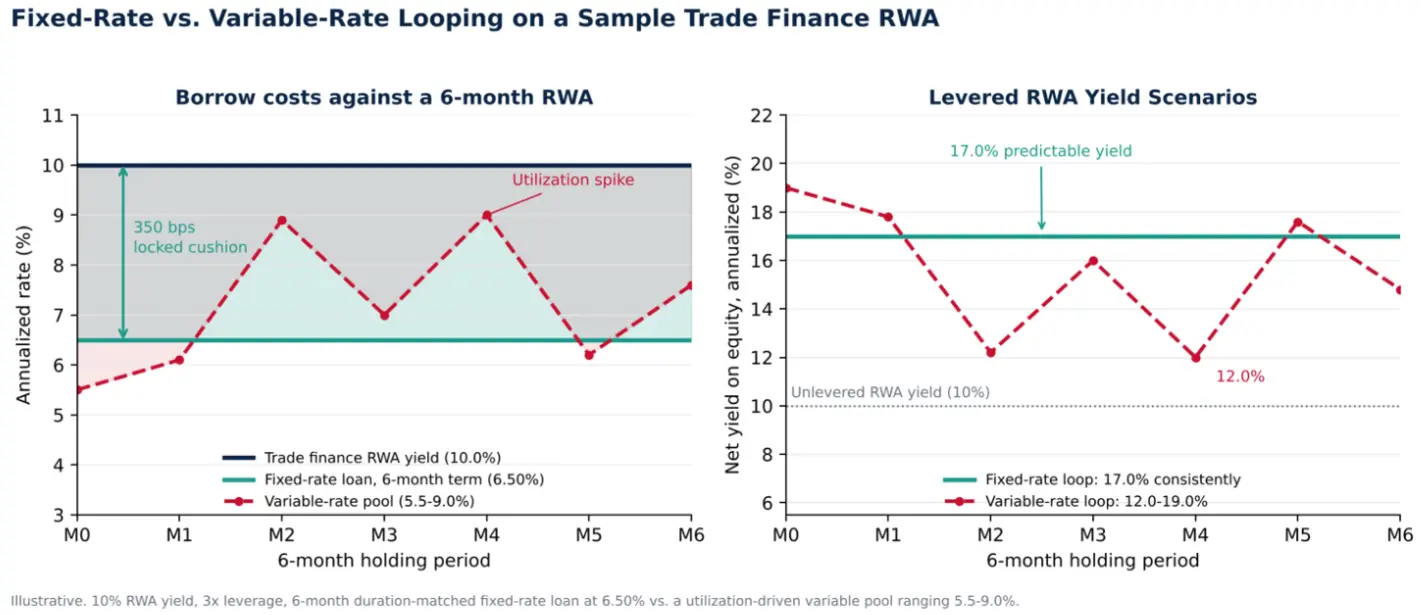

Real-world assets already back major stablecoins, but onchain borrowing against them still relies largely on variable-rate pools. Peter Gaffney of O2O Capital Partners argues that fixed-rate, fixed-term loans could make RWA-backed leverage more workable for institutional investors. A 5% reallocation of the $12 billion in Sky and Ethena reserves into 3x looped RWA strategies would represent $600 million in equity and $1.8 billion in potential RWA demand.
Why it matters
Variable rates leave borrowers exposed to utilization spikes, while redemptions for tokenized credit can take from T+1 to beyond T+90. Aave’s USDC borrow rate can rise from 4% to 14% as utilization moves from 92% to 100%. During the April 2026 KelpDAO rsETH exploit, Aave’s USDC pool reached full utilization and borrowers paid the maximum rate for five days.
That volatility can erase the slim spread between borrowing costs and asset yields. JAAA yields 4.5% to 5%, and Maple’s syrupUSDC pays 5.2%; Aave V3 Ethereum’s one-year average USDC borrow rate was 4.56%, leaving little room for rate spikes. Fixed terms let allocators match a loan’s maturity to collateral duration and assess a borrowing cost at entry.
Market impact
The infrastructure is beginning to emerge. Morpho has opened fixed-rate, fixed-term markets through Morpho Midnight, and Coinbase used the platform to launch fixed-rate crypto-backed customer loans in September 2026. Tenor Finance, Kamino, Term Labs and Loopscale also quote fixed rates; one Kamino market offered 5.3% loans against Figure’s auto-loan portfolio in rolling 30-day terms.
The potential extends beyond Sky and Ethena reserves to foundations, digital-asset treasury companies and exchange Earn programs. For DeFi, the broader thesis is that predictable financing could widen collateral beyond volatile crypto assets and connect onchain lending with established credit markets. The $1.8 billion figure is an illustrative demand estimate, contingent on the proposed 5% reserve shift and 3x leverage strategy.

Frequently asked questions
-
How does the article estimate $1.8B in potential RWA demand?
A 5% reallocation of Sky and Ethena’s $12 billion in reserves would provide $600 million in equity. At 3x leverage, that implies $1.8 billion in RWA demand.
-
Why can variable-rate borrowing undermine RWA strategies?
Borrow costs rise with pool utilization and can eliminate the spread between an RWA’s yield and financing cost. Aave’s USDC rate can rise from 4% to 14% as utilization moves from 92% to 100%.
-
What happened to Aave’s USDC borrowing rate during the KelpDAO exploit?
In April 2026, the pool reached 100% utilization during the KelpDAO rsETH exploit, leaving borrowers paying the maximum 14% rate for five days.
-
Why do fixed loan terms matter for tokenized credit assets?
Redemptions can take from T+1 to beyond T+90. Matching loan maturity to collateral duration helps borrowers manage timing risk and know their borrowing cost at entry.
-
Which platforms are developing fixed-rate lending markets?
The article names Morpho, Tenor Finance, Kamino, Term Labs and Loopscale. One Kamino market offered 5.3% loans against Figure’s auto-loan portfolio in rolling 30-day terms.
 Crypto Rank News
 CryptoSlate
 WatcherGuru
 CoinTelegraph
 WuBlockchain
 TheBlock