


 CryptoSlate


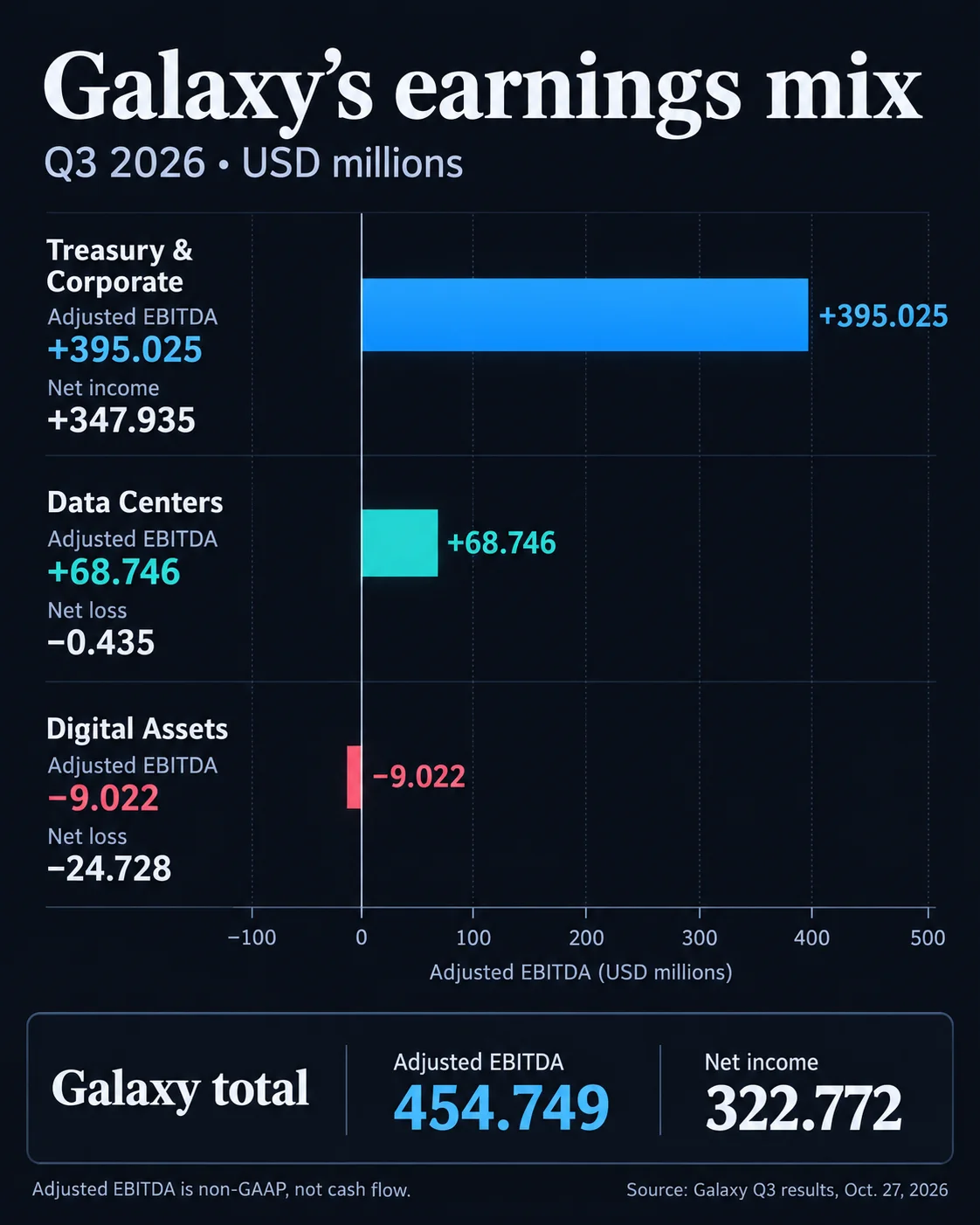
Galaxy Digital’s first full quarter of AI data-center leasing generated $79 million in revenue and $69 million in adjusted EBITDA, but the Data Centers segment still recorded a $435,000 net loss. The quarter ended Sept. 30 included a full period of operations under the Helios I, Phase I lease to CoreWeave, with all 133 MW of critical IT load delivered by the end of Q2.
Why it matters
The lease adds a substantial operating income stream, but adjusted EBITDA is not free cash flow or net profit after financing and other costs. Galaxy’s reconciliation includes $75.4 million in notes interest and other expense, alongside depreciation and other adjustments. The company’s reported segment loss cannot be explained by subtracting interest alone.
Galaxy reported $323 million in consolidated net income for Q3. Treasury & Corporate contributed $348 million, while Digital Assets lost $25 million and Data Centers lost $435,000. Treasury & Corporate also generated $395 million of the group’s $455 million in adjusted EBITDA, making it the largest contributor to the recovery. The segment carries Galaxy’s digital-asset and investment exposure, with net digital assets and investments at about $1.7 billion at quarter-end, up from $1.2 billion at Q2-end.
Market impact
Galaxy spent $757 million on Data Centers capital expenditure in Q3 as Helios I, Phase II remained under construction and fully financed. Initial data-hall deliveries are scheduled for Q2 2027. The planned expansion covers two buildings with eight data halls, 400 MW of utility capacity and 260 MW of critical IT capacity, separate from the 133 MW already delivered.
Project debt and tenant performance remain part of the diversification equation. The $3.507 billion senior secured notes carry a 9.875% rate and mature Aug. 1, 2031; cash interest payments are scheduled to begin Feb. 1, 2027. CoreWeave’s growth supports the commercial case for the campus, but its Q2 results also included a $626 million net loss and $640 million in net interest expense. The next tests are whether lease income translates into segment net profit after financing costs and whether Phase II deliveries begin on schedule.
Frequently asked questions
-
Why did Galaxy’s Data Centers segment post a net loss despite $69M in adjusted EBITDA?
Adjusted EBITDA excludes financing expenses and other accounting items. Galaxy’s reconciliation includes $75.4 million in notes interest and other expense, and the segment reported a $435,000 net loss.
-
How much of Galaxy’s Q3 adjusted EBITDA came from Treasury & Corporate?
Treasury & Corporate generated $395 million of Galaxy’s $455 million in adjusted EBITDA, making it the largest contributor.
-
How much Helios capacity was operating under the CoreWeave lease?
All 133 MW of critical IT load for Helios I, Phase I had been delivered by the end of Q2.
-
When are initial Helios Phase II data-hall deliveries scheduled?
Galaxy said initial Phase II data-hall deliveries are scheduled for Q2 2027. The project was fully financed and under construction.
-
What are the main financial risks to Galaxy’s AI data-center expansion?
Project debt creates financing obligations before the expansion contributes operating income, while the lease business also depends on tenant performance. Galaxy’s notes carry a 9.875% rate, with cash interest payments scheduled to begin Feb. 1, 2027.
 WatcherGuru
 WuBlockchain
 CoinDesk
 Crypto News