








 CoinDesk

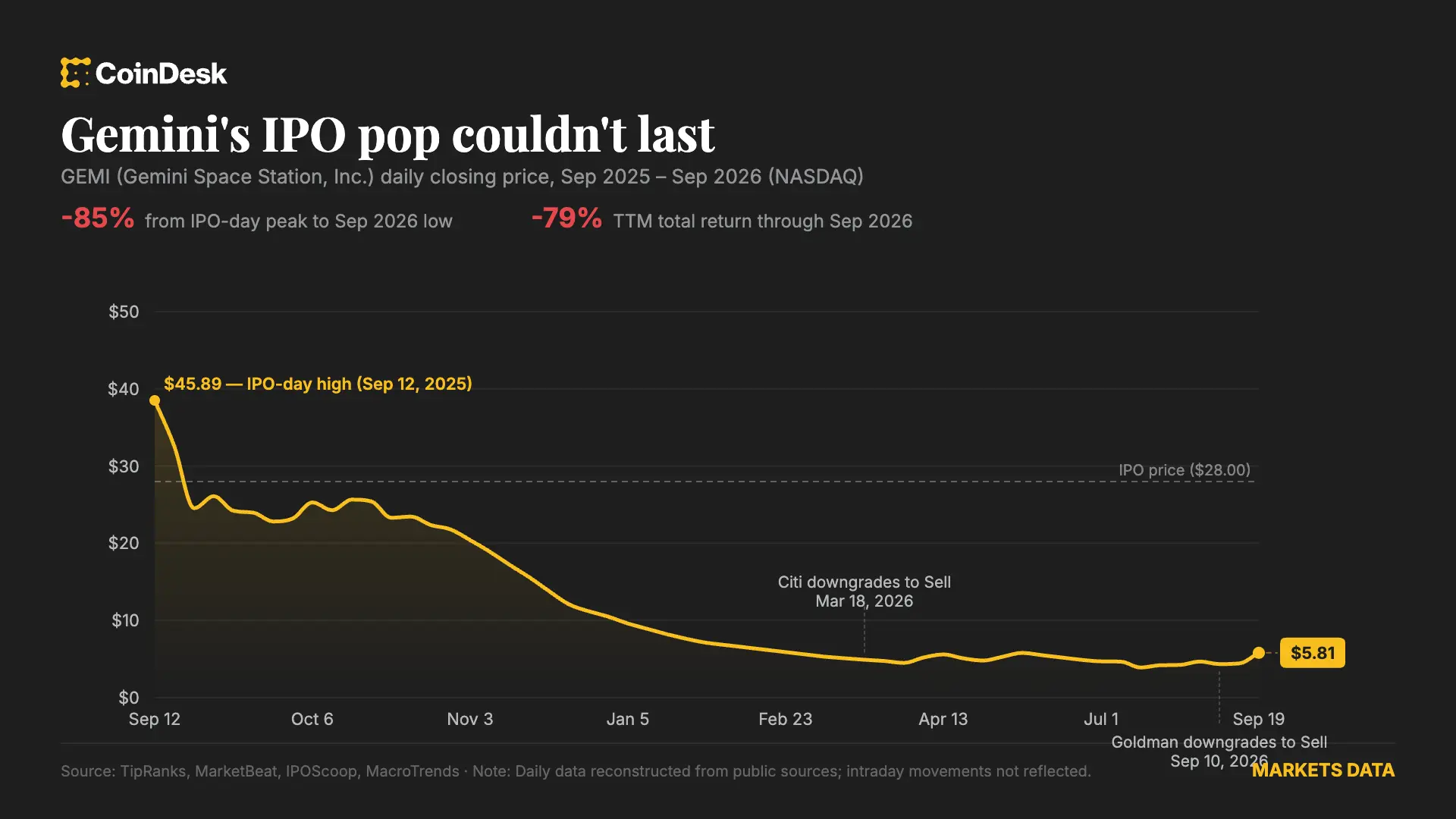


Gemini Space Station (GEMI) has fallen roughly 80% since its public debut, cutting its market value from about $4 billion at its peak to $753 million as trading volume, revenue and platform assets have declined. Second-quarter exchange revenue dropped 38% from a year earlier to $12.5 million, spot trading volume fell 66% to $3.8 billion, and assets on the platform shrank to $8.4 billion from $18.2 billion. There is no indication of an active bid, but the collapse is reviving takeover speculation around the platform founded by Cameron and Tyler Winklevoss.
Why it matters
Lorenzo Valente, director of digital assets research at ARK Invest, argued on X last month that Hyperliquid, the offshore perpetual-trading platform, should acquire Gemini and use it as a regulated U.S. gateway for perpetual futures and prediction markets. Hyperliquid is not actively pursuing a deal, but the proposal frames the broader question: what is Gemini worth to a buyer if its regulatory infrastructure matters more than its shrinking spot-exchange business?
A venture investor told CoinDesk that Gemini's exchange technology offers limited differentiation from rivals, but its licenses and approvals would be costly and time-consuming for competitors to replicate organically. That fits a wider crypto M&A pattern where buyers pay for regulatory infrastructure, distribution and market access rather than trading volume. Keyrock bought BlockFills' trading assets in July partly for licenses, Ondo has explored a deal worth up to $500 million, and LMAX and B2C2 have also weighed strategic transactions. CoinDesk reported in April that prospective buyers were eyeing Gemini's shuttered European and U.K. operations primarily for their licenses, though no deal has materialized amid differing views on valuation.
Market impact
The Winklevoss twins control 94.5% of Gemini's voting power, which would streamline negotiations by routing them through two people but makes a hostile takeover virtually impossible. Any sale effectively requires their approval. The depressed valuation offers a relatively inexpensive route to regulated U.S.
Frequently asked questions
-
Why has Gemini's stock fallen 80% since its IPO?
Trading volume, revenue and platform assets have declined sharply. Q2 exchange revenue fell 38% year over year to $12.5 million, spot volume dropped 66% to $3.8 billion, and assets on the platform fell to $8.4 billion from $18.2 billion, cutting market value from about $4 billion to $753 million.
-
Who might acquire Gemini?
No active bid exists, but ARK Invest's Lorenzo Valente has proposed that Hyperliquid acquire Gemini and use it as a regulated U.S. gateway for perpetual futures and prediction markets. CoinDesk also reported buyers previously considered Gemini's shuttered European and U.K. operations for their licenses.
-
What makes Gemini attractive to a potential buyer?
Its regulatory licenses and approvals would be costly and time-consuming for competitors to replicate organically, and it brings a customer base and custody infrastructure. The broader crypto M&A trend favors buying regulatory infrastructure and market access rather than trading volume.
-
Could Gemini be taken over without the Winklevoss twins' approval?
No. Cameron and Tyler Winklevoss control 94.5% of Gemini's voting power, which makes a hostile takeover or shareholder-driven effort to force a transaction virtually impossible. Any sale effectively depends on their approval.
-
How much has Gemini's business contracted since going public?
Second-quarter exchange revenue fell 38% from a year earlier to $12.5 million, spot trading volume dropped 66% to $3.8 billion, and assets on the platform declined to $8.4 billion from $18.2 billion.
 CryptoSlate
 WuBlockchain
 TheBlock
 WatcherGuru