








 CoinDesk
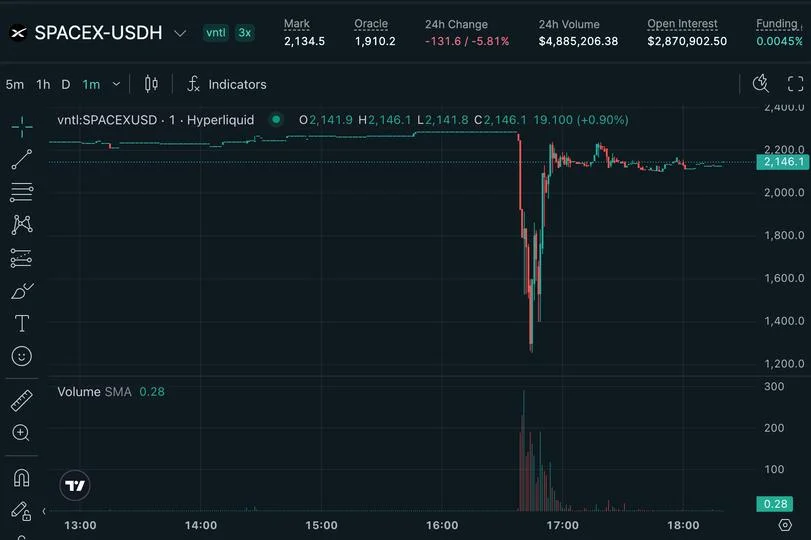


Hyperliquid's SPACEX-USDH perpetual contract flash-crashed roughly 45% in a 30-minute window on Thursday, plunging from a $2,277 open to a low of $1,254 before partially recovering to around $2,169. The move liquidated 405 users across 1,393 positions, wiping out $1.51 million in notional value, according to Hyperliquid data.
Why it matters
The episode is a textbook case of thin-book fragility. Over the prior 24 hours, the contract had drifted quietly on just $4.87 million of total trading volume against under $2.9 million in open interest — then a single candle appears to have absorbed the bulk of that activity with no depth on the other side to cushion the move. The median liquidated position held only $31 in margin, pointing to a retail-heavy cohort taking on roughly 3x leverage with almost no cushion. Unlike BTC or ETH perps, which anchor to deep spot markets, the SPACEX contract has no public price benchmark — SpaceX shares trade only on private secondary markets gated to accredited investors, so the oracle price itself is a derived estimate rather than a tape-driven print.
Market impact
Even after the dust settled, the mark price of $2,132 still sat more than $220 above the oracle price of $1,908, implying the contract remained at a premium despite the carnage — a reminder that the recovery is mechanical, not a sign of restored confidence. With SpaceX reportedly targeting a June IPO, the crash lands in a fragile window: retail traders are loading leveraged exposure to a pre-IPO name on a venue whose only price reference is itself, while liquidity providers have little reason to step in during stress. The next flash crash on a thin, oracle-anchored contract won't look like this one — it will just be faster and quieter.
Source: [Hyperliquid's pre-IPO SpaceX contracts suffers 45% flash crash, liquidating $1.5 million]

Frequently asked questions
-
What happened to the Hyperliquid SpaceX contract?
Hyperliquid's SPACEX-USDH perpetual contract flash-crashed roughly 45% in a 30-minute window on Thursday, falling from a $2,277 open to a low of $1,254 before partially recovering to around $2,169. The move liquidated 405 users across 1,393 positions, wiping $1.51 million in notional value.
-
Why did the SpaceX perp crash so hard?
The market was too thin to absorb a large sell order. The contract had generated just $4.87 million in 24-hour volume against under $2.9 million in open interest, and there was no depth on the buy side to cushion the move — a textbook thin-book liquidation cascade.
-
How leveraged were the traders who got wiped out?
The median liquidated position held only $31 in margin, pointing to a retail-heavy user base running roughly 3x leverage with almost no cushion against price moves.
-
Does the SPACEX contract have a real price reference?
No. Unlike BTC or ETH perps that anchor to deep spot markets, the SPACEX contract has no public price benchmark. SpaceX shares trade only on private secondary markets gated to accredited investors, so the oracle price is a derived estimate rather than a tape-driven print.
-
What is the IPO timeline risk here?
SpaceX is reportedly targeting a June IPO. That puts the crash in a fragile window: leveraged retail is loading exposure to a pre-IPO name on a venue whose only price reference is itself, with little incentive for liquidity providers to step in during stress.
 Crypto News
 TheBlock
 Crypto Capital Venture
 Crypto Rank News
 CoinTelegraph