








 CoinDesk



Japan's Finance Minister Satsuki Katayama said Friday that the government is actively steering the $2 trillion Government Pension Investment Fund, the world's largest pension fund, to substantially lift its allocation to domestic financial assets including government bonds. Her comments came as concern over Japan's debt-to-GDP ratio above 200% pushed bond yields to three-decade highs and kept the yen under pressure.
The directive fits a broader government objective to rebalance household financial assets away from cash and deposits toward stocks, mutual funds, and bonds, a structural tilt that channels Japanese savings back into yen-denominated paper regardless of the yield it offers.
Why it matters
Financial historian Russell Napier has argued for years that heavily indebted nations eventually fall back on what he calls national capitalism, or state-directed capitalism, in which governments lean on domestic savings institutions to absorb their own debt at yields that sit below inflation. That hidden tax lets authorities finance deficits cheaply, erode the real debt burden through moderate inflation, and avoid the more visible cost of outright default or severe austerity. With Japan's debt-to-GDP above 200% and yields already at multi-decade highs, the country is the clearest live test of that thesis.
The mechanism matters for hard assets because fixed-income returns that fail to cover inflation push capital toward scarce supply assets that can preserve purchasing power. Bitcoin and gold are the textbook beneficiaries, and BTC has already demonstrated the property on long timeframes: housing priced in bitcoin looks dramatically cheaper than housing priced in dollars, a rough proxy for the asset's ability to hold real value across cycles.
Market impact
The near-term read is more complicated. GPIF holds roughly $931 billion in foreign assets, including $232.1 billion in U.S. Treasuries, so even a modest reallocation toward domestic holdings could dent demand for Treasuries and inject risk aversion across global markets, including crypto. Other indebted economies, including the U.S., U.K.

Frequently asked questions
-
What did Japan's Finance Minister say about the GPIF pension fund?
Satsuki Katayama said Friday that the government is actively steering the $2 trillion Government Pension Investment Fund to substantially lift its allocation to domestic financial assets including government bonds, even as Japan's debt-to-GDP sits above 200% and yields hover at three-decade highs.
-
How does the GPIF reallocation affect bitcoin and gold?
Steering the world's largest pension fund into domestic bonds at sub-inflation yields pushes Japanese savers toward scarce-supply assets that can preserve purchasing power. Bitcoin and gold are the canonical beneficiaries, and BTC has already shown the property on long timeframes: housing priced in bitcoin looks far…
-
What is Russell Napier's 'national capitalism' thesis?
Napier argues that heavily indebted nations eventually force domestic savings institutions to absorb their own debt at yields below inflation. That hidden tax lets governments finance deficits cheaply, erode the real debt burden through moderate inflation, and avoid the more visible cost of default or severe austerity.
-
What is the near-term risk for crypto from Japan's pension shift?
GPIF holds roughly $931 billion in foreign assets including $232.1 billion in U.S. Treasuries. Even a modest reallocation toward domestic holdings could dent Treasury demand, lift risk aversion on Wall Street, and drag crypto with it before the longer-term store-of-value bid kicks in.
-
What bitcoin price levels are traders watching now?
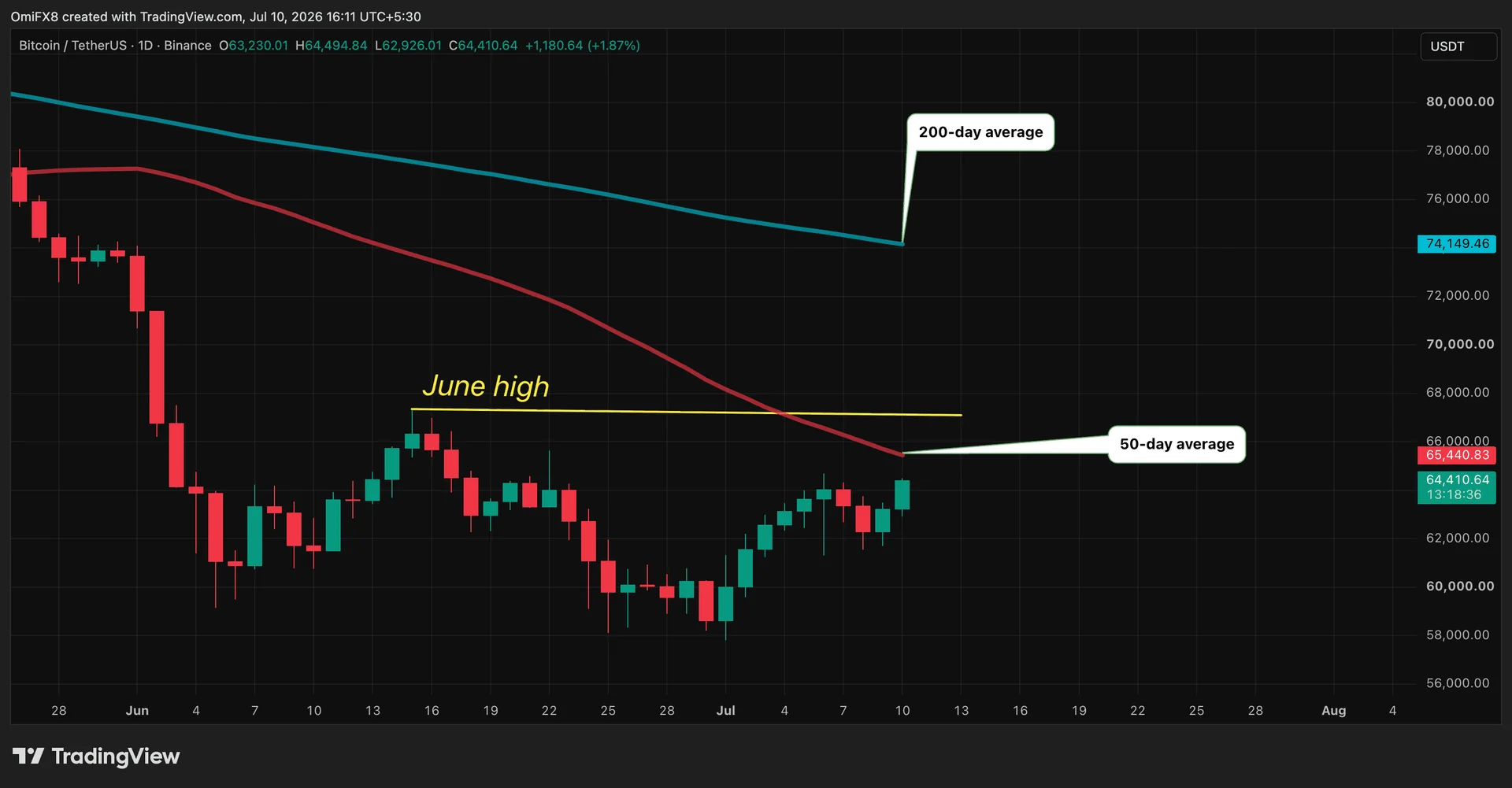
Bitcoin is trading above $64,000 with a momentum indicator flashing a renewed bullish shift. The 50-day moving average near $65,440 is the first resistance; a clean break opens the path to the June high around $67,300 and, with enough demand, the 200-day average above $74,000.
 WatcherGuru
 WuBlockchain
 TheBlock
 Glassnode
 CoinTelegraph