








 CoinDesk
JPMorgan told clients on Thursday that the pandemic-era "debasement trade" — which lifted both bitcoin and gold as hedges against inflation, currency debasement and Middle East instability — is losing its grip on investor positioning. The bank's strategists, led by Nikolaos Panigirtzoglou, pointed to simultaneous outflows from spot bitcoin and gold ETFs over the past two weeks alongside a contraction in CME futures exposure across both assets.
The pattern matters because it isn't a rotation. Panigirtzoglou argued that capital is not simply moving from BTC into gold or vice versa — both assets are seeing softer demand at the same time, suggesting a broader unwind of the macro-hedge thesis rather than a reshuffle within it. "Bitcoin had been the main manifestation of the debasement trade since the start of the Iran conflict," the report said.
Why it matters
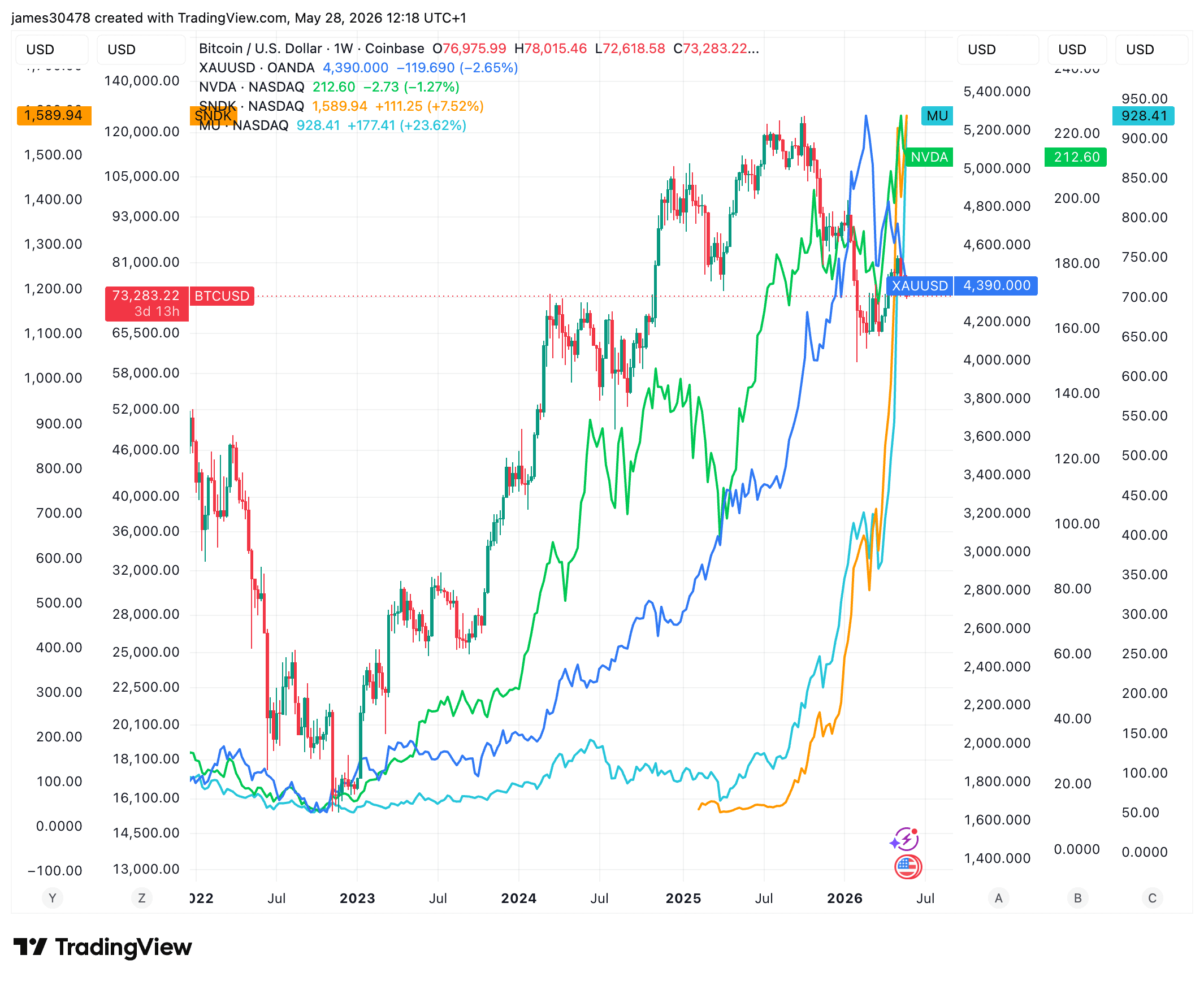
The debasement trade was the framing that carried BTC through most of 2024 and into 2025 — the idea that ballooning sovereign debt, persistent fiscal deficits and recurring geopolitical shocks would drive institutional money into hard assets. JPMorgan's read is that the framing itself is now being priced out. The bank attributed the cooling partly to growing expectations that US–Iran tensions could ease through a diplomatic agreement, removing the most acute geopolitical premium that had been bid into both assets. Bitcoin's surge of more than 650% between November 2022 and October 2025 — followed by a prolonged drawdown — and gold's parallel run from $2,000 to above $5,200 an ounce before a near-20% correction, frame how much positioning has to unwind.
Market impact
The rotation is going somewhere, just not into another debasement hedge. JPMorgan flagged that flows are increasingly chasing AI infrastructure, semiconductor and memory-related equities, with memory-chip exposure recently supplanting names like Nvidia as the hot-money target. For bitcoin specifically, the risk is that ETF outflows over the past two weeks — tracked by Farside Investors — extend into a structural unwind if the US–Iran de-escalation thesis holds.

Frequently asked questions
-
What is the 'debasement trade' JPMorgan is referring to?
The debasement trade is positioning in assets — historically gold, and more recently bitcoin — viewed as stores of value during periods of inflation fears, currency weakness, or expansive fiscal and monetary policy. It surged in popularity earlier this year amid Middle East tensions and renewed inflation concerns.
-
Why is JPMorgan saying the debasement trade is fading now?
JPMorgan's Nikolaos Panigirtzoglou pointed to simultaneous outflows from spot bitcoin and gold ETFs over the past two weeks and a contraction in CME futures exposure across both assets. The bank attributed the cooling partly to growing expectations of a US–Iran diplomatic agreement, which would reduce the geopolitical…
-
Is money rotating from bitcoin into gold, or are both selling off?
JPMorgan's report argued it is the latter. Panigirtzoglou said the move does not reflect rotation between bitcoin and gold, but rather softer demand for both at the same time — a broader unwind of the macro-hedge thesis rather than a reshuffle within it.
-
How much have bitcoin and gold moved during the debasement cycle?
Bitcoin surged more than 650% between November 2022 and October 2025 before entering a prolonged bear market. Gold followed months later, climbing from $2,000 to above $5,200 per ounce before correcting nearly 20%.
-
Where is the money rotating to if not into another hard asset?
JPMorgan said flows are increasingly chasing AI infrastructure, semiconductor and memory-related equities. The bank noted that memory-chip exposure has recently supplanted AI names like Nvidia as the hot-money target, a notable shift in institutional risk appetite.
 WatcherGuru
 WuBlockchain
 CryptoSlate
 Crypto News
 Crypto Rank News
 Altcoin Daily