


 CryptoSlate



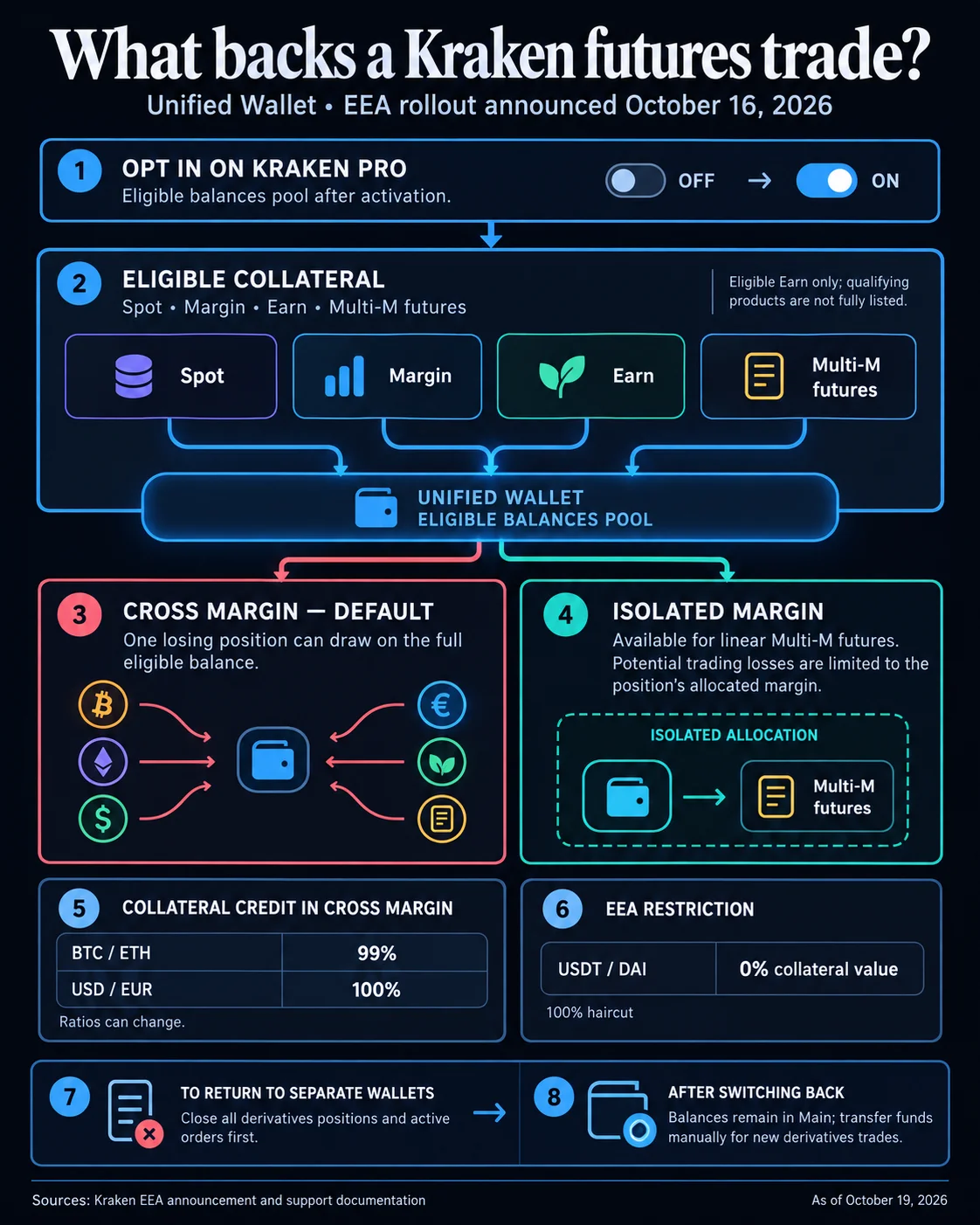
Kraken's EEA Unified Wallet lets eligible Kraken Pro users pool qualifying spot, Earn, margin and futures balances after manually activating the feature. Its default cross-margin setting means a losing futures position can draw on the full eligible pool, including balances that would otherwise remain separate. Kraken announced EEA availability on October 16, 2026.
Users must enable Unified Wallet through Kraken Pro settings, and futures trading must also be active. More than 40 cryptocurrencies, along with USD, EUR and gold, can serve as collateral. Kraken applies asset-specific valuation ratios, including introductory rates of 99% for bitcoin and ether and 100% for USD and EUR. The parameters can change, while USDT and DAI receive a 100% haircut for EEA users.
Why it matters
The wallet removes the need to transfer collateral into a separate futures wallet, but that convenience changes the loss boundary. Under cross margin, a losing derivatives position can reach eligible spot holdings and qualifying Earn balances. Active staking and some Earn strategies remain in an Earn wallet, while Auto Earn balances can remain in Main, so eligibility depends on the balance type.
Users who want a narrower risk boundary can use isolated margin on linear Multi-M futures contracts. Isolated margin limits a position's potential loss to the margin allocated to that trade rather than the entire eligible pool.
Market impact
The rollout increases the importance of wallet settings for EEA derivatives users. A user can activate Unified Wallet without closing open positions, but switching back to separate wallets requires closing all derivatives positions and active orders. Afterward, funds remain in Main and must be transferred manually before new derivatives positions can be opened.
The practical choice is between simpler collateral management and broader account-level exposure. Users should review which balances qualify as collateral, the applicable haircuts and whether cross or isolated margin matches the intended risk limit.




Frequently asked questions
-
How does Kraken's EEA Unified Wallet expose spot holdings to futures losses?
Its default cross-margin mode pools eligible balances, allowing a losing futures position to draw on qualifying spot holdings and Earn balances.
-
Which assets can serve as collateral in Kraken's Unified Wallet?
Kraken says more than 40 cryptocurrencies, plus USD, EUR and gold, can serve as collateral. Bitcoin and ether have introductory 99% valuation rates.
-
How are USDT and DAI treated for EEA collateral?
Kraken's collateral rules assign USDT and DAI a 100% haircut for EEA users, giving them zero collateral value.
-
Does isolated margin protect all balances from a futures loss?
Isolated margin limits a position's potential loss to the margin allocated to that trade on eligible linear Multi-M futures. It provides a narrower boundary than cross margin.
-
What is required to switch back to separate wallets?
Users must close all derivatives positions and active orders before switching back. Funds then remain in Main and must be transferred manually before new derivatives positions can open.
 CoinTelegraph
 Whale Alert
 CoinDesk
 TheBlock
 Crypto Capital Venture
 Crypto News