








 CryptoSlate


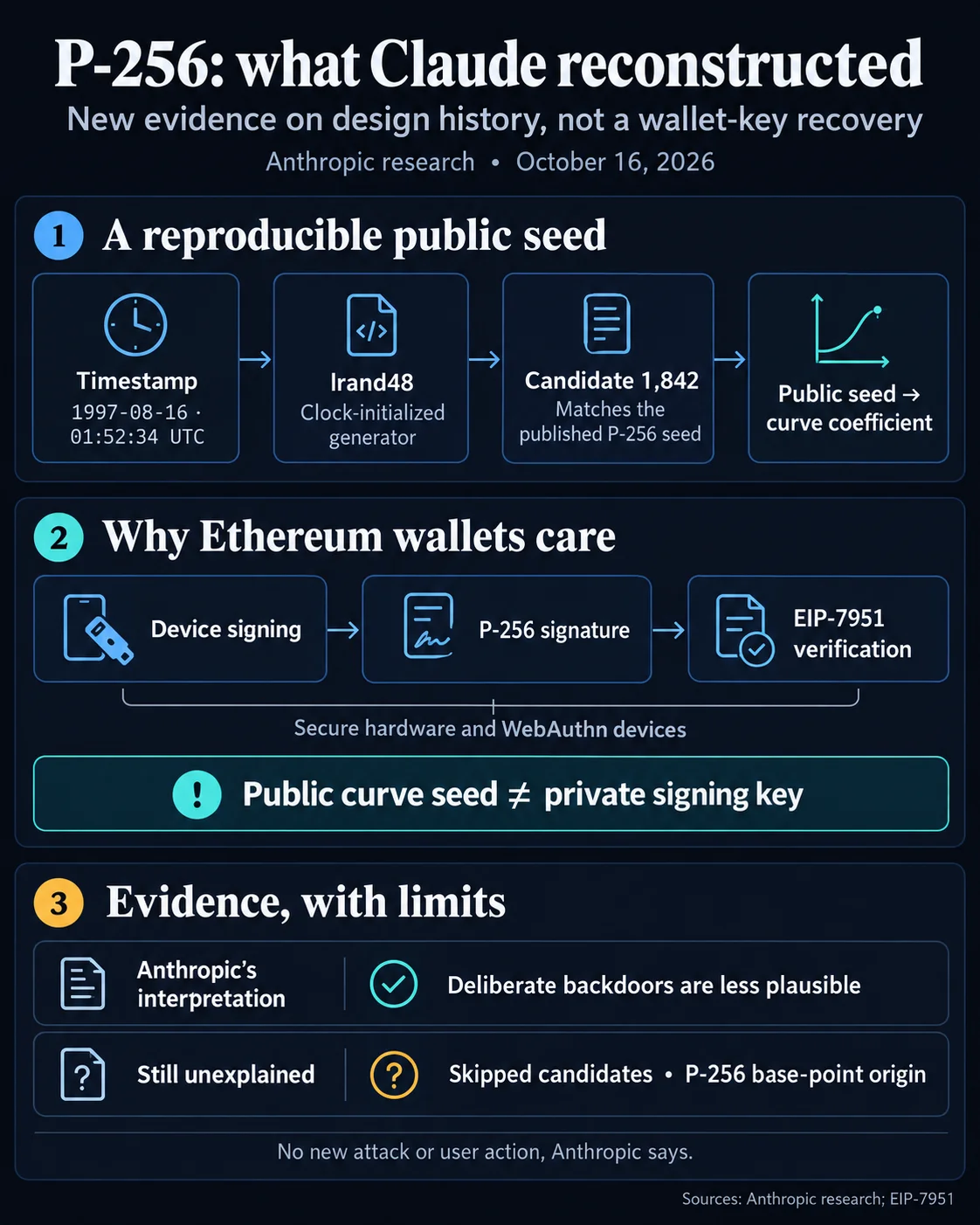

Anthropic said Claude reconstructed the public seed behind P-256, a NIST-standardized curve used for Ethereum passkey signing. The recipe starts the lrand48 generator with the timestamp Aug. 16, 1997, at 01:52:34 UTC, then reaches the published curve value at candidate 1,842. Anthropic says the result makes deliberate backdoors less plausible, but does not reveal a new attack or require user action.
Why it matters
P-256 is separate from Ethereum's existing secp256k1 curve and from the private credentials that authorize wallet activity. Its relevance is concentrated in P-256-compatible signing, including the device-native authentication supported by Apple Secure Enclave, Android Keystore and FIDO2/WebAuthn hardware.
Ethereum's EIP-7951 specifies P256VERIFY, which checks a message hash, signature and public key. The proposal connects that verification path to account abstraction, passkeys, multifactor authentication and simpler key management. For wallet builders, the reconstructed seed offers a repeatable explanation for a public curve parameter that had drawn scrutiny because its origin was unclear.
Market impact
The result is primarily a security and infrastructure signal rather than a direct market catalyst. It may reduce one source of concern around P-256, while leaving important historical questions open. Anthropic says candidate 876 also produced a prime-order curve of the required size, and the selection criteria remain unclear. The number of generation runs and the origin of P-256's base point are also unresolved.
Ethereum wallet developers will still need to distinguish P-256 passkey support from compatibility with every existing ETH wallet. The finding changes the evidence around the curve's public design inputs, not the security of users' private signing credentials.

Frequently asked questions
-
What did Claude reconstruct about P-256?
Claude reconstructed the public seed used to derive a coefficient in P-256's equation. The recipe reaches the published value at candidate 1,842.
-
Does the finding reveal a new attack on Ethereum wallets?
No. Anthropic says the work describes no new attack, and the reconstructed public seed is separate from the private credentials that authorize wallet activity.
-
Why is P-256 relevant to Ethereum passkeys?
Ethereum's EIP-7951 specifies P-256 signature verification for device-native signing. The curve is supported by hardware and authenticators such as Apple Secure Enclave, Android Keystore and FIDO2/WebAuthn devices.
-
Is P-256 the same curve used by existing Ethereum wallets?
No. P-256 differs from secp256k1, the curve already used in Ethereum. The finding applies to P-256-compatible signing rather than every ETH wallet.
-
What questions about P-256 remain unresolved?
Anthropic says candidate 876 also produced a prime-order curve of the required size. The selection criteria, number of generation runs and origin of P-256's base point remain unclear.
 Crypto Rank News
 CoinTelegraph
 Crypto Capital Venture
 CoinDesk
 WatcherGuru
 WuBlockchain