








 CryptoSlate


TRON processed $2.2126 trillion in stablecoin settlement during Q3 2026, up 5.1% from Q2, while TRX supply increased on all 108 days from July 1 through October 16. Net issuance reached 125.8 million TRX in Q3 and another 22.9 million in the first 16 days of October, for a combined addition of 148.6 million tokens.
Why it matters
The figures show that high dollar settlement does not automatically create equivalent pressure to burn TRX. TRON users can obtain Bandwidth and Energy by staking or receiving delegated resources, and those resources recover over a rolling 24-hour period. The underlying staked TRX remains committed rather than being destroyed each time capacity is used.
TRX is also minted through block-production and voter rewards. The documented parameters provide 8 TRX per block for producers and 128 TRX per block for voters, although governance can change them. This creates distinct outcomes for resource users, stakers and passive holders. Stakers can support recurring network activity and earn rewards, while an unchanged unstaked balance does not automatically receive newly issued tokens.
Market impact
The supply increase remained modest relative to the network's overall base. Q3's 125.8 million TRX net addition represented about 0.133% of an opening supply of roughly 94.850 billion TRX. On TRON, combined USDT and USDD balances reached $93.88 billion, up 5.5% from Q2, but those stablecoins serve a different role from TRX.
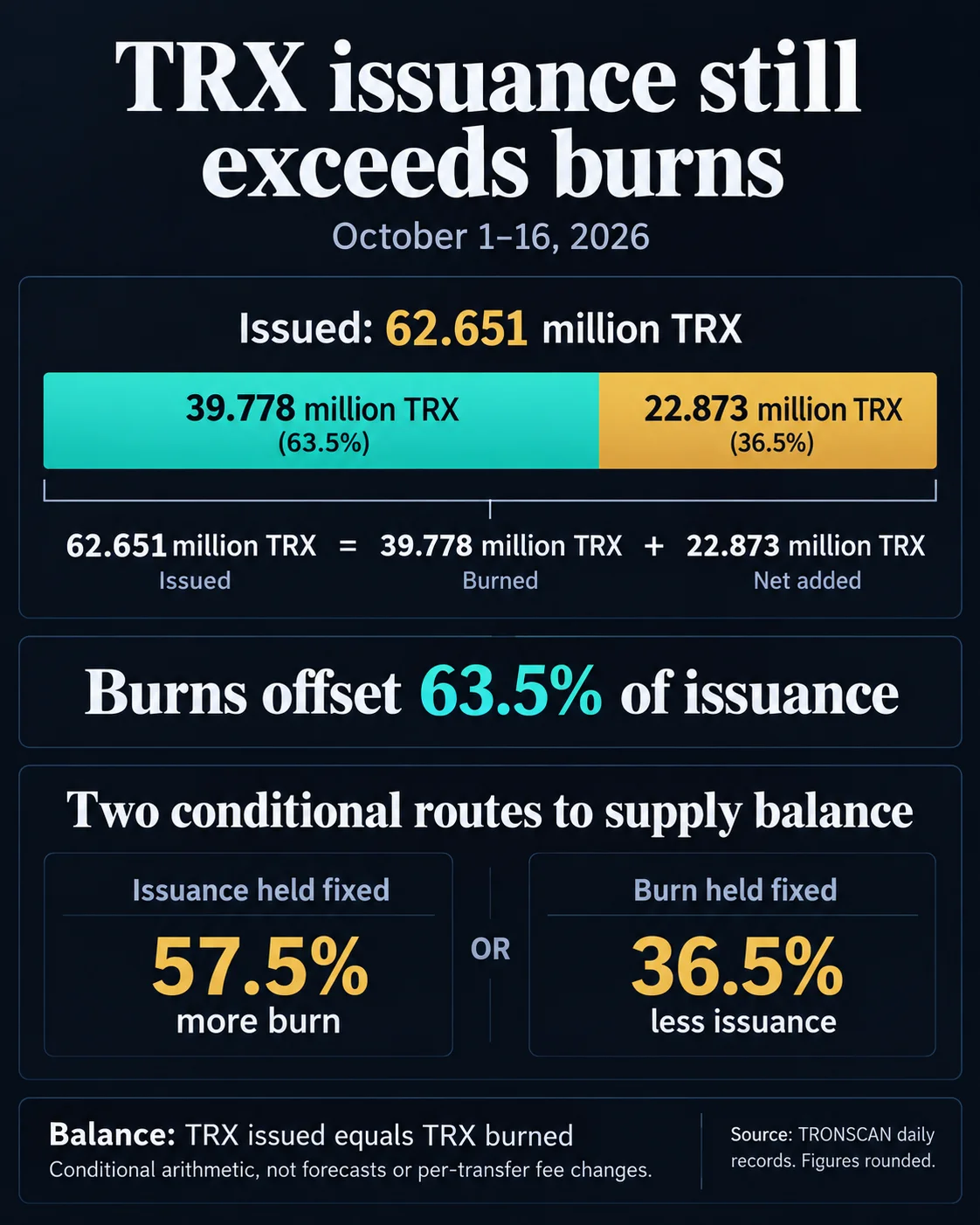
The October data shows the supply gap more clearly. Burns offset about 63.5% of issuance, leaving an average daily shortfall of 1.430 million TRX. Reaching balance with issuance unchanged would have required burns to rise 57.5%; keeping burns unchanged would have required issuance to fall 36.5%. Deflation would require burns to exceed new issuance.



Frequently asked questions
-
How much stablecoin settlement did TRON process in Q3 2026?
TRON processed $2.2126 trillion in stablecoin settlement during Q3 2026, up 5.1% from Q2.
-
How long did TRX supply increase without interruption?
TRX supply increased on all 108 days from July 1 through October 16, adding 148.6 million TRX after burns.
-
Why does TRON activity not automatically burn more TRX?
Users can obtain Bandwidth and Energy through staked or delegated resources. These resources recover over time, allowing repeated network use without destroying the underlying staked TRX.
-
What creates new TRX on the network?
TRON mints TRX through rewards for block producers and voters. The documented parameters provide 8 TRX per block for producers and 128 TRX per block for voters.
-
What would have been needed to bring TRX supply to balance in October?
With issuance unchanged, burns would have needed to rise 57.5%. With burns unchanged, issuance would have needed to fall 36.5%.
 Crypto Capital Venture
 WuBlockchain
 WatcherGuru
 CoinDesk
 Crypto News
 CoinTelegraph
 Crypto Rank News
 Lookonchain