








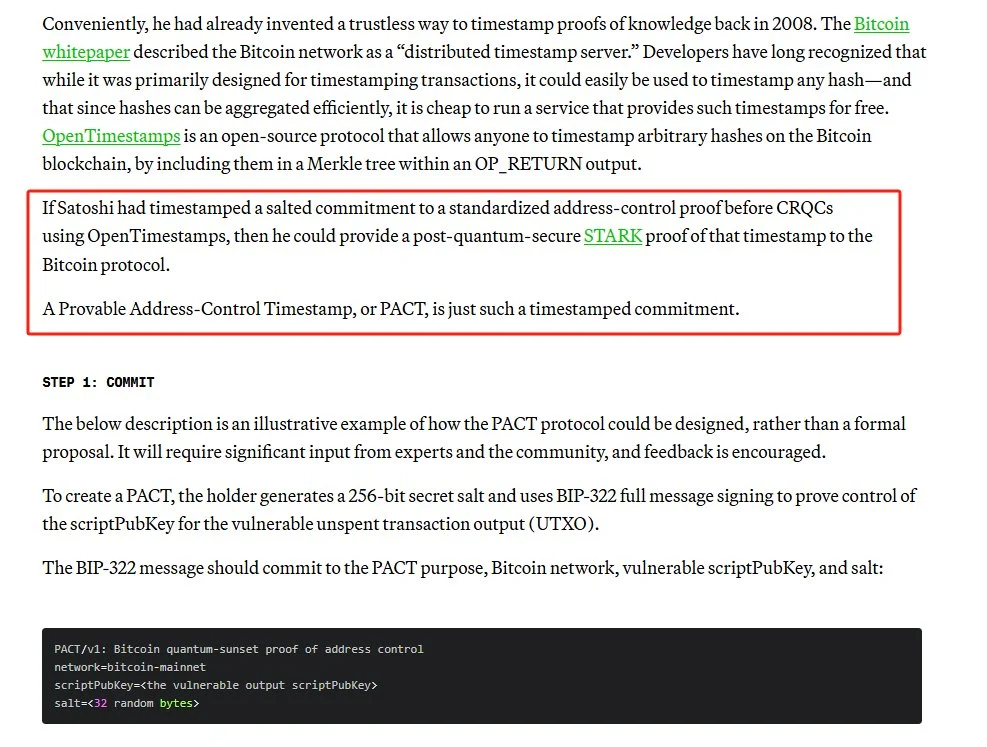
Dan Robinson, a researcher at Paradigm, has proposed a scheme called PACTs — Provable Address-Control Timestamps — that lets Bitcoin holders publish on-chain proof they control an address without moving assets or generating visible spending activity. The timestamped proof could later be used to claim funds on a quantum-secure successor network if the secp256k1 curve that secures current Bitcoin keys is broken.
Why it matters
The proposal is a pre-emptive scaffolding, not a fork: it assumes a future where sufficiently powerful quantum computers can derive private keys from public keys exposed on the blockchain, but where some fraction of BTC remains recoverable by the original owners. By letting addresses broadcast a control timestamp now, PACTs would give those owners a verifiable claim in a post-quantem world — distinguishing them from attackers who could sweep the same coins using a broken key.
Market impact
PACTs does not require a protocol change today, and the on-chain footprint is minimal — meaning adoption is essentially a wallet-vendor and custody-platform decision rather than a network coordination event. Watch for whether major custodians and Bitcoin Core contributors engage with the spec, since the scheme's value is only as strong as the social consensus that recognises the timestamps when a quantum fork ever lands.

Frequently asked questions
-
What are PACTs and who proposed them?
PACTs, or Provable Address-Control Timestamps, are a scheme proposed by Dan Robinson, a researcher at crypto venture firm Paradigm. They let Bitcoin holders publish on-chain proof they control an address without moving funds or producing visible spending activity.
-
How do PACTs protect Bitcoin from quantum attacks?
If quantum computers become powerful enough to derive private keys from public keys exposed on the Bitcoin blockchain, PACTs give original owners a pre-recorded timestamp proving control — separating legitimate claimants from attackers who could otherwise sweep the same coins.
-
Does the PACTs proposal require a Bitcoin protocol change?
No. PACTs work without a network-level fork today; the on-chain footprint is minimal. Adoption is effectively a wallet-vendor and custody-platform decision rather than a network coordination event.
-
Which cryptographic curve would quantum computers need to break?
Bitcoin currently relies on the secp256k1 elliptic curve for its public-key cryptography. A sufficiently powerful quantum computer running Shor's algorithm could theoretically derive a private key from a public key, exposing funds in any address that has broadcast its public key on-chain.
-
What determines whether PACTs would actually work in a quantum scenario?
The scheme's value depends on social consensus — specifically, whether the Bitcoin community would recognise the pre-recorded timestamps as valid claims during a post-quantem fork. Without that agreement, the timestamps remain inert data on chain.

 TheBlock
 WatcherGuru
 CryptoSlate
 Crypto News
 CoinDesk
 CoinTelegraph