








 CoinDesk

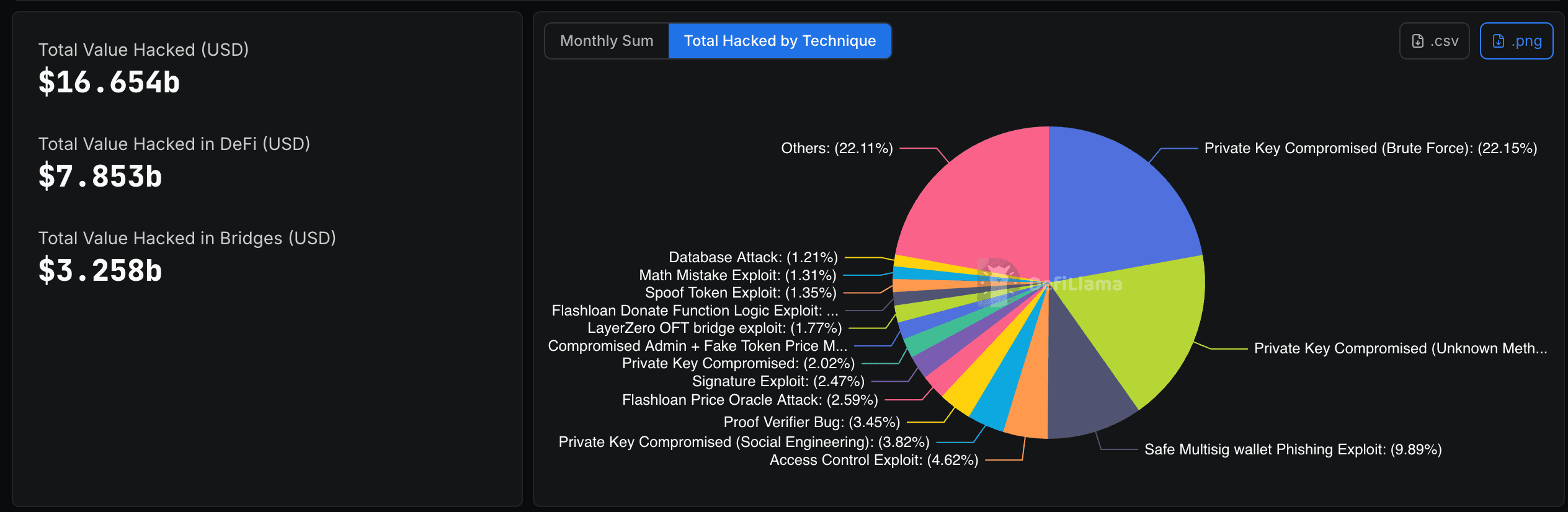


Roughly $16.69 billion has been lost to crypto hacks, bridge attacks and DeFi exploits to date, and about 40% of that total traces back to compromised private keys rather than flaws in blockchain or smart-contract code, according to DeFiLlama data. Security firm CertiK told CoinDesk that operational security incidents are rising while smart-contract exploits decline, a sign attackers are following the path of least resistance as projects concentrate audit spend on code.
Why it matters
Single-key architecture is the root design choice leaving the industry exposed. Wish Wu, co-founder and CEO of Pharos, framed it bluntly: most blockchain infrastructure was built for a one-user, one-key model in which a stolen key drains everything instantly, against the separation-of-duties and multi-approver norms that traditional finance has leaned on for decades. Le Fan, founder of ZK proof layer Cysic, called private-key hacks a key-management failure the industry keeps mislabeling as a cryptography problem.
The Bybit hack of February 2025 crystallised the widening attack surface. Attackers compromised the software supply chain of a third-party developer tool, slipped malicious code into the wallet interface, and tricked executives into signing $1.5 billion in Ethereum away. Once a key is hot enough to be useful, it lives inside running services, cloud credentials and human operators, and that surrounding layer is what keeps getting breached.
Market impact
The mitigations are coalescing. Multi-party computation (MPC) and threshold signing split the signing process so no full key ever exists in one place, denying attackers a single breach target. Account abstraction layers spending limits, approved addresses and social-recovery guardians directly into the wallet, so a compromised signer cannot drain funds alone. Passkey-based login, hardware-wallet enforcement and stricter key-management SOPs round out the stack. Wu cautioned that adoption is uneven, with most chains still bolting security on as an optional extra rather than baking it into the protocol layer, the gap the next wave of institutional money will look at first.

Frequently asked questions
-
What share of crypto hack losses trace back to private keys?
About 40% of the roughly $16.69 billion lost to crypto hacks, bridge attacks and DeFi exploits to date has been tied to compromised private keys rather than smart-contract or blockchain flaws, according to DeFiLlama data cited by CoinDesk.
-
Why are private-key failures outsizing smart-contract exploits?
Security firm CertiK says projects have concentrated audit spend on smart contracts while leaving operational layers exposed. Operational key-management, secret stores, software dependencies and human operators become the path of least resistance for attackers.
-
What is multi-party computation (MPC) and how does it reduce key risk?
MPC and threshold signing split the signing process so the full private key never exists in a single place at any one time. There is no single artefact for an attacker to steal, so a single breach cannot drain funds.
-
How does account abstraction change wallet security?
Account abstraction turns wallets into smart-contract accounts with built-in rules: spending limits, approved address lists and social-recovery guardians. That means a compromised signer cannot empty the account on their own.
-
What made the February 2025 Bybit hack a watershed moment?
Attackers compromised the software supply chain of a third-party developer tool, injected malicious code into Bybit's wallet interface and tricked executives into signing roughly $1.5 billion in Ethereum away. The exploit ran through people and tooling, not a code bug in the protocol itself.
 TheBlock
 CryptoSlate
 CoinTelegraph
 WuBlockchain
 Lookonchain
 Crypto News