








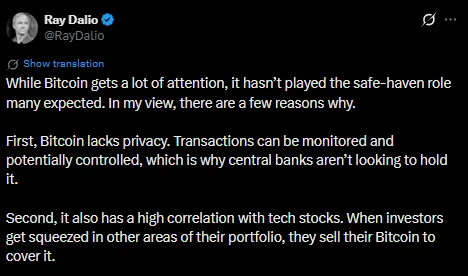

Bridgewater founder Ray Dalio said Bitcoin has not played the safe-haven role some investors expected, citing its lack of privacy, the potential for transactions to be monitored or restricted, and its relatively high correlation with tech stocks. Dalio argued that in stress episodes investors typically sell Bitcoin to raise liquidity rather than hold it as a store of value, and he noted that Bitcoin's market remains relatively small and easier to influence compared with gold, which he said continues to hold a central role in the global financial system.
Why it matters
The comments land at a sensitive moment for the Bitcoin-as-treasury thesis. Dalio's argument cuts along three lines — liquidity, surveillance, and correlation — that institutional allocators have been quietly testing since spot ETF approval. A "no" from a figure of his stature to the safe-haven framing doesn't end the conversation, but it gives every pension committee still on the fence a familiar voice to defer to.
Market impact
MicroStrategy chairman Michael Saylor responded directly, calling gold "analog capital" and Bitcoin "digital capital" and arguing Bitcoin's transparency is a strength, not a flaw, because it makes the asset ideal global collateral. Saylor added that since MicroStrategy adopted its Bitcoin standard in August 2020, BTC has significantly outperformed gold — a comparison designed for the same committee audience Dalio is addressing. The exchange is the cleanest articulation yet of the institutional pitch (auditable, collateral-grade) versus the macro-hedge pitch (private, liquidity-resistant) that Dalio is rejecting.

Frequently asked questions
-
What did Ray Dalio say about Bitcoin as a safe-haven asset?
Dalio said Bitcoin has not played the safe-haven role some investors expected, citing its lack of privacy, the potential for transactions to be monitored or restricted, and a relatively high correlation with tech stocks. He argued that in stress episodes investors typically sell Bitcoin to raise liquidity.
-
How did Michael Saylor respond to Dalio's comments?
Saylor called gold "analog capital" and Bitcoin "digital capital," arguing that Bitcoin's transparency is a strength because it makes the asset ideal global collateral. He added that BTC has significantly outperformed gold since MicroStrategy adopted its Bitcoin standard in August 2020.
-
What reasons did Dalio give for Bitcoin not acting as a safe haven?
Dalio pointed to three main reasons: Bitcoin's lack of privacy, the ability for transactions to be monitored or restricted, and Bitcoin's relatively high correlation with tech stocks rather than acting as an uncorrelated store of value.
-
Why does Dalio prefer gold to Bitcoin?
Dalio said gold continues to hold a central role in the global financial system due to its broader ownership base, longer-established status, and a market that is larger and harder to influence than Bitcoin's.
-
What is the core disagreement between Dalio and Saylor on Bitcoin?
The disagreement is over what role Bitcoin is best suited to play: Dalio frames it as a private macro hedge and concludes it falls short, while Saylor frames it as auditable, collateral-grade digital infrastructure where transparency is a feature, not a flaw.

 WatcherGuru
 Crypto News
 Benjamin Cowen
 CoinTelegraph
 Crypto Capital Venture
 CoinDesk
 TheBlock