








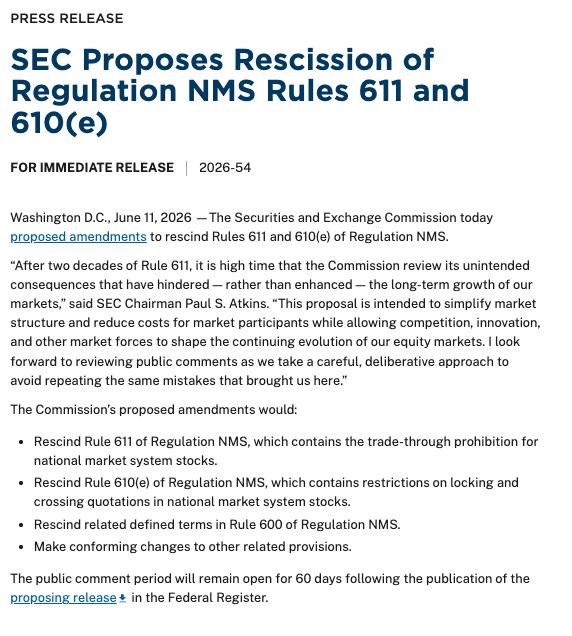
The Securities and Exchange Commission has proposed rescinding Rules 611 and 610(e) of Regulation NMS, a move aimed at reducing compliance costs and allowing competitive and market forces to shape the future structure of US equity markets. Rule 611, known as the Order Protection Rule or "trade-through" rule, currently requires brokers to route orders to the venue displaying the best price — a mandate critics argue has entrenched incumbent exchanges and stifled innovation. Rule 610(e) governs access fees between trading venues.
Why it matters
Regulation NMS has been the foundational ruleset governing US equity market structure since 2005. Removing its two most contested pillars signals a significant philosophical shift at the SEC toward deregulation and venue-level competition. For crypto markets, which have long operated without NMS-style mandates, the move is a data point in a broader regulatory trend: the current administration is rewiring legacy financial infrastructure toward lighter-touch oversight. That posture has direct implications for how digital asset trading venues may be regulated — or not — going forward.
Market impact
Alternative trading systems, dark pools, and newer execution venues stand to benefit most if the proposal advances, as the Order Protection Rule has historically funneled order flow toward lit exchanges. Traditional exchange operators like NYSE and Nasdaq could face increased competitive pressure. For crypto-native investors, the signal is that Washington's appetite for prescriptive market-structure mandates is shrinking — a backdrop that broadly supports the case for less restrictive digital asset regulation.
Frequently asked questions
-
What does Rule 611 actually require, and why is its removal significant?
Rule 611, the Order Protection Rule, requires brokers to route orders to the venue displaying the best available price, which critics say has entrenched major exchanges and limited competition. Removing it would allow market forces and venue innovation to determine order routing instead.
-
How could rescinding these Reg NMS rules affect crypto market regulation?
The SEC's willingness to unwind a foundational 20-year equity market mandate signals a broader deregulatory posture that analysts expect to carry over into digital asset market structure, potentially supporting lighter-touch oversight for crypto trading venues.
-
Which market participants stand to gain most if the proposal is adopted?
Alternative trading systems, dark pools, and newer execution venues would benefit most, as the Order Protection Rule has historically directed order flow toward lit exchanges like NYSE and Nasdaq, limiting competitive pressure on incumbents.

 CryptoSlate
 Crypto News
 WatcherGuru
 TheBlock