








 CoinDesk
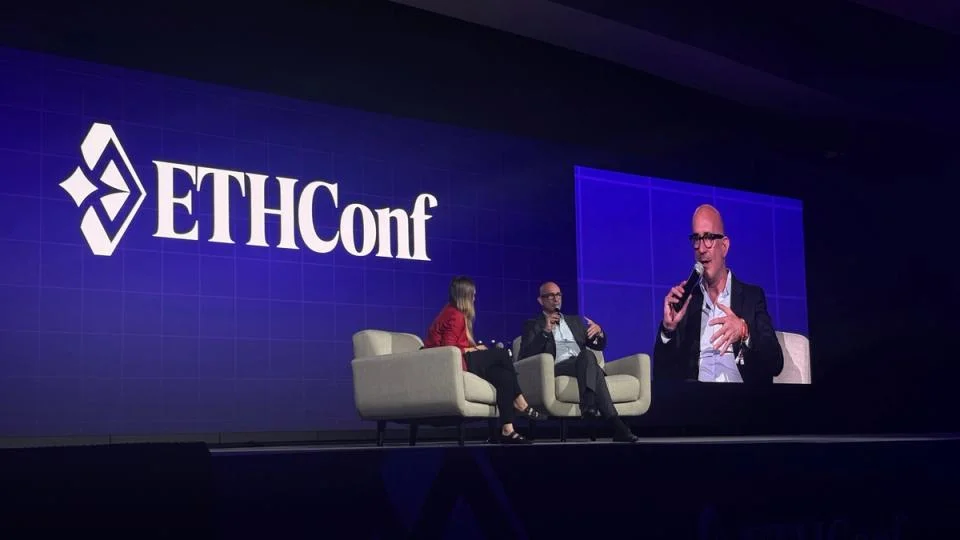

Securitize CEO Carlos Domingo said tokenized equities and exchange-traded funds, not Treasury products or private credit, will be the asset class that drives the real-world asset (RWA) market into the trillions, arguing at an ETHConf panel in New York on Tuesday that bringing stocks and ETFs onchain could grow the sector from roughly $30 billion today to as much as $5 trillion. "The entire equities and ETF market worldwide is probably like $150 trillion," Domingo said. "Only if a small percentage of that, like 2% or 3%, moves onchain, it gets you very close to that $5 trillion."
Why it matters
The framing matters because it repositions tokenization's growth story away from the Treasury-backed money-market funds that have dominated RWA on-chain volume for the past two years, toward the far larger equities complex. Domingo drew a sharp line between what he called "real" tokenized equities and the growing number of blockchain-based stock products that rely on derivatives or synthetic structures rather than direct ownership of the underlying shares. Securitize has already announced partnerships with the New York Stock Exchange and transfer agent Computershare aimed at enabling on-chain trading and settlement of equities, and the firm is preparing to go public on the NYSE with BlackRock among its backers.
Market impact
Domingo maintained that public blockchains, particularly Ethereum, remain the preferred infrastructure for institutional tokenization, with Securitize using smart contracts to restrict ownership to approved investors while letting assets move on permissionless networks. The long-term trajectory he described is coexistence rather than displacement: traditional markets persist, while a parallel blockchain-native market gradually absorbs a larger share of activity, offering instant settlement, 24/7 transferability and deeper integration with decentralized finance. If even a fraction of the $150 trillion global equities market begins to settle onchain, the implication for Ethereum as the dominant settlement layer — and for RWA protocols built on top of it — is structural, not incremental.

Frequently asked questions
-
What did Securitize CEO Carlos Domingo say about tokenized stocks at ETHConf?
Speaking at an ETHConf panel in New York on Tuesday, Domingo argued that tokenized equities and ETFs, rather than tokenized Treasuries, are the asset class that could push the real-world asset market from roughly $30 billion today to as much as $5 trillion.
-
How does Domingo get to a $5 trillion tokenization figure?
Domingo pegged the global equities and ETF market at roughly $150 trillion and said even a 2-3% migration of that onchain would land close to the $5 trillion number, against a current RWA sector of about $30 billion.
-
Why does Domingo criticize existing tokenized stock products?
He argued that many blockchain-based stock offerings rely on derivatives or synthetic structures rather than direct ownership of the underlying shares, lacking the voting rights, dividends and true equity exposure that traditional shares carry.
-
What partnerships is Securitize pursuing for on-chain equities?
Securitize has announced partnerships with the New York Stock Exchange and transfer agent Computershare aimed at enabling on-chain trading and settlement of equities, and the firm is preparing to go public on the NYSE with BlackRock among its backers.
-
Why does Domingo favor Ethereum for institutional tokenization?
Domingo said public blockchains, particularly Ethereum, remain the preferred infrastructure for institutional tokenization, with Securitize using smart contracts to restrict ownership to approved investors while letting assets move on permissionless networks.
 Crypto Rank News
 Lookonchain
 WuBlockchain
 Crypto News
 CryptoSlate