








 CoinDesk
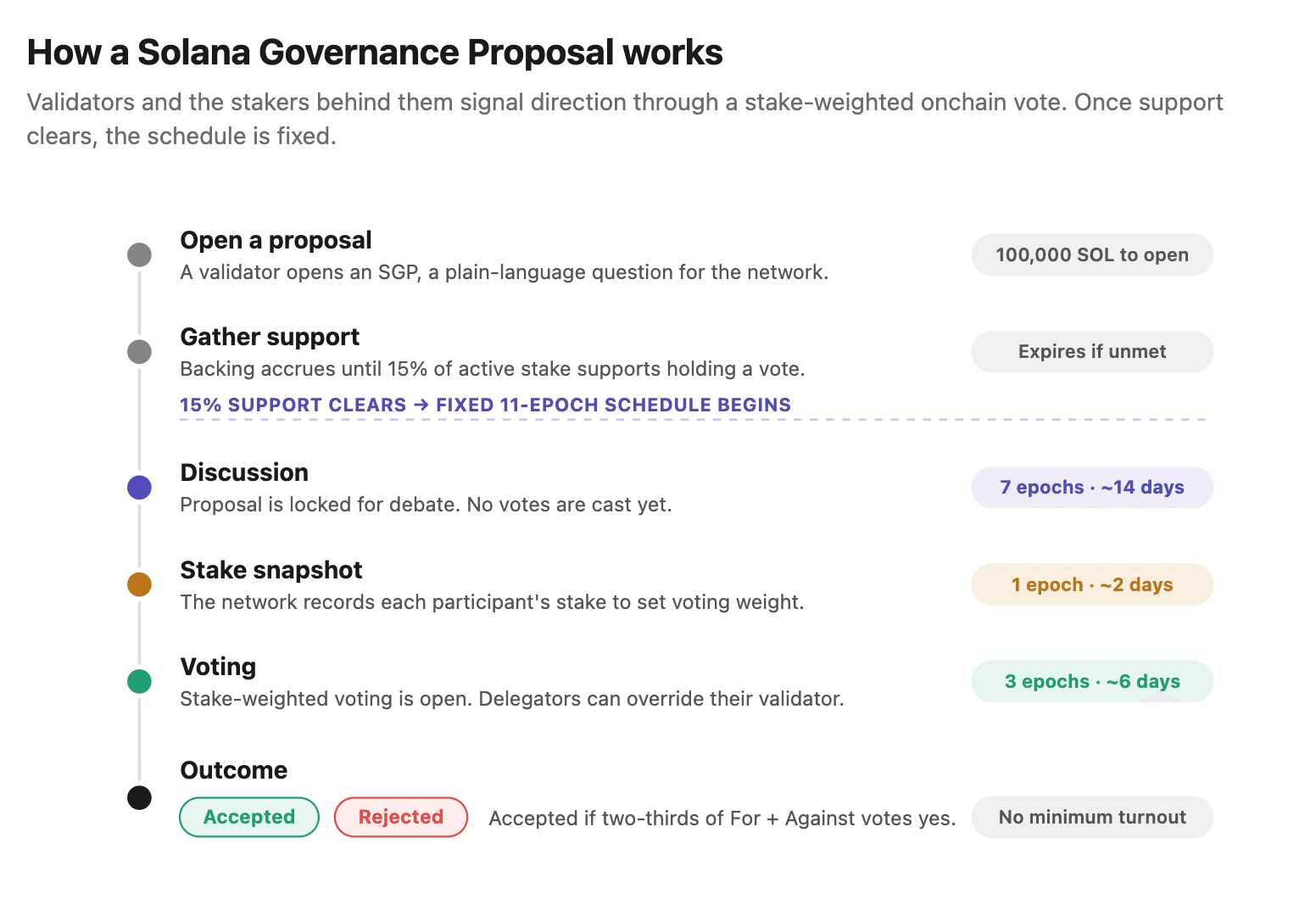


Solana has activated its first formal onchain governance system, Solana Governance Proposals, giving validators and their delegators a recorded, stake-weighted vote on the network's direction. Any validator with at least 100,000 SOL staked, roughly $7.7 million at recent prices, can open a proposal, and everyday stakers can override how their validator votes.
Proposals follow a two-stage gate. A measure first has to clear 15% of active stake to show community interest before it moves to a ballot, where it passes with a two-thirds supermajority of voting stake, with abstentions excluded from the math. There is no minimum turnout requirement, and the tally is checked through a Merkle proof so a vote's place in the count can be verified without rerunning it.
Why it matters
The framework splits two questions Solana had long conflated: whether a change should happen at all, and the technical specifics of how to ship it. A yes on an SGP signals direction, with the engineering work that follows formalised as one or more Solana Improvement Documents handled by core developers. Core engineering teams can keep shipping routine changes without holding a referendum on each one.
The bigger shift is what the Solana Foundation is calling "staker sovereignty." Delegators, the users who stake their SOL with validators rather than run nodes themselves, can now override or replace their validator's vote with their own stake-weighted choice. The design hands the final say on direction to the token holders rather than the operators they delegate to, a model Ethereum has pointed to for years but never formalised at the SGP layer.
Market impact
SOL trades near $78, up roughly 16% over the past week, one of the few large tokens to gain while the broader market sold off, per CoinDesk data. Onchain governance is a long-running ask for Solana critics who have pointed to its foundation-led roadmap as a centralisation risk. A working SGP framework gives institutional and DAO allocators a more legible way to underwrite the network's directionality.
The first real test will be whether a proposal can clear the 15% threshold and what the first SGP actually asks.

Frequently asked questions
-
What is Solana Governance Proposals (SGP)?
SGPs are Solana's new formal onchain governance mechanism. Any validator with at least 100,000 SOL staked can open a proposal on a plain-language directional question, with the vote weighted by stake and recorded onchain.
-
How does a Solana Governance Proposal actually pass?
A proposal first has to clear 15% of active stake as a support threshold before it reaches a ballot. To pass once on the ballot, it needs a two-thirds supermajority of voting stake, with abstentions excluded. There is no minimum turnout requirement.
-
What is staker sovereignty in Solana's new governance system?
Staker sovereignty lets delegators, the users who stake their SOL with validators, override or replace their validator's vote with their own stake-weighted choice. The design hands the final voting power to token holders rather than the validators they delegate to.
-
How does SGP differ from a SIMD on Solana?
SGPs handle the directional question of whether the network should pursue a change. SIMDs, the older Solana Improvement Document track, handle the technical implementation after an SGP signals green light. The two-stage split lets core developers keep shipping routine changes without a referendum on each one.
-
Why launch Solana onchain governance now?
Onchain governance has been a long-running ask from critics who flagged Solana's foundation-led roadmap as a centralisation risk. SOL is also up roughly 16% over the past week to around $78, one of the few large caps green while the broader market sold off, giving the launch a friendlier tape.
 Crypto News
 Crypto Rank News
 TheBlock
 Lookonchain