


 CryptoSlate


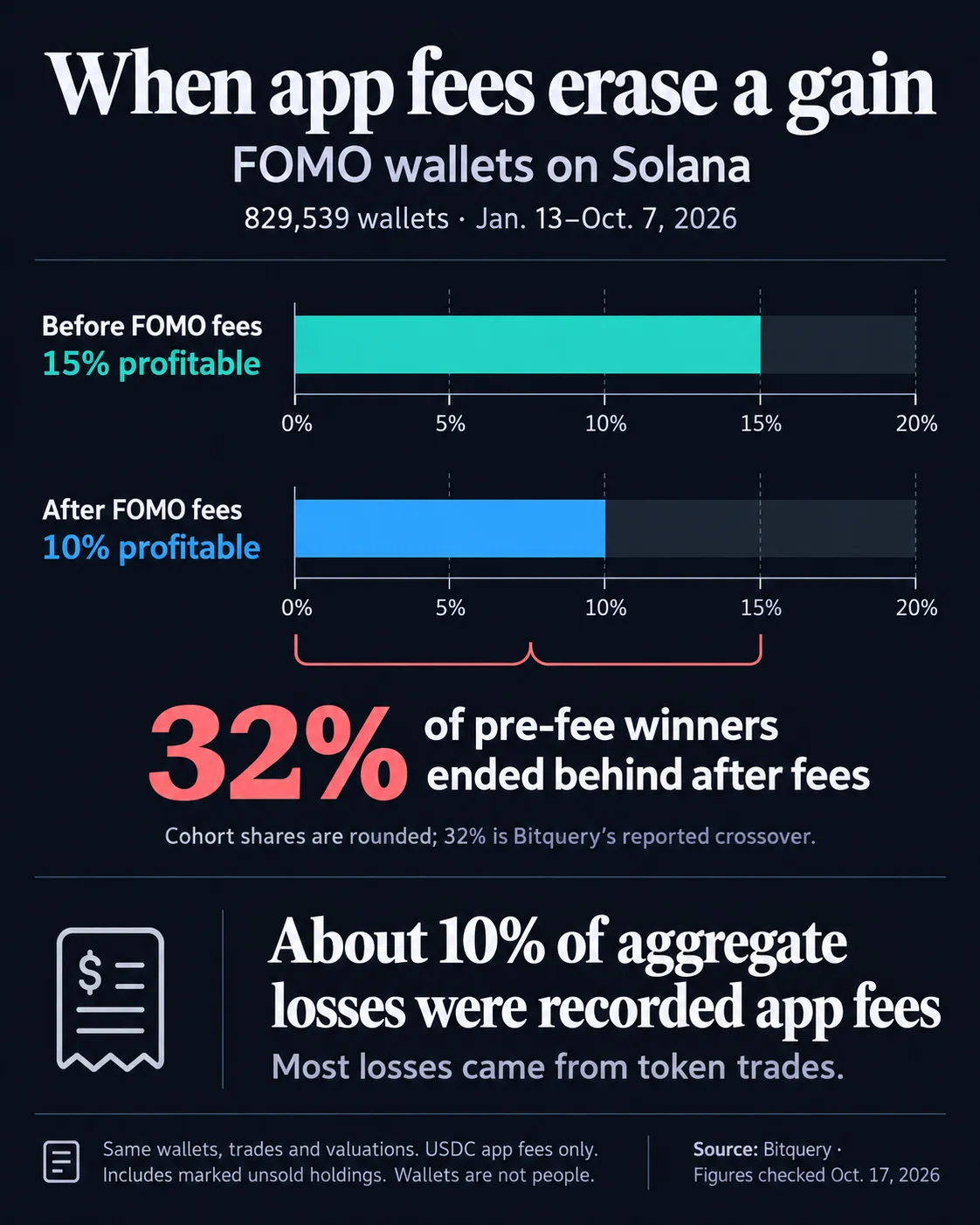
Bitquery’s study of 829,539 wallets that bought coins through FOMO on Solana from Jan. 13 to Oct. 7, 2026, found 15% were profitable before recorded app fees and 10% afterward. Fees pushed 32% of wallets that were ahead before charges below break-even. The study’s figures were checked Oct. 17.
Why it matters
The results show how trading costs can erase a narrow gain without being the main source of losses. Recorded FOMO fees accounted for about 10% of aggregate losses; token trades drove most of the cohort’s shortfall. The study measures wallets, not individual people, and covers Solana only.
Bitquery compared the same wallets, trades and valuation method with and without recorded USDC payments to FOMO. For each wallet, it combined sale proceeds with the value of unsold coins on Oct. 7, then deducted acquisition spending and fees. Trades those wallets made outside the app in the coins being followed were also included, so the measure is broader than app-only activity.
Market impact
A 10-USDC trade illustrates why route-specific minimums matter: FOMO’s published standard schedule puts the fee at 0.2 USDC on its lowest-fee Solana route and 0.95 USDC on other routes. The app charges on purchases and sales, and actual costs depend on route and token. FOMO says it covers Solana gas and priority fees, which should not be added again to its quoted app fee.
The study recorded about $40 million in FOMO fees. Its estimated aggregate loss ranged from $204 million using uncapped last prices to $490 million when unsold tokens were valued at zero, versus a baseline of about $395 million. Yet the share of wallets profitable after fees stayed between 9% and 12% under alternative assumptions. The study tests the accounting effect of fees, not how traders might behave under a different price schedule.


Frequently asked questions
-
How many FOMO wallets were profitable after recorded fees?
About 10% of the 829,539-wallet Solana cohort was profitable after recorded FOMO fees, compared with 15% before fees.
-
What does the 32% figure measure?
It is the share of wallets that were profitable before recorded fees but fell below break-even after those fees were deducted.
-
Did FOMO fees account for most of the cohort’s losses?
No. Recorded FOMO fees accounted for about 10% of aggregate losses. Bitquery attributed most losses to the token trades themselves.
-
How much could a 10-USDC trade cost in FOMO fees?
FOMO’s published standard schedule lists 0.2 USDC on its lowest-fee Solana route and 0.95 USDC on other routes. The actual fee depends on route and token.
-
Why did Bitquery report different estimates for aggregate losses?
Unsold tokens were valued using different assumptions. The estimate was about $204 million using uncapped last prices and $490 million when unsold tokens were valued at zero, against a baseline of about $395 million.
 TheBlock
 CoinDesk
 Lookonchain
 WatcherGuru
 Crypto Rank News
 CoinTelegraph
 WuBlockchain