








 CoinDesk
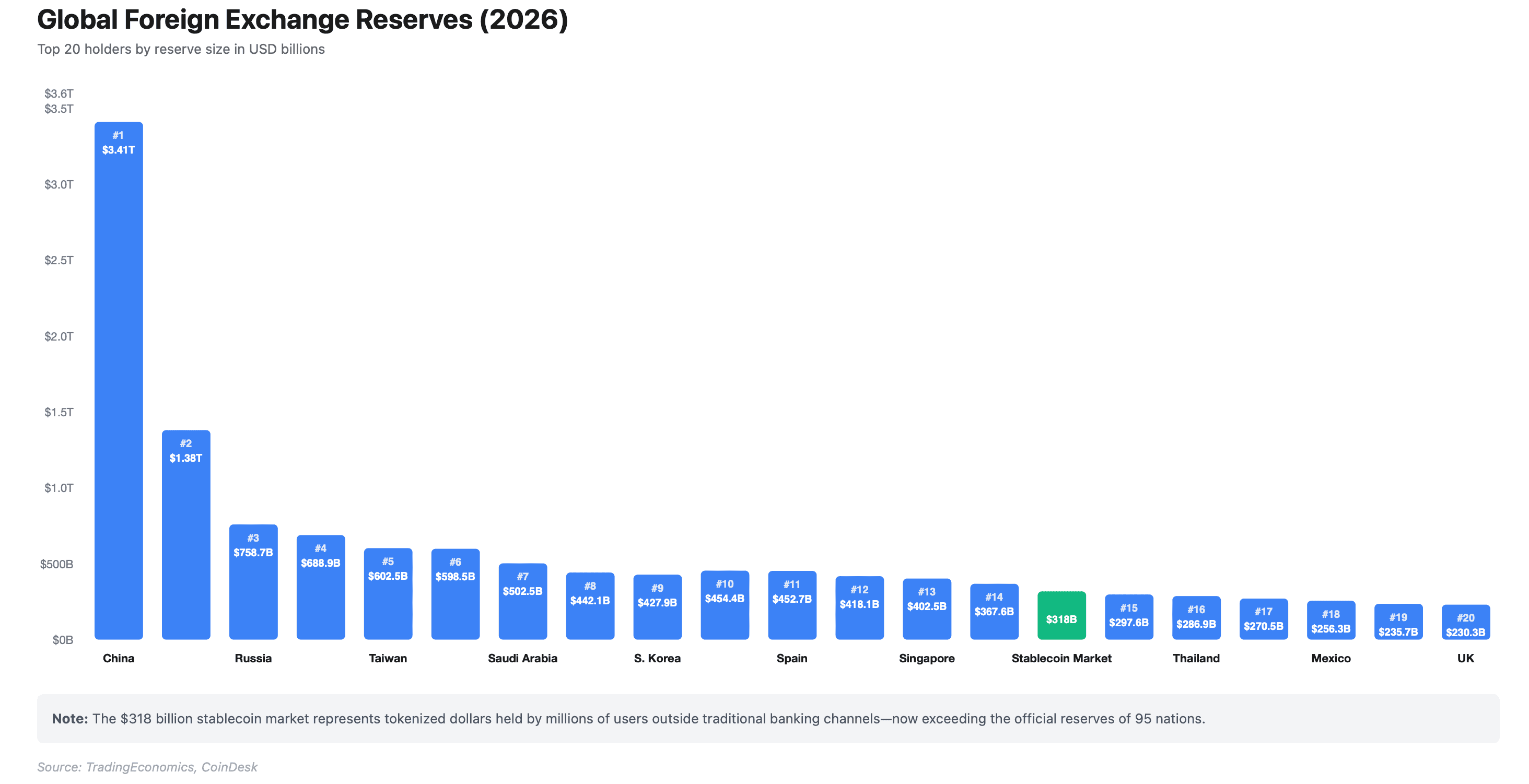

The combined market capitalization of all stablecoins has reached a record $322 billion, surpassing the official foreign-exchange reserves of 95 countries — including developed economies like the United Kingdom, Canada and the United Arab Emirates, alongside mid-sized sovereigns such as Poland, Thailand and Mexico.
Stablecoins are tokenized versions of fiat currencies issued on blockchain rails, pegged 1:1 to the U.S. dollar and, in smaller pools, to the euro, yen and Swiss franc. Dollar-pegged issuers — led by Tether — account for the bulk of that $322B. Only 14 nations now hold more FX reserves than the stablecoin market: China, Japan, Russia, India, Taiwan and Germany lead the list, with the United States, Switzerland, Saudi Arabia and a handful of others rounding it out.
Why it matters
Foreign-exchange reserves are the dollars, euros, yen and gold central banks stockpile to defend their currencies, service foreign debt and finance energy and import bills. The fact that a private, permissionless dollar instrument now eclipses the sovereign buffer of 95 jurisdictions is a structural shift in where global dollar liquidity actually sits — and it changes the political economy of money. Dollars held in stablecoins are dollars that sit outside the domestic banking system of any one country, outside any one central bank's perimeter, and outside the reach of any one capital-control regime.
The Bank for International Settlements has flagged the same trend in its own data. Cross-border stablecoin flows have grown substantially since 2022, with the heaviest activity in corridors experiencing high inflation and exchange-rate volatility — a sign that EMDE residents are using stablecoins as a frictionless on-ramp into dollar-denominated savings. Only 14 countries hold more FX reserves than the stablecoin market at $322B — a marker of how quickly digital rails have absorbed a balance-sheet role once reserved for sovereigns.
Market impact
The growth cuts two ways.

Frequently asked questions
-
Why is the $322B figure structurally important?
A private, permissionless dollar instrument now exceeds the sovereign reserve buffer of 95 jurisdictions, shifting where global dollar liquidity sits — outside any single central bank's perimeter or capital-control regime.
 CryptoSlate
 WuBlockchain
 Crypto Rank News
 Crypto News
 TheBlock