








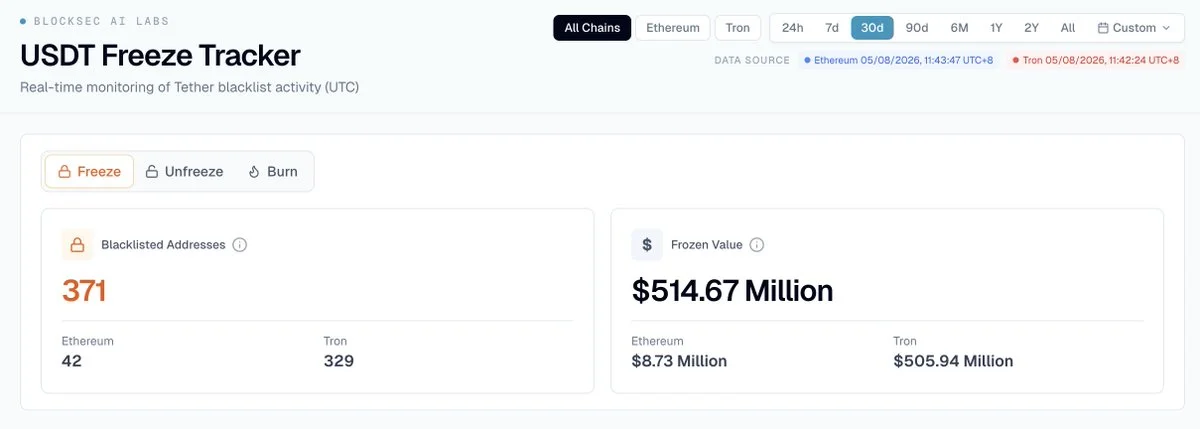

Tether has blacklisted 371 addresses across Ethereum and Tron over the past 30 days, freezing roughly $515 million in USDT, according to the BlockSec USDT Freeze Tracker as of May 7, 2026. Tron accounted for the bulk of the activity — 329 addresses and $506 million — while Ethereum saw 42 addresses and $8.73 million frozen.
Why it matters
The dollar figure is loud, but the address count is the structural read. Freezing 371 wallets in a single month is an unusually aggressive compliance tempo for the largest stablecoin issuer, and a useful proxy for the volume of on-chain requests Tether is now fielding from law enforcement and blockchain analytics partners. The Tron skew mirrors a pattern that's held for years: TRC-20 USDT remains the dominant rail for cross-border flows into jurisdictions that trigger sanctions or AML scrutiny.
Market impact
For users, freezes are non-reversible and the funds are removed from circulating supply until Tether chooses to reissue or burn them. Historically, sustained freeze activity of this scale has not moved USDT's peg, but it does shrink effective float marginally and is a recurring data point critics use to argue against USDT's censorship-resistance claims. The next watch: whether May's run rate continues or pulls back as a one-off enforcement cluster.



Frequently asked questions
-
How much USDT did Tether freeze in the past 30 days?
Tether blacklisted 371 addresses on Ethereum and Tron between roughly April 7 and May 7, 2026, freezing approximately $515 million in USDT — $506 million on Tron and $8.73 million on Ethereum, according to the BlockSec USDT Freeze Tracker.
-
Why did Tether freeze these addresses?
Tether routinely freezes addresses at the request of law enforcement or its blockchain analytics partners when wallets are linked to illicit activity, sanctions exposure, or AML concerns. The tracker does not name individual cases, so the specific reason for each freeze isn't disclosed.
-
Does freezing USDT affect the stablecoin's peg?
Historically, no. Sustained freeze activity at this scale has not moved USDT's peg to the US dollar, though it does marginally reduce effective circulating supply until Tether reissues or burns the underlying tokens.
-
Why is most of the frozen USDT on Tron rather than Ethereum?
Tron's TRC-20 USDT dominates cross-border transfers into higher-risk jurisdictions, which is where the bulk of sanctions and AML enforcement attention falls. The 329-to-42 address split roughly mirrors TRC-20's share of USDT's overall network footprint.
-
Can frozen USDT ever be unlocked?
Tether retains the ability to unfreeze wallets, and in past cases has done so when addresses were cleared by law enforcement or shown to be false positives. But freezes are not reversible by the holder — only the issuer can move tokens out of a blacklisted address.

 CryptoSlate
 TheBlock
 Crypto News
 Crypto Rank News
 Lookonchain