








 WuBlockchain
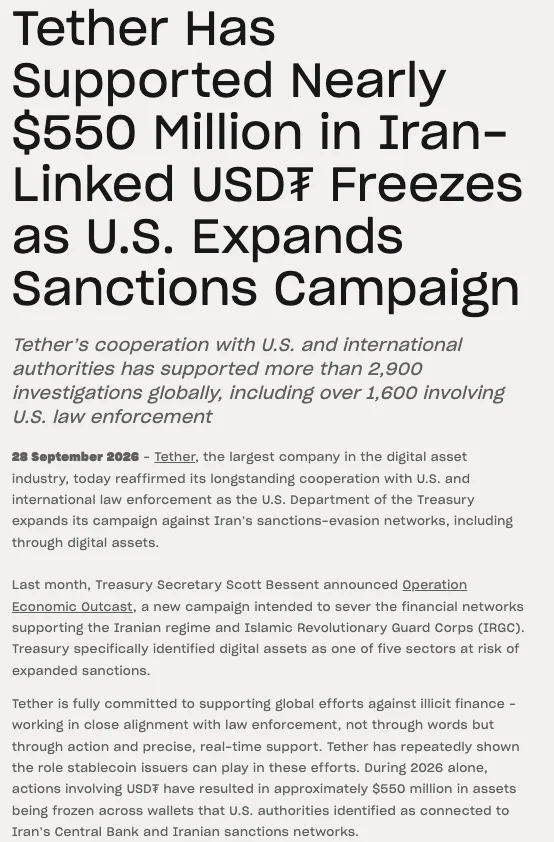
Tether said it supported U.S. law enforcement and sanctions authorities in freezing approximately $550 million in USDT linked to Iran’s central bank and sanctions networks in 2026. More than $344 million across two addresses was frozen in April; OFAC later designated those addresses as digital currency identifiers for the Central Bank of Iran. More than $130 million across four wallets was frozen in July.
Why it matters
The freezes show how a centralized stablecoin issuer can work with authorities to restrict access to funds on-chain. Tether says it works with more than 340 law-enforcement agencies across 67 countries and has helped freeze more than $4.9 billion in assets globally.
Market impact
For USDT users and markets, the case highlights the compliance powers built into a widely used stablecoin. Tether’s cooperation supports enforcement efforts, while the ability to freeze tokens also keeps issuer control and sanctions compliance in focus.
Source: [Tether Has Supported Nearly $550 Million in Iran-Linked USD₮ Freezes as U.S. Expands Sanctions Campaign - Tether.io](https://tether.io/news/tether-has-supported-nearly-550-million-in-iran-linked-usdt-freezes-as-u-s-expands-sanctions-campaign/)

Frequently asked questions
-
How much Iran-linked USDT did Tether say it helped freeze?
Tether said it supported freezes of approximately $550 million in USDT linked to Iran’s central bank and sanctions networks in 2026.
-
What happened to the two addresses frozen in April?
More than $344 million across the two addresses was frozen in April. OFAC later designated them as digital currency identifiers for the Central Bank of Iran.
-
How much USDT was frozen across wallets in July?
Tether said more than $130 million across four wallets was frozen in July.
-
How widely does Tether say it works with law enforcement?
Tether says it works with more than 340 law-enforcement agencies across 67 countries.
-
What does the case show about USDT issuer controls?
It illustrates that a centralized stablecoin issuer can work with authorities to restrict access to funds on-chain, bringing issuer control and sanctions compliance into focus.
 WatcherGuru
 CoinTelegraph
 CoinDesk
 CryptoSlate
 Crypto News