








 CryptoSlate


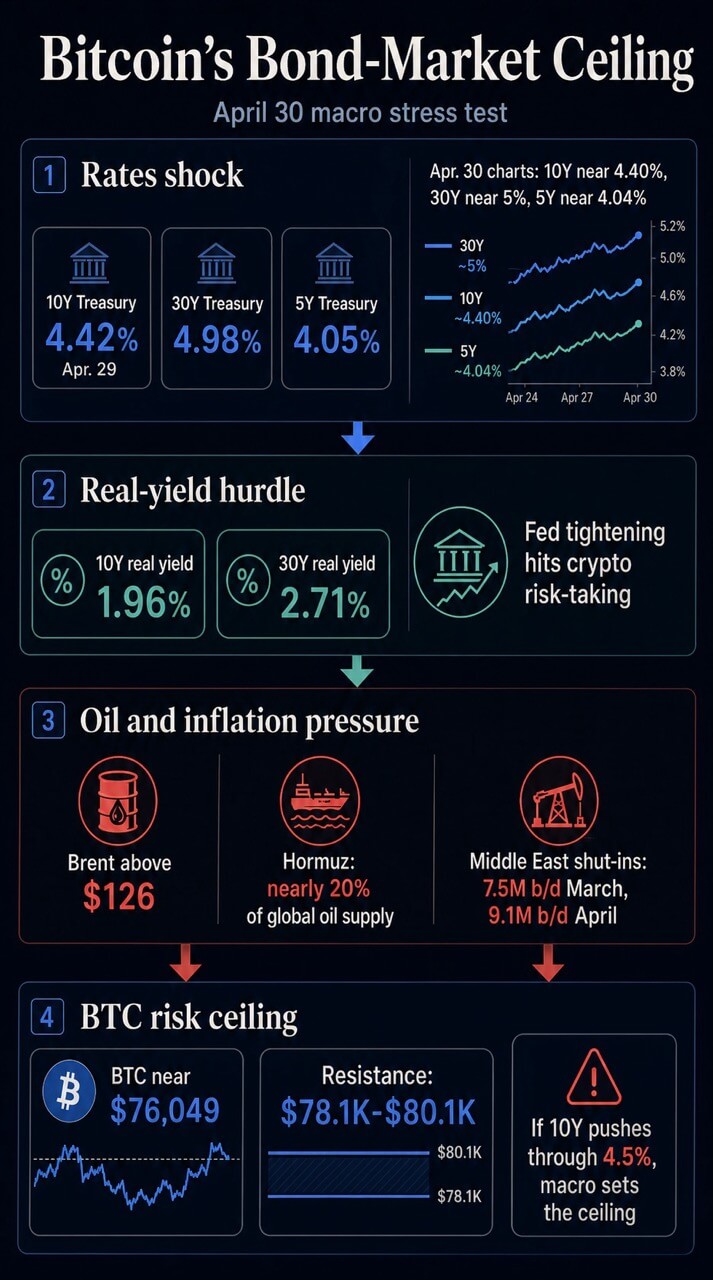

The US Treasury curve closed April 29 with the 10-year yield at 4.42%, the 30-year at 4.98%, and the 5-year at 4.05% — the highest long-end cluster in roughly a year. Brent crude pushed above $126 after reporting that President Trump is willing to keep the Iran blockade in place for months, with the EIA estimating nearly 20% of global oil supply normally flowing through the Strait of Hormuz and 9.1 million barrels per day shut in across the Middle East in April. Bitcoin is trading near $76,049, about 40% below its October 2025 high, and broader crypto market cap sits near $2.54 trillion with BTC dominance at 59.9%. The Fed held its target range at 3.50% to 3.75% the same day, with Stephen Miran dissenting in favor of a 25bp cut and three members opposing the easing-bias language — a split that mirrors the oil-versus-growth tug of war pulling on the front end of the curve.
Why it matters
Bitcoin has no coupon, dividend, or earnings stream, so its macro case leans on liquidity, risk appetite, scarcity demand, ETF access, and balance-sheet bid. When the long end of the risk-free curve pays close to 5%, that comparison tightens — investors can earn near 5% on a US Treasury while BTC sits below its early-year highs. Real yields sharpen the setup further: the 10-year real yield closed at 1.96% and the 30-year at 2.71% on April 29, a hurdle rate that IMF research linked to the common crypto factor losing ground through the risk-taking channel when the Fed tightens. CryptoSlate's own framing treats Bitcoin less as a clean gold or dollar hedge and more as a liquidity-sensitive tech beta, which means rising real yields act as a structural drag on how much volatility the market is willing to pay for.
Market impact
The two-front squeeze is now oil plus duration, and oil has become a rates variable. Reuters reported the US seeking international support to reopen the Strait of Hormuz, and the Fed's own April 29 statement cited elevated inflation tied to global energy prices and Middle East uncertainty, with Powell's opening statement flagging 3.5% headline PCE and 3.2% core PCE. On Bitcoin's own tape, short-term holder profit-taking clustered between $78,000 and $79,000 according to Glassnode, and buyers would need to absorb that overhead supply to push toward $84,000 — a break below $68,000 would expose a deeper correction path. The battleground between $78,100 and $80,100 is now the practical confirmation zone: a reclaim shows spot or ETF demand can absorb the macro shock, a rejection keeps the bond market in charge of BTC's ceiling.

Frequently asked questions
-
What are the current US Treasury yields and why do they matter for Bitcoin?
The April 29 Treasury curve closed with the 10-year at 4.42%, the 30-year at 4.98%, and the 5-year at 4.05% — the highest long-end cluster in roughly a year. With no coupon or earnings stream, Bitcoin has to compete with a risk-free rate paying close to 5%, which tightens the hurdle rate investors apply to volatile…
-
How high has Brent crude gone and what is the Iran blockade connection?
Brent pushed above $126 after reporting that President Trump is willing to keep the Iran blockade in place for months. The EIA estimates nearly 20% of global oil supply normally flows through the Strait of Hormuz and that Middle East producers had 9.1 million barrels per day shut in during April.
-
What did the Fed decide on April 29 and why is the dissents split important?
The FOMC held its target range at 3.50% to 3.75%. Stephen Miran dissented in favor of a 25bp cut, while Beth Hammack, Neel Kashkari, and Lorie Logan supported the hold but opposed keeping easing-bias language — a split that mirrors the oil-versus-growth tug of war pulling on the front end of the curve.
-
What Bitcoin price levels matter most right now according to on-chain data?
BTC is trading near $76,049, about 40% below its October 2025 high. Glassnode flagged short-term holder profit-taking between $78,000 and $79,000, with $84,000 needing fresh demand absorption and a break below $68,000 exposing a deeper correction. The $78,100 to $80,100 band is the practical confirmation zone.
-
How do real yields change Bitcoin's macro setup compared to nominal yields?
Real yields strip out inflation expectations and reflect the true discount rate on risky assets. On April 29 the 10-year real yield closed at 1.96% and the 30-year at 2.71%, which IMF research linked to the common crypto factor losing ground through the risk-taking channel when the Fed tightens — acting as a…
 CoinTelegraph
 Lookonchain
 WatcherGuru
 Crypto News
 CoinDesk
 TheBlock
 Crypto Rank News