








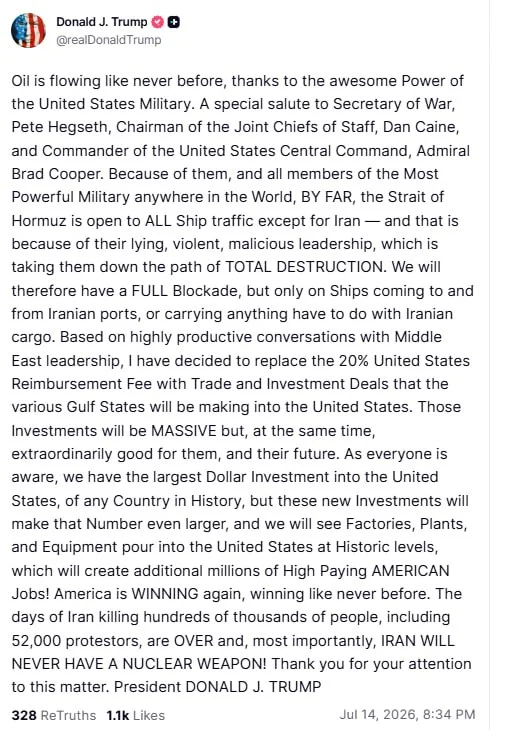
President Trump replaced the 20% US reimbursement fee with a package of Gulf trade and investment deals while ordering a blockade on Iranian shipping, in a sharp reordering of Middle East economic statecraft.
The reimbursement fee, a short-lived tariff structure designed to capture a share of transit-related revenue, is dropped in favor of bilateral investment commitments and trade concessions negotiated directly with Gulf partners. The shift trades tariff income for capital flows and political alignment.
Why it matters
Replacing a fee with negotiated deals reframes the US economic relationship with the Gulf from a revenue-extraction posture to a partnership posture. Gulf states gain predictability on access, the US gains capital commitments and strategic alignment, and the tariff line disappears from the budget math.
Market impact
The blockade on Iranian shipping puts the Strait of Hormuz back at the center of the oil-flow narrative. With roughly a fifth of global seaborne oil transiting the chokepoint, even the threat of interdiction moves crude premia and lifts shipping insurance. Watch for retaliatory moves on tanker traffic, Brent's term structure, and any secondary sanctions tightening from Treasury on Iranian oil buyers.
Frequently asked questions
-
What was the 20% US reimbursement fee?
It was a short-lived tariff structure designed to capture a share of transit-related revenue. Trump has now dropped it in favor of negotiated Gulf trade and investment deals.
-
Why is the Iranian shipping blockade significant?
Iranian shipping is the channel through which Tehran moves sanctioned crude. A US blockade disrupts those flows and raises the cost of evasion for buyers.
-
What share of global oil moves through the Strait of Hormuz?
Roughly a fifth of global seaborne oil transits the Strait of Hormuz, making any interdiction threat a direct driver of crude premia and shipping insurance.
-
Do Gulf states benefit from the new deal structure?
Yes. Replacing a fee with negotiated bilateral deals gives Gulf partners predictability on US access in exchange for capital commitments and political alignment.
-
What should markets watch next?
Retaliatory moves on tanker traffic, the Brent term structure, war-risk insurance pricing, and any Treasury secondary sanctions tightening on Iranian oil buyers.

 CoinDesk
 WatcherGuru
 TheBlock
 Crypto Capital Venture
 CryptoSlate
 Crypto Rank News