








 CryptoSlate


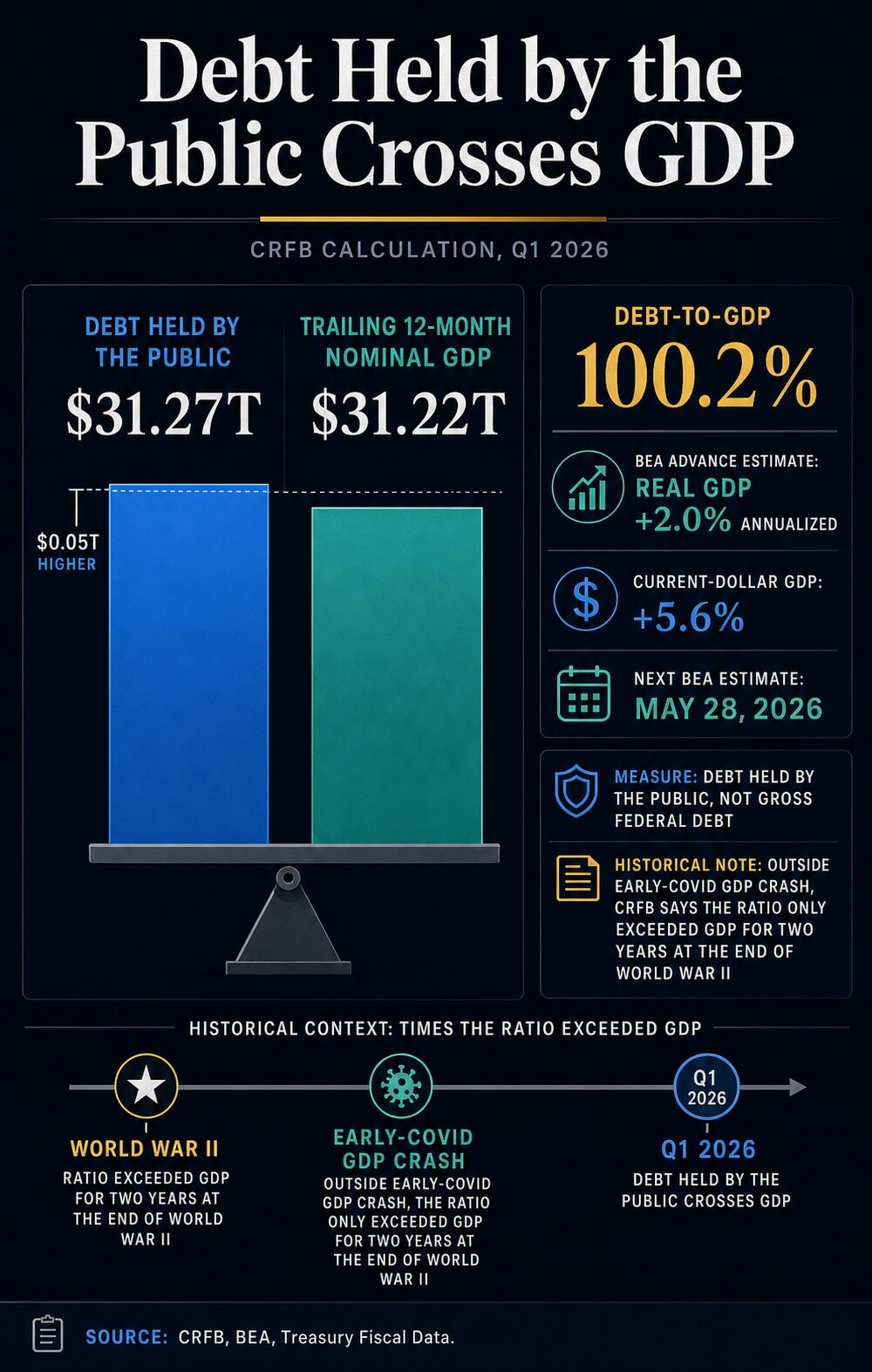

U.S. public debt held by investors reached $31.27 trillion at the end of the first quarter of 2026, edging past the BEA's advance estimate of $31.22 trillion in trailing 12-month nominal GDP. The Committee for a Responsible Federal Budget put the debt-to-GDP ratio at 100.2%, a threshold the U.S. has only crossed twice before — for two years at the end of World War II and briefly during the early-COVID GDP crash. The Congressional Budget Office's February baseline projects the ratio climbing from 101% this year to 120% by 2036, above the 106% postwar high.
Why it matters
The crossing turns Bitcoin's hard-money case from a long-run abstraction into a current macro question. With about 20.02 million BTC in circulation on May 1, 2026 against a hard cap of 21 million, the supply schedule is the cleanest monetary contrast available to a fiscal system that can issue more debt at will. BlackRock's own diversifier paper has already named U.S. fiscal sustainability as one of the long-term adoption drivers for a scarce, non-sovereign, decentralized asset — the CRFB marker gives allocators a current U.S. reference point for a thesis that previously sat in scenario analysis.
The wartime comparison is the language shift. Debt at the size of the economy reframes fiscal credibility as a market variable, not a political one, even though the Treasury market remains the center of global collateral. CBO's projection of wider deficits driven by rising net interest costs extends the pressure across a decade rather than a quarter.
Market impact
A stronger narrative does not automatically become demand. Bitcoin still trades with liquidity, yields, ETF flows, and volatility in view — BTC sat near $77,000 on May 1, with a market cap around $1.55 trillion, dominance near 60%, and a price roughly 39% below its October 6, 2025 all-time high. Higher long-end Treasury yields raise the hurdle for an asset with no coupon or dividend, and recent CryptoSlate analysis argued that debt growth, Treasury issuance, reserve balances, and bank-credit conditions can tighten the plumbing that moves liquidity into risk assets even when broad money is expanding.
The constructive path: inflation cools, reserve conditions improve, Treasury supply absorbs cleanly, and the milestone strengthens the case for a modest allocation to scarce monetary assets. The restrictive path: issuance stays heavy, yields remain elevated, and Bitcoin keeps trading as a high-beta liquidity asset despite a stronger long-run story. The two-layer market — macro setup vs.

Frequently asked questions
-
What is the current U.S. debt-to-GDP ratio according to CRFB?
The Committee for a Responsible Federal Budget put debt held by the public at $31.27 trillion against $31.22 trillion of trailing 12-month nominal GDP, a ratio of 100.2% at the end of Q1 2026. The exact figure can shift as BEA revises its advance estimate.
-
When has the U.S. debt-to-GDP ratio crossed 100% before?
Outside the brief early-COVID GDP crash, debt held by the public only exceeded GDP for two years at the end of World War II, according to CRFB. CBO's February baseline projects the ratio rising to 120% by 2036, above the 106% high recorded in 1946.
-
How does U.S. debt growth connect to Bitcoin's investment case?
A fixed-supply, non-sovereign asset becomes more attractive as a monetary hedge when confidence in sovereign balance sheets weakens, the argument BlackRock made in its Bitcoin diversifier paper. CRFB's 100.2% marker gives that thesis a current U.S. fiscal reference point rather than an abstract scarcity case.
-
Why doesn't the debt milestone automatically lift BTC price?
Bitcoin still trades with liquidity, Treasury yields, ETF flows, and volatility in view, and higher long-end yields raise the hurdle for an asset with no coupon. A debt-to-GDP break improves the macro setup but does not guarantee flow confirmation.
-
What are the two paths CRFB's marker opens for Bitcoin?
In the constructive path, inflation cools, reserve conditions improve, Treasury supply absorbs cleanly, and the milestone strengthens the case for a modest allocation to scarce monetary assets. In the restrictive path, issuance stays heavy, yields remain elevated, and BTC keeps trading as a high-beta liquidity asset…
 WatcherGuru
 CoinDesk
 Crypto Capital Venture
 CoinTelegraph
 TheBlock