








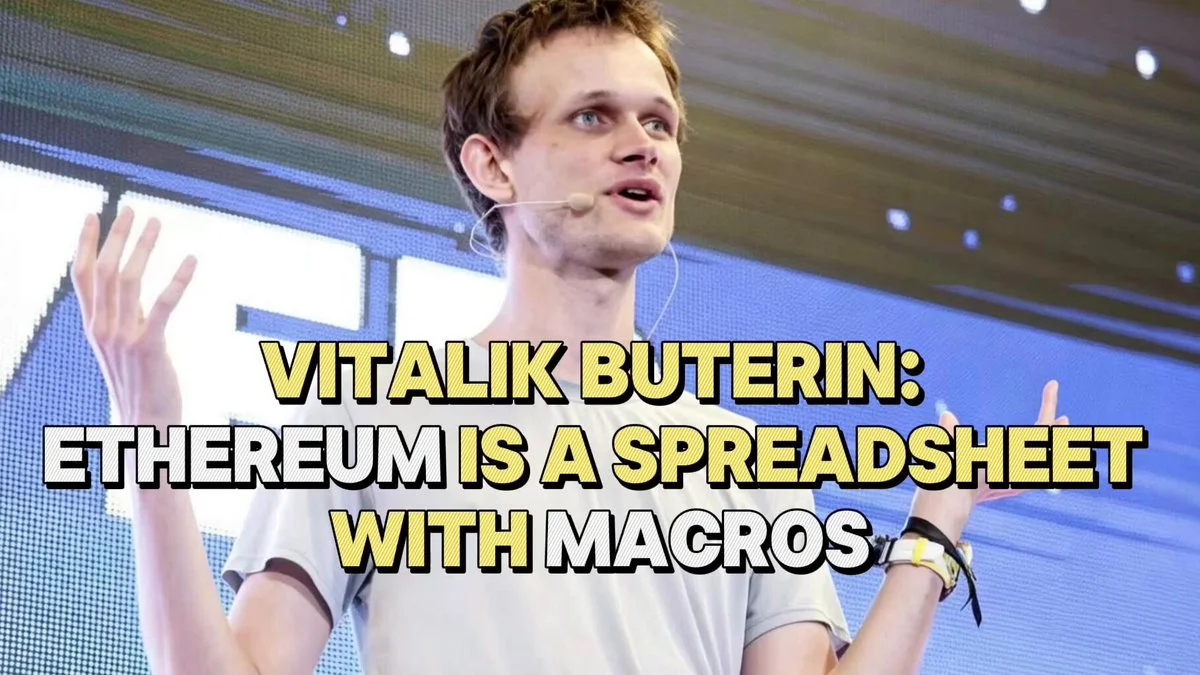
In a March 12, 2021 interview with Tim Ferriss, Ethereum founder Vitalik Buterin offered a one-line description of the network: a "general-purpose blockchain," or, more concretely, a "spreadsheet with macros." The metaphor works because it isolates what Ethereum adds on top of Bitcoin. A Bitcoin spreadsheet is static — users control specific cells and nothing more. An Ethereum spreadsheet has macros: accounts that execute code and interact autonomously under pre-programmed rules.
Why it matters
The "macros" framing is the cleanest articulation of why Ethereum shipped smart contracts at all. Once an application is deployed, it no longer depends on its creator or any individual maintainer to keep running. The contract executes by its code, not by anyone's continued goodwill. That property — credible neutrality at the application layer — is what makes DeFi, NFTs, and on-chain governance possible in a way that Bitcoin's UTXO model is not designed to support.
Market impact
The interview itself is five years old, but the framing still does heavy lifting when L2 rollups, account abstraction, and intent-based architectures are extending exactly that thesis: code, not intermediaries, owns the outcome. The "spreadsheet with macros" line tends to resurface whenever the market needs reminding that Ethereum's value proposition is programmability of ownership, not just soundness of money.

Frequently asked questions
-
What did Vitalik Buterin mean by calling Ethereum a spreadsheet with macros?
In a March 12, 2021 interview with Tim Ferriss, Vitalik Buterin said Bitcoin is like a static spreadsheet where users only control specific cells, while Ethereum is a spreadsheet with macros — accounts that can execute code and interact autonomously based on pre-programmed rules.
-
How does the spreadsheet metaphor explain smart contracts?
The metaphor isolates what Ethereum adds on top of Bitcoin. Bitcoin's ledger is static; Ethereum accounts can run code that executes autonomously, so a deployed application no longer depends on its creator or any individual maintainer to keep running.
-
Why does Vitalik emphasize that deployed apps run without their creators?
He frames it as autonomy at the application layer — once a smart contract is deployed, it executes strictly by its rules without interference from any individual, which is the property that makes DeFi, NFTs, and on-chain governance viable.
-
Is this a new statement from Vitalik Buterin?
No. The interview aired on March 12, 2021. The framing resurfaces periodically because it is one of the cleanest plain-language descriptions of why Ethereum shipped smart contracts in the first place.
-
Why does the spreadsheet-with-macros line still matter today?
It captures Ethereum's core value proposition — programmability of ownership rather than just soundness of money — and continues to describe what L2 rollups, account abstraction, and intent-based architectures are extending across the network.

 Crypto Capital Venture
 Lookonchain
 CoinTelegraph
 CoinDesk
 CryptoSlate
 TheBlock