








 CoinDesk
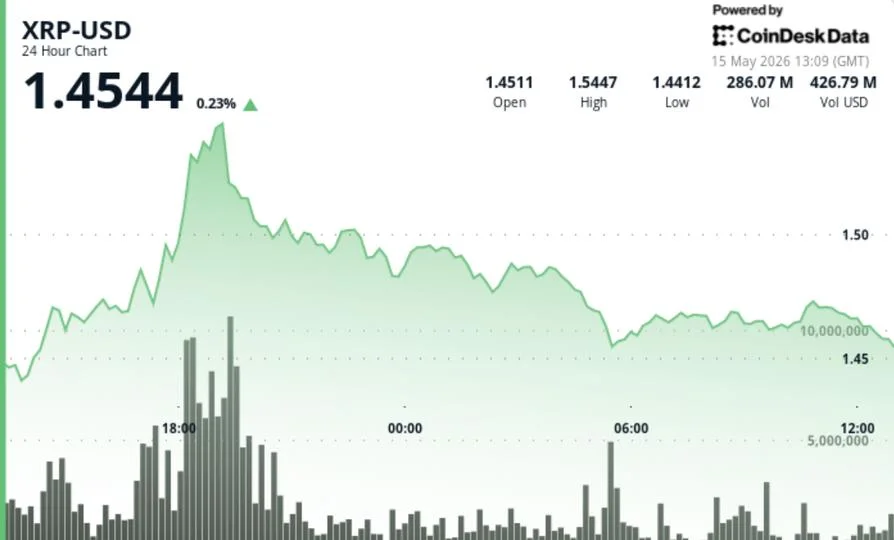


XRP climbed to $1.5417 during the May 14 18:00 UTC session on volume of 291.5 million tokens, a sharp move that briefly pierced the $1.50 resistance zone before the price drifted back toward $1.46 as traders locked in profits near the highs. Over the 24-hour window XRP moved from $1.4468 to $1.462, consolidating just below the same breakout level that has capped every rally since February.
The setup matters because positioning is building rather than fading. Binance open interest climbed to its highest levels in weeks, and XRP exchange-traded products absorbed $40 million in inflows during the week ending May 8, with year-to-date inflows now at $191 million. XRP ETFs also recorded their strongest daily inflow session since January earlier in the week, a separate signal that institutional money is rotating in ahead of a potential regulatory trigger.
Why it matters
The Senate Banking Committee's May 14 markup of the CLARITY Act is the immediate catalyst. The bill, if it advances, would formally reinforce XRP's regulatory status as a commodity — a classification Ripple has argued for in its multi-year fight with the SEC. A confirmed commodity designation would open the door to broader institutional access and clearer derivatives oversight, both of which would feed directly into the kind of ETF flows already accelerating.
The combination of regulatory tailwind plus rising open interest is the structural read. Traders are not just buying spot; they are adding leveraged exposure into the vote, which means realized volatility around the markup will likely exceed the move implied by spot price alone.
Market impact
The chart structure supports the bull case tactically. XRP continues making higher lows underneath the $1.50 ceiling, and repeated tests of overhead supply tend to weaken it over time. A sustained close above $1.50 would shift the next reference levels to $1.60 and then $1.80, while a failure back through $1.46 would expose the consolidation to a deeper pullback.
Near-term, the $1.46 floor is the line that defines whether the buildup is constructive positioning or a coiled spring. The CLARITY Act markup is the first test of which it is.

Frequently asked questions
-
What is the CLARITY Act and how does it affect XRP?
The CLARITY Act is legislation before the Senate Banking Committee, with a markup scheduled for May 14. If it advances, the bill would formally reinforce XRP's regulatory status as a commodity — a classification Ripple has argued for in its years-long fight with the SEC.
-
Why did XRP spike to $1.5417 and then pull back?
XRP ran to $1.5417 on May 14 during a 291.5 million-token hourly session, briefly cracking the $1.50 resistance that has capped rallies since February, before drifting back to $1.46 as traders locked in profits near the highs.
-
What are the key price levels to watch for XRP?
$1.50 remains the breakout level — a sustained close above it shifts focus to $1.60 and then $1.80. $1.46 is the immediate support after the post-rally consolidation.
-
How much have XRP ETFs pulled in recently?
XRP exchange-traded products absorbed $40 million in inflows during the week ending May 8, with year-to-date inflows climbing to $191 million. XRP ETFs also recorded their strongest daily inflow session since January earlier in the same week.
-
What does the rising open interest signal for XRP?
Binance open interest climbed to its highest levels in weeks as the CLARITY Act markup approached, indicating traders were adding leveraged exposure into a known regulatory catalyst — a setup that typically produces realized volatility exceeding what spot price alone implies.
 Crypto Rank News
 Crypto News
 Lookonchain
 TheBlock