Why crypto keeps reinventing how tokens reach you
If you've ever opened a crypto wallet and found a token you didn't buy, or watched a project raise tens of millions in minutes, you've bumped into one of four distribution models. None of them is the original way. Each one was invented because the previous model failed the people it was supposed to help.
That fact is the single most useful thing to understand before you touch any of them. A token distribution mechanism is not neutral infrastructure. It is a set of rules that decides who gets cheap tokens, who gets dumped on, and who gets locked out. The history of these mechanisms is a history of retail getting squeezed, regulators cracking down, and builders trying the next thing.
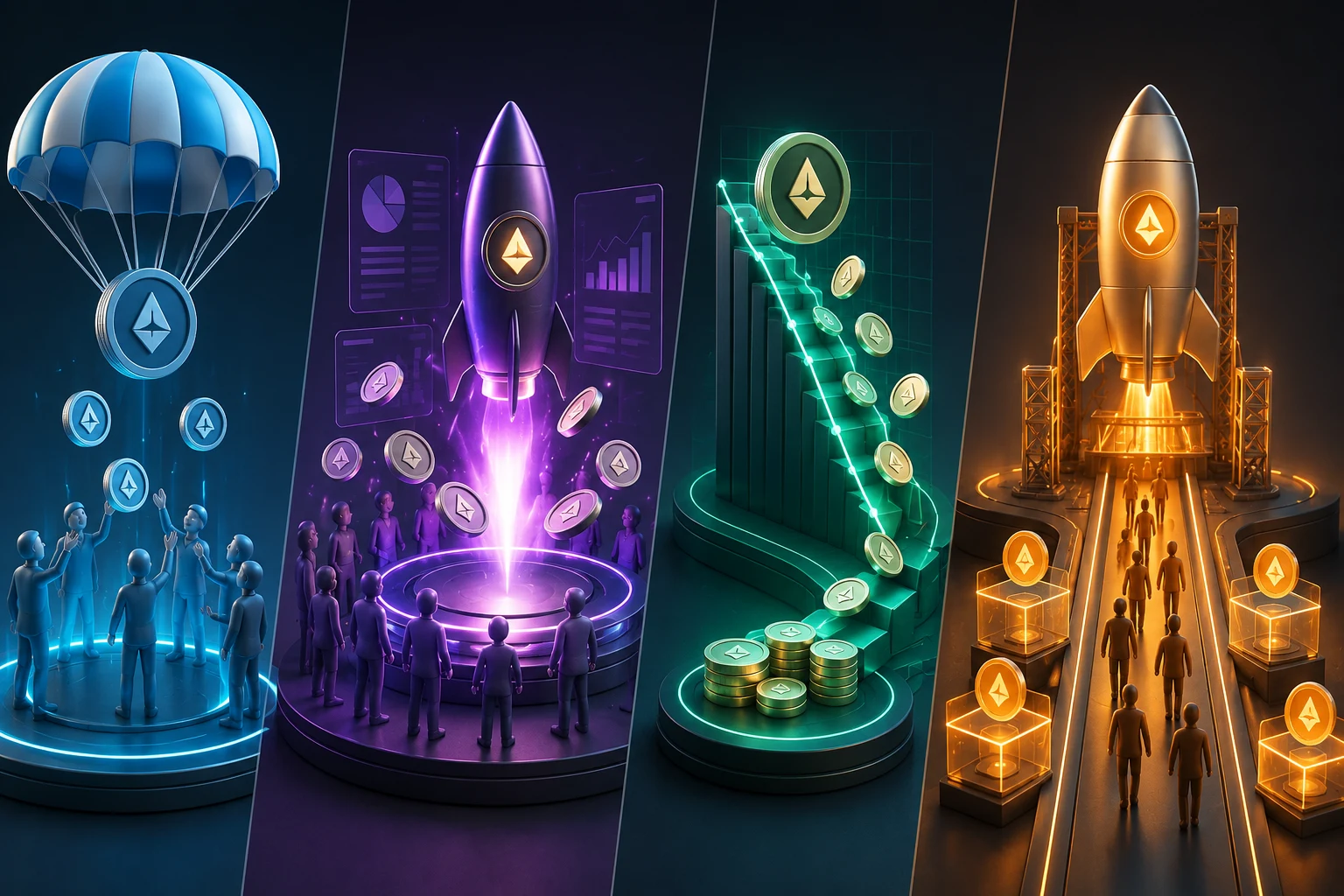
This article walks through the four main ways tokens reach the public today: ICOs, airdrops, LBPs, and launchpads. We'll look at what each one promised, what actually happened, and what the trade-offs look like for someone showing up in 2025 with a wallet and a question.
The 2017 ICO lesson: what the original model actually delivered
An Initial Coin Offering, or ICO, is the oldest model on this list. A project writes a whitepaper, publishes a wallet address, and sells tokens directly to anyone who sends ETH or BTC. No middleman, no listing, no prospectus. Between 2017 and 2018, projects raised over $20 billion this way, including Ethereum itself back in 2014.
The promise was radical: anyone in the world could buy a stake in an early-stage network without a bank, a broker, or a securities regulator. For a brief window, that promise held. Some real protocols funded their early development through ICOs. Then the floodgates opened.
What actually happened was grim. A 2018 Statis Group study estimated that roughly 80% of ICOs that year were scams, including outright rug pulls where the team vanished with the funds. Legitimate projects sold tokens to retail at prices that immediately crashed once exchanges listed them, because the team and early insiders held large allocations they could dump. The U.S. Securities and Exchange Commission started treating most ICO tokens as unregistered securities, and several issuers received enforcement actions. The dream of permissionless fundraising became, in practice, a permissionless way to lose money.
ICOs are not dead in a literal sense, but the term has become a warning label. Most reputable projects have moved to other mechanisms. When you see 'ICO' today, treat it as a yellow flag rather than a feature.
Airdrops: free tokens, but rarely really free
An airdrop is when a protocol sends tokens to wallets that meet certain criteria, often for free, sometimes in exchange for a small task (follow a Twitter account, bridge a token, sign a message). The 2023-2024 wave of retroactive airdrops, where projects like Uniswap, Arbitrum, and Optimism distributed tokens to past users based on historical activity, turned airdrops into a genuine income source for skilled wallet operators.
The promise here is alignment. Instead of insiders capturing all the value, the people who actually used the protocol early get a slice. The economic logic is that giving tokens to real users creates a more distributed holder base, which makes the token less likely to be dumped by a small whale group.
What actually delivered is more complicated. Retroactive airdrops did redistribute wealth, but they also spawned a professionalized 'airdrop farming' industry. Operators run hundreds of wallets, route transactions through relayers, and optimize on-chain behavior to look like a real user. The result is that a meaningful share of every major airdrop ends up in the hands of people who are not the intended audience. Some teams have responded by filtering recipients using on-chain heuristics, which has its own fairness problems.
For a beginner, the practical reality is that most airdrops are small. A hundreds-of-dollars-level retroactive airdrop to a real user is the exception, not the rule. Most modern airdrops are either worth a few dollars, claim-gated for marketing purposes, or heavily sybil-filtered. Treat them as a bonus, not a strategy.
LBPs: the Dutch auction that punishes hesitation
A Liquidity Bootstrapping Pool, or LBP, is a specific design popularized by the Balancer protocol. It's a form of Dutch auction where the price starts high and automatically falls over time, often across 24-72 hours, until enough buyers step in to stabilize it. The mechanism is designed to find a market-clearing price without a centralized order book.
Bot resistance is the main promise. Because the price falls continuously, an automated bot that buys at the start still has to hold while the price drops, eating the opportunity cost. If the bot is wrong about demand, it loses. In theory, this weights the purchase toward patient human capital rather than sniping bots.
What actually delivered is mixed. LBPs have been used for genuinely fair launches, and they do reduce the impact of front-running bots compared to fixed-price sales. But they also expose buyers to a slow-motion decline if no one else shows up. Retail who buy early sometimes find themselves holding the bag as the price drifts down. The mechanism is also unforgiving: if you don't watch the LBP closely, you can easily buy at a price that proves to be the top.
For a beginner, the LBP experience feels like 'is it falling, should I buy, is it going lower?' That's the design. The question is whether the project has enough genuine interest to absorb the falling supply without the price collapsing. Many do. Many don't.
Launchpads: curated IDOs with stakes and lotteries
Launchpads are platforms (think Binance Launchpad, Polkastarter, DAO Maker) that host token sales for vetted projects. To participate, you typically hold and 'stake' the platform's native token, then receive a lottery ticket or allocation based on how much you've staked and for how long. If selected, you buy the new token at a fixed price, usually before it lists on exchanges.
The promise is curation. The launchpad screens the project, so users get at least a basic diligence filter. The fixed price is below the expected listing price, so there is a theoretical arbitrage profit if the project is real. Staking requirements are meant to commit users to the platform's ecosystem.
What actually delivered, in many cases, is bot-farming and whale dominance. Sophisticated users split their holdings across hundreds of wallets to multiply lottery tickets. Staking tiers favor those who can lock up large amounts of the platform token. The 'fixed price' often opens at a much higher market price briefly, gives early buyers a quick scalp, then drifts down as the token finds its real level. Retail participants who got a small allocation still come out ahead, but the largest gains accrue to the launchpad insiders and the biggest stakers.
Launchpads are not scams, but they are not meritocracies either. They are a hybrid of curation and gatekeeping that benefits committed capital. If you don't have a large native-token stake, your expected allocation is small, and your expected profit on a typical launchpad sale is modest.
What changed between 2017 and today: a one-line summary
Each model is a reaction to the previous failure. ICOs failed because of fraud and insider dumping. Airdrops partly solve the insider problem but introduced sybil farming. LBPs try to neutralize bots but expose buyers to falling prices. Launchpads centralize the screening but reintroduce whale advantages. None of them is the final answer. All of them are still being iterated on.
That history matters because it tells you what to watch for. When a new project pitches a 'revolutionary' distribution model, the question is not whether it sounds clever. It is: which specific failure of the previous model is this design trying to prevent, and does it actually prevent it, or does it just move the failure elsewhere?
Regulatory exposure: which mechanism gets the most legal heat
Regulators, especially in the U.S. and EU, have been more aggressive against some mechanisms than others. ICOs have drawn the most enforcement actions because selling tokens to raise capital from public investors looks a lot like selling unregistered securities. The SEC has settled with multiple ICO issuers, and the trend has not stopped.
Airdrops sit in a murkier space. When tokens are given for free, especially retroactively to past users, regulators have so far been more cautious. The argument is that no money changed hands, so securities laws may not apply. That argument is not bulletproof, though. If the airdrop is conditioned on a promotional action or steered toward U.S. persons, the legal picture changes. Don't assume 'free' means 'safe from the SEC'.
LBPs, because they are continuous Dutch auctions on a DEX, are structurally harder to classify as securities offerings. The buyers are anonymous, the price is set by supply and demand, and the protocol is decentralized. That is not a legal shield, but it has meant fewer enforcement actions so far.
Launchpads are the most legally exposed of the modern models. They often involve a centralized platform selling tokens at a fixed price to identified users, which looks very much like a securities offering in the U.S. framework. Some launchpads have responded by geo-blocking U.S. users and adding KYC. The legal status of the launchpad model is genuinely unsettled, and that uncertainty is a real risk if you use one.
How to think about token distribution the smart way
Crypto distribution moves fast and so does the news around it. Each new model promises to fix the failures of the last one, and each one ships its own new failure mode. Tracking which mechanism is gaining traction, which projects are launching via which model, and how the market is reacting to each new launch is a full-time job if you do it manually. Zippfeed surfaces token-launch and distribution headlines with sentiment scoring (bullish, neutral, or bearish) and an importance rating, so you can spot genuine launches before the crowd does and skip the noise that doesn't matter.




 WuBlockchain
 CryptoSlate
 Glassnode
 WatcherGuru
 Altcoin Daily