The two giants, and a common misunderstanding
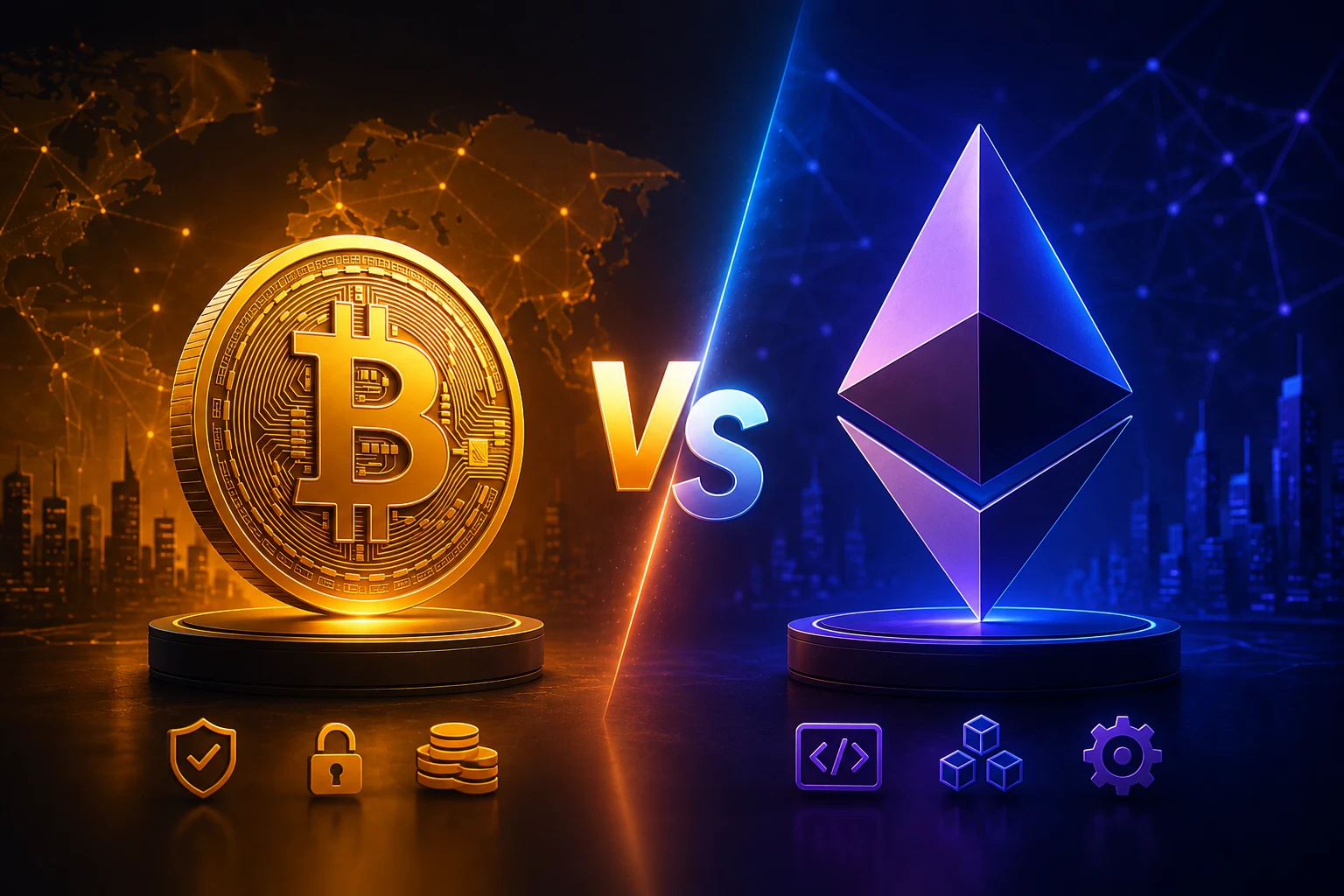
Bitcoin and Ethereum are the two largest and most important cryptocurrencies, and they are constantly compared as if they were rivals competing for the same crown. That framing misses the point. They were designed to do different things. Understanding *what* each was built for is far more useful than asking which is "better," because the honest answer to that question is "better at what?"
Bitcoin: digital money and digital gold
Bitcoin came first, launched as a response to the traditional financial system. Its purpose is focused and deliberately narrow: to be a decentralized form of digital money and a store of value that no government or institution controls.
Everything about Bitcoin's design serves this goal:
- Fixed supply. Only 21 million bitcoin will ever exist, enforced by the Bitcoin halving. This hard scarcity underpins the "digital gold" narrative.
- Security and stability over features. Bitcoin changes slowly and cautiously. It is intentionally conservative, prioritizing being rock-solid over being flexible.
- Proof of work. Bitcoin uses proof of work mining to secure its network, which is energy-intensive but extremely battle-tested.
Bitcoin's strength is its simplicity and singular focus. It aims to do one thing — be sound, scarce, decentralized money — and do it more reliably than anything else.
Ethereum: a programmable platform
Ethereum took a fundamentally broader vision. Rather than just being money, it was built as a decentralized computing platform — a foundation on which developers can build applications. Its native asset, ether (ETH), powers this platform.
Ethereum's defining features:
- Smart contracts. Ethereum popularized smart contracts — programs that run on the blockchain. This is the key that unlocked everything built on top of it.
- An entire ecosystem. DeFi, NFTs, DAOs, stablecoins, and countless applications live on Ethereum. It is less a currency and more a platform for an economy.
- Proof of stake. Ethereum uses proof of stake, allowing holders to stake ETH to secure the network and earn rewards.
- Scaling via Layer 2. Ethereum leans on Layer 2 blockchains to handle volume cheaply while keeping its base layer secure.
Ethereum's strength is flexibility. If Bitcoin is digital gold, Ethereum is closer to a global, programmable settlement layer.
The core differences, side by side
- Purpose: Bitcoin is money and a store of value; Ethereum is a platform for applications.
- Supply: Bitcoin has a fixed 21 million cap; Ethereum's supply policy works differently and is not fixed in the same way.
- Consensus: Bitcoin uses proof of work; Ethereum uses proof of stake.
- Philosophy: Bitcoin prioritizes stability and security; Ethereum prioritizes capability and evolution.
- What you can do: Hold and transact Bitcoin; build and use applications on Ethereum.
So which is "better"?
It depends entirely on what you value, and this is not investment advice. If you want the most established, scarce, security-focused digital money, Bitcoin's case is clear. If you believe in a future of decentralized applications and want exposure to that broader ecosystem, Ethereum's case is compelling. Many investors hold both precisely because they are betting on different things.
The crucial insight: they are not really competing for the same job. Bitcoin and Ethereum can both succeed at what they were each designed to do. For a related comparison among smart-contract platforms, see Solana vs Ethereum.
Follow both with clarity
Bitcoin and Ethereum each generate enormous, often conflicting news flow — upgrades, ETF developments, regulatory shifts, and ecosystem changes. Zippfeed tracks headlines for both with sentiment and importance scoring, so you can follow the developments that actually matter for each asset separately, instead of drowning in noise that blurs two very different networks together.


 Glassnode
 WatcherGuru
 CryptoSlate
 TheBlock
 CoinTelegraph
 WuBlockchain