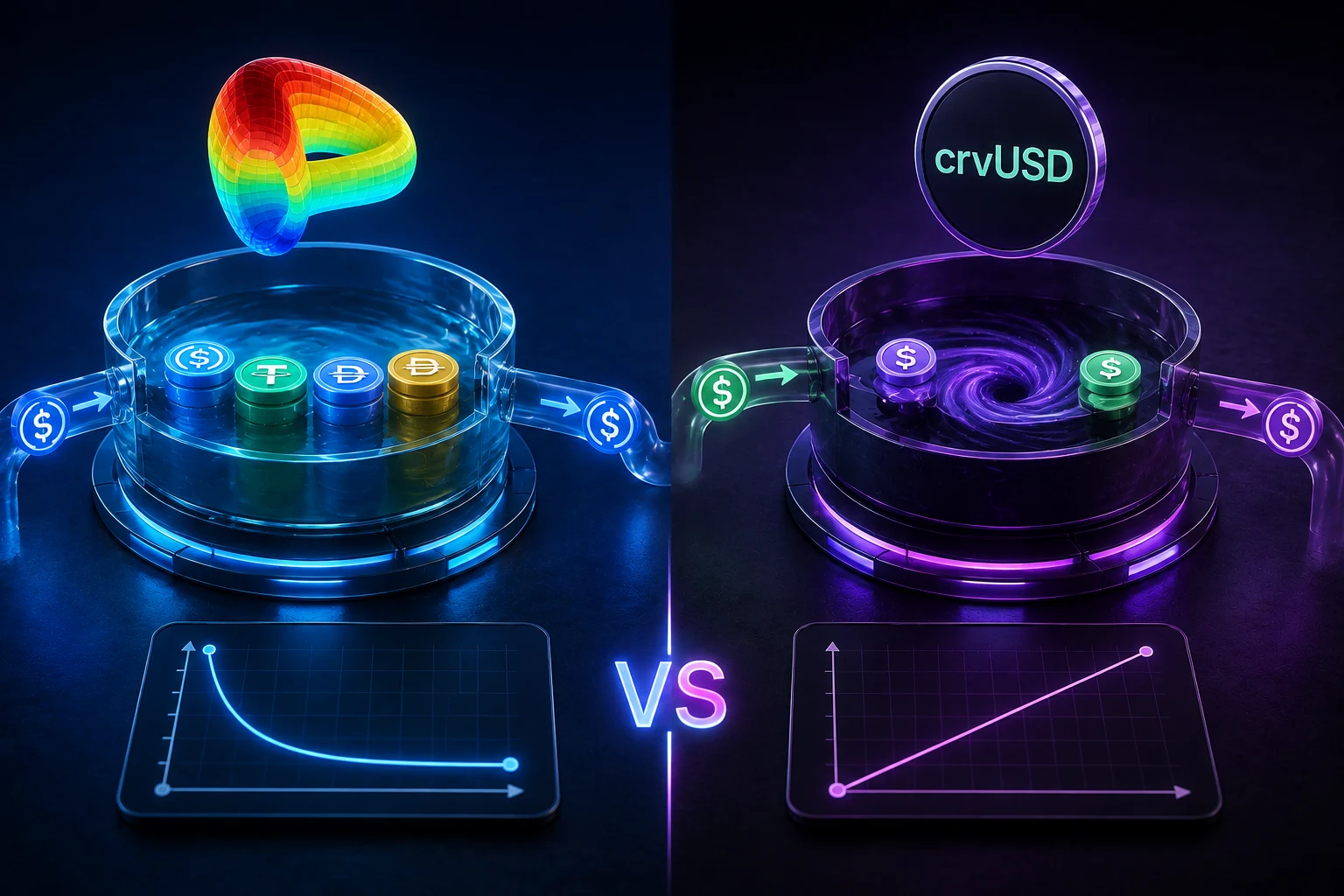
Why Curve has two different AMM designs
The phrase Curve AMM can describe more than one system. Curve StableSwap is the best-known design: it is an automated market maker, or AMM, that lets users trade assets with similar prices, such as stablecoins or liquid staking tokens. Its main job is exchange. A StableSwap pool holds reserves and prices trades according to an invariant designed to keep slippage low when the assets remain near the same value.
The crvUSD AMM serves a different purpose. It is part of Curve’s crvUSD lending system, where users can borrow the crvUSD stablecoin against approved collateral. Its liquidation component is called LLAMMA, short for Lending-Liquidating AMM Algorithm. LLAMMA is not simply a StableSwap pool with a new token pair. It is a mechanism for managing collateral as a borrower’s position becomes unsafe.
That distinction matters because the systems answer different questions. StableSwap asks how liquidity providers and traders can exchange similar assets efficiently. LLAMMA asks how a lending protocol can keep a position near its safety boundary while converting collateral into crvUSD when necessary. One is primarily a trading design. The other combines pricing, lending, collateral management, and liquidation.
For a broader foundation, it helps to read how AMMs price trades alongside this comparison. The key point is simple: similar names and shared Curve deployments do not mean identical math, economic incentives, or failure modes.
Risks to understand before using either system
Neither design removes market risk. A StableSwap pool can experience an imbalance when one asset trades below its intended value or when arbitrageurs withdraw the stronger asset. Liquidity providers may then hold more of the weakening asset. This is an instance of inventory risk, often described through impermanent loss, although the loss can become effectively permanent when an asset suffers a lasting depeg.
crvUSD adds lending risk and liquidation risk. A borrower can lose collateral if its value falls far enough, even if LLAMMA reduces the chance of a single instant liquidation. A depositor or liquidity provider can also be exposed to bad debt, oracle errors, smart contract bugs, governance decisions, and insufficient liquidity in the relevant collateral market. The protocol’s intended behavior is not the same as a guarantee of solvency.
LLAMMA’s distinctive weakness appears during volatile collateral moves. It needs liquid markets and usable prices to sell collateral into crvUSD and later acquire the collateral again as conditions improve. A rapid fall, a sharp reversal, or thin liquidity can make those transitions costly. The system may sell collateral at unfavorable prices, leaving a borrower with less upside if the collateral recovers, while the protocol can still face stress if the sale does not raise enough value.
There are also technology and integration risks. Curve contracts differ across chains, pool versions, collateral types, and front ends. An application that reads one deployment’s parameters incorrectly can calculate collateral ratios, prices, or available liquidity incorrectly. DeFi smart contract risk is therefore not one generic category. It includes the core protocol, the specific pool, the oracle path, the chain, the wallet interface, and every application that composes with them.
How StableSwap pricing works
A traditional constant-product AMM uses a rule commonly expressed as x times y equals k. That design is useful for assets that may have very different prices, but it can produce unnecessary slippage when two assets should trade close to one another. StableSwap modifies the pricing curve by combining constant-sum behavior near equilibrium with constant-product behavior farther away from equilibrium.
Near the intended balance, the curve is relatively flat. A trader can exchange one stablecoin for another without moving the price as much as they might in a basic constant-product pool. As the pool becomes more imbalanced, the curve becomes steeper. This discourages draining one side of the pool and helps compensate liquidity providers for taking on the risk that the assets are not actually equivalent.
The invariant is a mathematical rule that determines how the pool’s reserves can change while preserving the pool’s accounting relationship. It does not create value or make the assets stable. If USDC, USDT, or another asset loses its peg, the invariant still operates, but it cannot force the market to treat the asset as worth one dollar. Arbitrage changes the pool’s composition, and liquidity providers can be left holding more of the asset that traders want to sell.
StableSwap therefore contributes to peg-keeping rather than guaranteeing a peg. Cheap, deep trading can help arbitrageurs correct small price differences, but the pool depends on external markets, functioning redemptions, sound token contracts, and adequate liquidity. A pool can process trades correctly while users lose money because the underlying asset or bridge has failed.
What crvUSD and its AMM are designed to do
crvUSD is a stablecoin issued through Curve’s lending system. A user supplies an eligible collateral asset and borrows crvUSD against it. The position is overcollateralized, meaning the collateral value is intended to exceed the debt. A liquidation mechanism is necessary because collateral prices can fall and make a position unable to support its outstanding crvUSD.
That structure resembles a collateralized debt position, or CDP, used by other stablecoin systems. A CDP is a smart contract position that locks collateral, tracks debt, and defines the conditions under which collateral may be sold. crvUSD’s important difference is not that it avoids this structure. It is that the liquidation process is integrated with LLAMMA, which uses an AMM to manage the transition between collateral and crvUSD.
LLAMMA is intended to make liquidation gradual. Instead of waiting for a position to cross a threshold and then selling all collateral in one auction or transaction, the system can move through price bands. As the collateral price enters a band, collateral is exchanged for crvUSD. If the price later rises through the relevant range, the mechanism can exchange crvUSD back toward the collateral. This is why the design is often called soft liquidation.
The crvUSD AMM is consequently not primarily a venue for users to make ordinary stablecoin swaps. It is a risk-management market attached to borrowing positions. It must price collateral, hold inventory, and support the protocol’s response to declining or recovering collateral values. Its liquidity and band parameters affect how borrowers, liquidators, and other participants experience the system.
LLAMMA soft-liquidation versus a conventional auction
In a conventional liquidation, a protocol identifies an unsafe position and sells some or all of its collateral. The sale may happen through an auction, a keeper transaction, or another liquidation market. The objective is to repay debt and protect the system, but a rushed sale can produce a large loss when markets are moving quickly. The borrower may lose collateral even if the price soon recovers.
LLAMMA changes the timing and shape of that process. It organizes collateral into price bands and allows the collateral to be gradually auctioned into crvUSD as prices move down. In practical terms, the system does not need to make one binary decision between fully safe and fully liquidated at a single price. The borrower can become progressively exposed to crvUSD as the collateral falls through bands.
The reverse path is important too. If the collateral price recovers through a band, LLAMMA can move in the other direction and acquire collateral using the crvUSD inventory associated with that range. This does not restore every dollar that a borrower might have held in the original asset. Trading costs, the path of prices, liquidity conditions, fees, and the size of the move all matter. A round trip through volatile bands can still leave the borrower worse off.
This design creates a useful contrast between peg-keeping and liquidation-keeping. StableSwap tries to make exchange around an expected peg efficient, which can help markets arbitrage back toward that peg. LLAMMA tries to keep a lending position and its collateral management functioning as prices move toward unsafe levels. It is not mainly trying to defend a stablecoin price. It is trying to keep liquidation continuous enough that the protocol can manage debt without relying on a single cliff event.
Where LLAMMA can break during volatile collateral moves
Soft liquidation sounds safer than a sudden liquidation, but the word soft describes the path, not the outcome. If collateral drops slowly in a deep market, gradual conversion may give the system time to process trades. If collateral falls rapidly, the system can pass through several bands before participants can respond. The borrower may end up with substantial crvUSD exposure and much less collateral at prices that look poor in hindsight.
Thin liquidity makes this problem more severe. An AMM can quote a price even when executing a meaningful order would move that price sharply. If many positions need to be managed at once, LLAMMA’s own inventory and the surrounding market may not be deep enough to absorb the flow. Slippage, or the difference between an expected price and the executed price, can then transfer losses to borrowers, liquidity providers, or the protocol.
Volatility can also create a difficult recovery pattern. Suppose collateral falls through several bands, is sold into crvUSD, and then rebounds quickly. The mechanism may buy back collateral at higher prices, but the borrower has experienced a path-dependent result. The final collateral balance depends not only on the starting and ending price, but also on how long the price spent in each band and how trades were executed. A recovered market does not necessarily mean a recovered position.
Depegs create another layer of risk. If the collateral is a liquid staking token, wrapped asset, or other token expected to track a reference asset, that relationship can weaken during stress. LLAMMA may be trying to manage a collateral asset whose market price is already unreliable or whose liquidity is disappearing. The crvUSD side can also face stress if users want to exit at the same time or if crvUSD itself trades away from its target. Stablecoin depeg mechanics are therefore relevant to both sides of the design.
Smart contracts and oracles remain part of the story. An oracle is a system that supplies external price data to a protocol. A delayed, manipulated, unavailable, or simply unsuitable price feed can cause a position to enter the wrong band or remain there too long. Governance can also change collateral parameters, fees, debt ceilings, or supported deployments. Readers should treat LLAMMA as a novel mechanism with observable trade-offs, not as a liquidation guarantee.
How crvUSD compares with DAI and Sky CDPs
DAI, now associated with the Sky ecosystem, also uses overcollateralized borrowing positions. A user locks approved collateral, creates debt, and must maintain enough collateral value to satisfy the system’s rules. If the position becomes unsafe, the protocol uses its own liquidation framework to sell collateral and address the debt. This broad CDP pattern is shared with crvUSD.
The major difference is the liquidation architecture. A typical DAI or Sky CDP experience is governed by collateral-specific parameters and a separate liquidation process, historically involving auctions and later designs using other market mechanisms. crvUSD positions use Curve’s lending design and LLAMMA price bands to make collateral conversion more continuous. That can reduce the sharpness of a single liquidation event, but it introduces exposure to the path through the bands and to the liquidity of the LLAMMA market.
The systems also differ in collateral menus, governance, monetary policy, oracle arrangements, stability mechanisms, and application integrations. DAI or Sky collateral rules cannot be used as a shortcut for understanding crvUSD. A borrower needs to inspect the exact crvUSD market, collateral asset, liquidation threshold, debt ceiling, fees, oracle, and available exit liquidity.
Neither stablecoin is made safe merely by being overcollateralized. Overcollateralization protects against some price movements, but it does not eliminate smart contract exploits, oracle failures, governance changes, liquidity runs, collateral depegs, or correlated market declines. The relevant comparison is not which system has a more attractive label. It is which risks a user can understand and tolerate in the specific deployment.
What this means for borrowers, liquidity providers, and integrators
Borrowers should view crvUSD as a leveraged position with a liquidation path, not as free liquidity. Before opening one, check how the collateral enters LLAMMA bands, how much crvUSD debt is created, what happens during a rapid decline, and whether the position can be unwound during a stressed market. A high collateral ratio can reduce liquidation probability, but it cannot make a volatile collateral asset stable.
StableSwap liquidity providers should ask a different set of questions. What assets are in the pool? How credible is each asset’s peg or backing? What happens if one side becomes impaired? How deep are external markets? A pool with low ordinary-day slippage can still produce large losses when liquidity is needed most. Fees are compensation for risk, not proof that the risk is attractive.
Integrators need an even wider checklist. A lending dashboard, wallet, aggregator, or collateral strategy may depend on pool balances, oracle prices, token decimals, rate limits, liquidation parameters, and chain-specific contract addresses. Curve deployments are not interchangeable. A parameter or interface that is valid on one chain or pool version may be wrong elsewhere. Integrator risk across Curve deployments can turn an otherwise understood protocol into an unexpectedly fragile application.
For research, separate four questions that are often blended together. First, how does the StableSwap invariant quote an ordinary trade? Second, how does LLAMMA move collateral through price bands? Third, where does crvUSD liquidity come from during stress? Fourth, what happens if the collateral, oracle, chain, or integration fails? This framework is more useful than treating every Curve pool as one product.
Follow Curve mechanics without confusing the signal
Curve designs change through governance, deployments, collateral markets, and broader DeFi conditions. Tracking those developments manually is difficult because a headline about a StableSwap pool may have very different implications from one about crvUSD debt or LLAMMA liquidation activity. Zippfeed brings those signals together with sentiment scoring marked bullish, neutral, or bearish, plus an importance rating, helping you separate meaningful protocol risk from routine market noise.
Use the feed as a research aid, not a substitute for contract-level due diligence. Read the underlying proposal, inspect the relevant deployment, and verify current parameters before acting. Zippfeed can help you notice changes in Curve, crvUSD, LLAMMA, and CRV news sooner, while the final decision about whether any exposure is appropriate remains yours.

 CoinDesk
 TheBlock