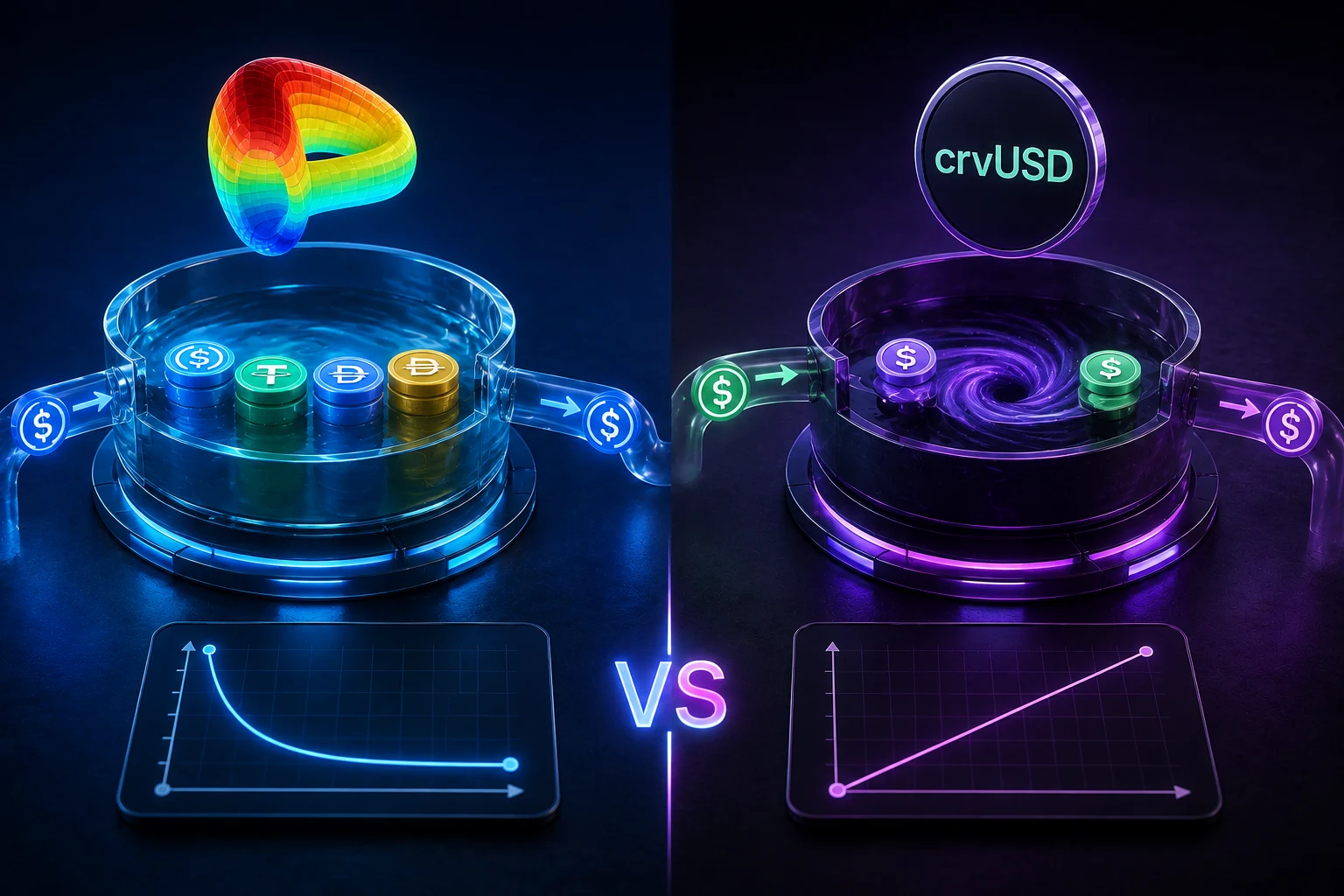
What is the difference between Curve StableSwap and Frax AMMs?
Curve StableSwap is an automated market maker, or AMM, built for assets expected to trade at nearly the same value. Common examples include USDC and USDT, or different wrapped versions of ETH. Its core idea is simple: make swaps very cheap when pool assets remain close to their intended exchange rate, while still providing a mechanism for prices to move when that assumption breaks.
Frax AMMs describe a broader set of liquidity designs associated with the Frax ecosystem. Depending on the pool and deployment, these may combine conventional AMM logic, time-weighted execution, incentives, protocol-controlled liquidity, or a convex-curve AMM approach. A convex curve changes how quickly marginal prices move as reserves shift. The important practical point is that there is no single Frax risk profile. The pool contract, collateral, incentives, and redemption mechanics matter.
Both approaches try to improve stablecoin trading compared with a basic constant-product pool, where the reserve product stays constant and slippage rises quickly. Neither design can make a weak stablecoin safe. An AMM can organize liquidity and discover a market price, but it cannot guarantee that an issuer has reserves, that redemptions will work, or that a peg will return.
How Curve’s StableSwap invariant works in plain English
Curve’s StableSwap invariant blends two familiar pricing ideas. A constant-sum curve would treat one USDC as one USDT indefinitely, producing almost no slippage but allowing a trader to drain the pool’s stronger asset if one token loses value. A constant-product curve, used by early AMMs, protects the pool by making the last units expensive, but can impose noticeable slippage even when both assets are genuinely worth about one dollar.
The amplification coefficient, commonly called A, controls where Curve sits between those models. Higher amplification makes the curve flatter near the target price. In effect, the pool behaves more like a deep fixed-rate market when balances are fairly even. As the pool becomes imbalanced, the curve increasingly behaves like a protective constant-product market and the price moves sharply.
Consider a simplified pool holding $10 million of USDC and $10 million of USDT. If a trader sells $100,000 of USDC for USDT while both are trusted near $1, a highly amplified Curve pool can return close to $100,000 of USDT before fees. A basic constant-product pool with the same reserves would usually quote a somewhat worse price. The exact result depends on A, fees, balances, token decimals, and the pool implementation, so a live quote is more useful than a hand calculation.
That efficiency is not a promise of a one-to-one price. If markets begin valuing USDC at $0.90, arbitrage traders can exchange USDC into the pool for USDT until the pool price reflects the outside market. The invariant then does what it was designed to do: it makes removing the remaining USDT progressively more expensive. By that stage, however, LPs may hold substantially more USDC and much less USDT.
The central risk: amplification can punish stablecoin LPs during a depeg
Amplification is a double-edged sword. It concentrates usable liquidity near the peg, which is valuable for ordinary payments, trading, and rebalancing. But it also means a pool can offer attractive prices for a failing stablecoin during the early part of a depeg. Arbitrageurs are not necessarily exploiting a bug. They are responding to the pool’s stated pricing rule and moving risk from themselves to passive LPs.
A pool with USDT, USDC, and FRAX may look diversified because it contains three names, yet a market shock can turn it into a concentrated position in the asset investors most want to exit. This is often called adverse selection. Liquidity providers earn fees when traders need liquidity, but the most urgent flow may arrive precisely when the pool’s model is least suited to taking more of one asset.
History gives this risk a concrete shape. TerraUSD collapsed in 2022 after its stabilization mechanism failed, with the related LUNA token falling dramatically as confidence and liquidity vanished. Other stablecoins have traded below their targets after banking, collateral, redemption, or regulatory concerns. A stablecoin pool may not lose every dollar in each event, but its LP token can suffer both from the depegged inventory it receives and from reduced confidence in the pool itself.
Smart-contract and governance risks sit alongside market risk. Curve has experienced exploits involving vulnerable pool implementations, and DeFi incidents frequently reveal that audited code is not the same as insured code. Admin keys, upgrade permissions, price-oracle dependencies, reward emissions, and bridges can each create failure paths. Before depositing, readers should determine which contract holds funds and whether the pool is immutable, upgradeable, or dependent on external systems.
How Frax’s convex-curve AMM approach changes the tradeoff
A convex-curve AMM generally makes its pricing response vary across the reserve range rather than relying on one simple constant-product shape. The curve can be designed to provide deep liquidity in a preferred zone while becoming more defensive outside it. In a stablecoin context, that can help target capital where a protocol expects most trading to occur, but it does not remove the need to decide which assets deserve that confidence.
Frax-related liquidity systems have also emphasized mechanisms beyond the swap curve itself, including liquidity incentives and, in some deployments, time-weighted trading features. A time-weighted AMM lets a large order execute gradually over a defined period rather than forcing all price impact into one block. This can reduce immediate execution impact for a scheduled trade, but it introduces timing, execution, and contract-design considerations that are different from a standard spot swap.
The comparison with Curve is therefore not simply fixed math versus better math. Curve’s StableSwap invariant makes a clear near-peg assumption and exposes its consequences. Frax’s convex-curve AMM framing can make liquidity allocation more flexible, but flexibility can add parameters, governance choices, and harder-to-evaluate incentives. A pool that appears resilient in a dashboard may rely on emissions that can change or on protocol actions that are discretionary.
FRAX itself also needs separate analysis from the AMM that trades it. Its collateral structure, redemption pathways, governance, and current protocol configuration affect its market behavior. Do not infer stablecoin safety from a low-slippage pool, a familiar brand, or a high displayed APY. Those observations describe current conditions, not guaranteed exit liquidity under stress.
Peg-keeping versus LP yield is the real economic tradeoff
Stablecoin liquidity pools help pegs function by giving users a venue to exchange tokens when supply and demand differ. If FRAX trades slightly below its intended value, buyers and arbitrageurs may purchase it in a pool, while protocol redemption or collateral mechanisms may create further incentives to close the gap. The pool supports market plumbing, but it is not the peg mechanism by itself.
LPs provide that plumbing by accepting changing inventory. Their return can include swap fees, CRV or FRAX-related incentives, and other reward tokens. The displayed APR or APY may look high because it annualizes a short period of rewards. It may not subtract token price declines, gas, withdrawal fees, slippage, tax effects, dilution from new emissions, or the loss from ending up overweight in a depegging asset.
Curve’s crvUSD design influence is relevant here because it highlights a different way to think about stablecoin stability. crvUSD uses a lending mechanism designed to adjust collateral sales and purchases across price bands rather than relying solely on a liquidity pool to absorb all pressure. That does not make crvUSD risk-free. It does show why traders should separate a stablecoin’s issuance and liquidation design from the AMM curve used for secondary-market swaps.
For an LP, the key question is not whether fees are currently larger than zero. It is whether the fees plausibly compensate for taking the unwanted side of a stressed market. That answer cannot be known in advance. It depends on the assets, pool depth, amplification setting, redemption credibility, correlation of collateral, and the severity of a future liquidity event.
Why pool data, bots, and LLM-driven manipulation need skepticism
On-chain data is public, but interpreting it is difficult. A pool can show high volume because of genuine demand, arbitrage, incentive farming, or circular activity. Liquidity can disappear quickly if large LPs withdraw. A quoted spot price can differ from the price achievable for a meaningful trade, especially after accounting for price impact and transaction costs.
LLM-driven pool manipulation risks add a newer layer. Automated systems using large language models may summarize social posts, respond to headlines, generate trading prompts, or coordinate attention around an alleged depeg or exploit. They can repeat false claims at scale, misread technical disclosures, or react to misleading screenshots. An LLM cannot verify reserves, confirm a contract address, or establish that a viral claim is true merely because many accounts repeat it.
Manipulators may exploit low-liquidity pools through temporary trades, misleading dashboard screenshots, fake governance proposals, or rumors that encourage hurried withdrawals. In more technical attacks, a short-lived price movement may be used to influence a weak oracle, trigger liquidations, or create a deceptive narrative around a token. The presence of AI-generated commentary makes source checking more important, not less.
Useful checks include comparing the official contract address with a block explorer, reading current governance documentation, reviewing stablecoin redemption terms, and checking whether volume persists across time. Cross-linking a pool’s claims with how stablecoin depegs work and impermanent loss in DeFi can reveal risks that an APY page leaves out.
What traders and liquidity providers should do differently
Traders should treat Curve and Frax pools as execution venues, not as assurances about the assets being exchanged. Check the actual route, fee tier, expected output, and price impact before submitting a transaction. For a large order, compare several venues and consider whether splitting the trade or using a time-weighted method fits the situation. A better displayed rate is not automatically better after failed transactions, delays, and changing market conditions.
LPs should begin with the downside scenario. Ask what assets would remain in the wallet if one stablecoin trades materially below its target, if rewards fall to zero, or if withdrawals become crowded. Review the amplification setting for Curve pools, the curve and liquidity rules for Frax pools, reward-token exposure, admin controls, and whether the pool contains bridged or yield-bearing versions of a token.
Small test transactions can reduce operational mistakes, but they do not test a crisis. Avoid depositing money needed for near-term bills or emergency reserves. Diversification across pools is not complete protection if the pools share the same stablecoin, bridge, collateral issuer, or market narrative. This is education, not financial advice, and individual risk capacity matters more than a headline yield.
Read stablecoin AMM signals critically with Zippfeed
Curve StableSwap and Frax AMM conditions can change quickly as depeg rumors, governance votes, exploit reports, redemption updates, and liquidity shifts reach the market. Tracking every relevant source manually is difficult and often leads to reacting to noise. Zippfeed surfaces headlines around CRV, FRAX, stablecoins, and DeFi with bullish, neutral, or bearish sentiment scoring plus an importance rating, helping readers separate a routine update from a development worth investigating before acting.
Sentiment is not proof and an importance score is not a trading signal. Use them as a starting point for research, then verify primary sources, on-chain data, and the exact pool mechanics. That process is especially useful when a dramatic claim appears to explain a price move but the underlying facts remain incomplete.


 CoinDesk