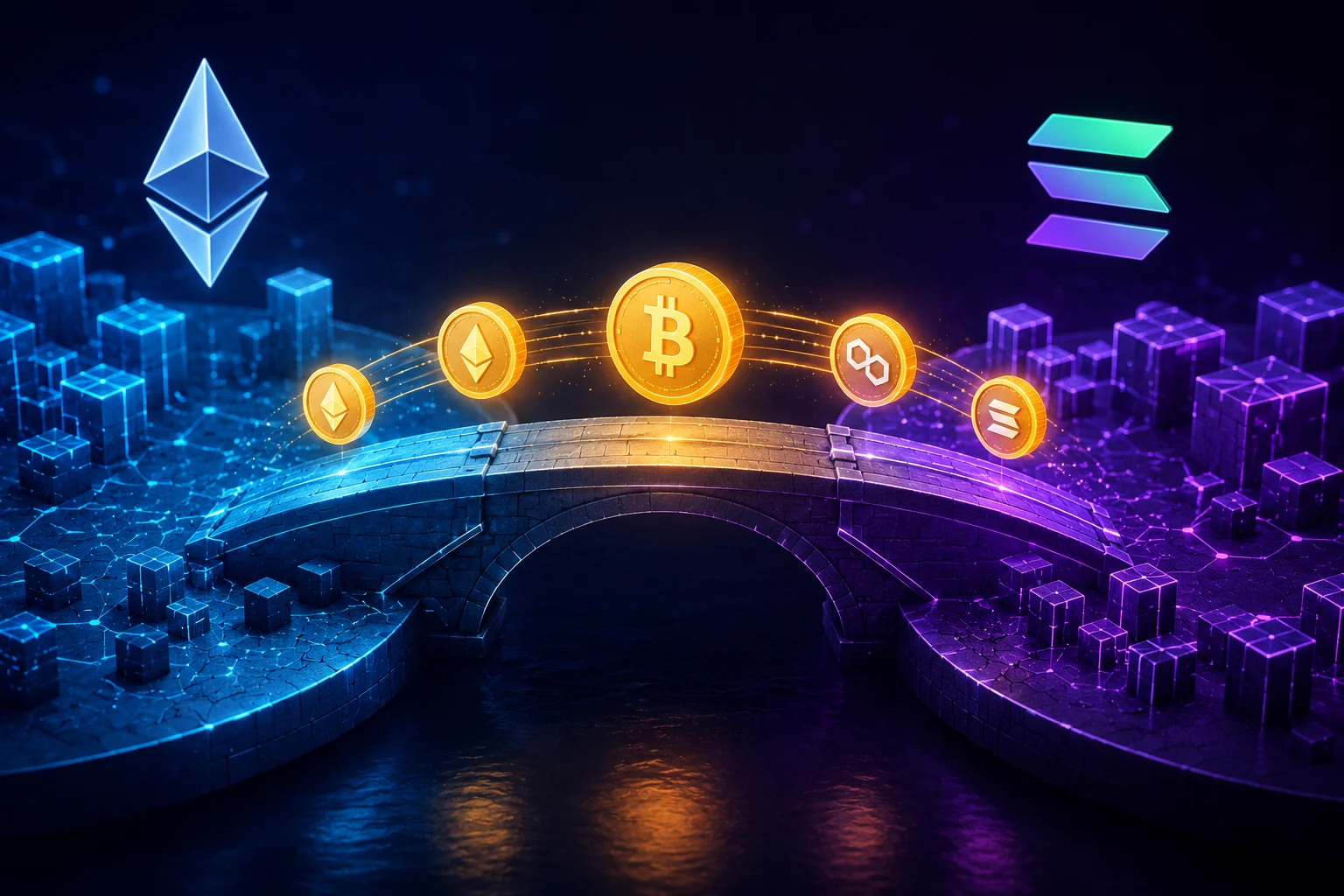
Step 1: Understand what a bridge actually does
Different blockchains are different systems — Ethereum can't directly read what's on Solana, and vice versa. A bridge sits between them. The simplest model: you send tokens to a bridge contract on chain A, the bridge locks them, and an equivalent amount appears on chain B in your wallet. To reverse, you burn the chain-B tokens and the chain-A bridge releases the original.
Variations on this exist (liquidity-based bridges, optimistic bridges, intent-based bridges) but the core is always: trust the bridge to honor its accounting. That trust is the risk.
Step 2: Pick the right kind of asset on the destination
When you bridge USDC from Ethereum to a Layer 2, you might end up with:
- Native USDC — the same asset, issued natively on the destination chain by Circle. Redeemable 1:1 with the original.
- Wrapped USDC (USDC.e, USDC.b, etc.) — a bridge-issued version that's a claim on the original sitting in the bridge contract.
Native is better when available. Wrapped depends on the bridge staying solvent — if the bridge is exploited, the wrapped version can decouple from the original and become worth less or worthless. Always check which version you're receiving and prefer native when the destination supports it.
Step 3: Choose a bridge you can trust
Bridges fall into a few categories:
- Official bridges. Each major chain has an official bridge to/from Ethereum (Arbitrum Bridge, Optimism Gateway, Base Bridge, zkSync Bridge). These are usually the safest for moving to/from that specific chain, slower for moving back to Ethereum.
- Aggregators. Sites like Across, Hop, Stargate, Synapse, deBridge offer fast multi-chain bridging via liquidity pools. They're convenient and fast but carry more counterparty risk than the canonical chain bridges.
- Anything you've never heard of. Avoid. Bridges are not a place to discover.
Stick to bridges with established audits, public team, sustained TVL, and a track record of not being exploited. A bridge that's only been live for a month is asking too much trust.
Step 4: Always send a test transaction first
Before bridging a large amount, send a small fraction — $5-50 — through the same flow first. Confirm it arrives in the right wallet on the right chain, in the right asset. Yes, you'll pay gas twice. That's cheap insurance compared to discovering your $5,000 bridge transfer went to a wrapped asset on a chain that doesn't have it, or to an address you can't sign for.
Many bridge losses are not exploits — they're users sending native tokens to a contract address on the wrong chain, or selecting the wrong destination network, and losing access permanently. A test transaction catches these.
Step 5: Watch for the obvious red flags
- Off-chain promises. If a Discord admin DMs you a special bridge link, it's a phishing site.
- Bridge fees that look too good. A bridge offering you 1% better rates than competitors is either subsidizing aggressively (temporary) or hiding something (permanent).
- No clear destination address. The interface should clearly show which address on which chain will receive what asset. If it's vague, stop.
- Approve once, lose forever. The token-approval step is where many exploits live. Read what you're approving — never sign an unlimited approval to a bridge you haven't researched.
Step 6: Account for the time and gas on both sides
Bridges aren't instant. Official rollup bridges back to Ethereum can take days (optimistic rollups have a 7-day challenge period). Aggregators that use liquidity pools are usually minutes to an hour. Whichever you pick, plan around the timing — don't bridge five minutes before you need the funds.
You also pay gas on both chains — the source chain to initiate, the destination chain to receive (or sometimes to claim manually). Make sure you have a small amount of the destination chain's native token already, or many bridges include a small swap to bootstrap your gas there.
Why bridges get hacked so often
The pattern in major bridge hacks (Ronin, Wormhole, Nomad, Harmony, Multichain): a bridge holds enormous pooled value on one or both sides, and the security of the multisig or validator set that authorizes transfers is the single point of failure. Compromise that signer set, and the bridge's locked assets walk out. Smart contract bugs, social engineering of operators, and key compromises have all been root causes.
The lesson: a bridge is only as safe as its weakest layer. "Audited" is necessary but not sufficient. Audited bridges have been exploited. Treat bridges as a transient piece of infrastructure to pass through — not a place to leave wrapped assets long-term.
Common mistakes
- Bridging to a chain your wallet doesn't support yet. Add the network first, verify the contract address, then bridge.
- Sending tokens to an exchange address on the wrong chain. Exchange deposit addresses are chain-specific; an ETH deposit on the wrong network is usually unrecoverable.
- Holding wrapped assets long-term. Convert to native on arrival when possible.
- Bridging during an active exploit. News of a bridge hack travels fast; if you see chatter, stop the transfer.
The safety checklist
- Am I on the official bridge URL?
- Is the destination chain right and is my wallet ready for it?
- Is the receiving asset native or wrapped?
- Did I send a test transfer first?
- Do I have destination-chain gas?
- Can I afford to lose what I'm sending?
Read bridge news before the market does
Bridge exploits don't give warning. The first sign is often a tweet from a security researcher, then a flood of withdrawals, then headlines. Zippfeed tracks bridge and DeFi security news across multiple sources with sentiment and importance scoring, so when something starts to break you see it before the bridge front-end shows a banner. The difference between bridging an hour earlier and an hour later can be the difference between safe and gone.