What wallet labels actually are, and why they exist
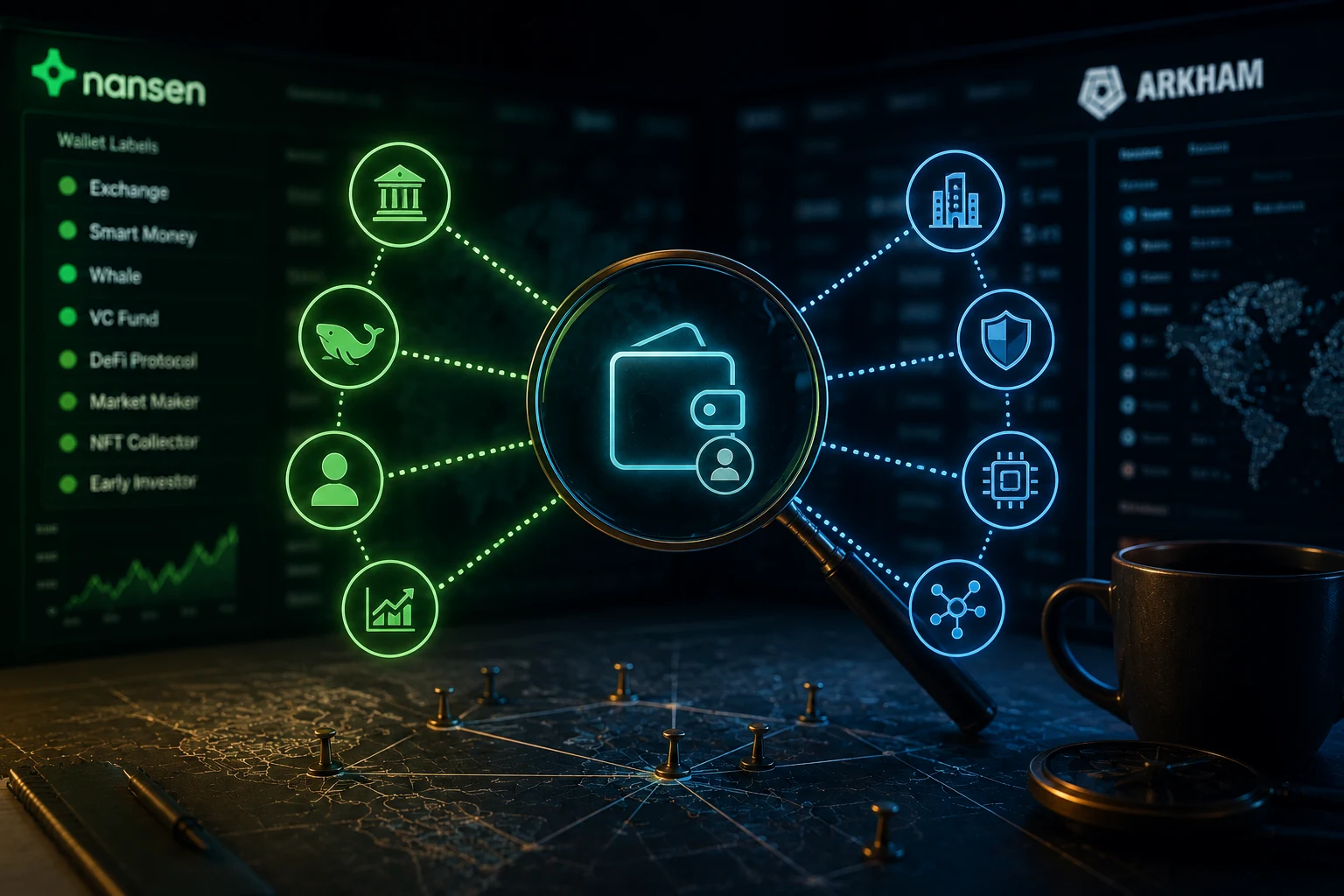
Every transaction on a public blockchain like Bitcoin, Ethereum, or Solana is permanently visible. The addresses themselves, though, are just long strings of letters and numbers. There is no field that says 'this is Binance' or 'this is Vitalik Buterin.' Wallet labels fill that gap. A label is a human-readable name attached to an address so traders can recognize who is doing what on-chain.
Two platforms have become the default home for these tags. Nansen started as an analytics suite built around labeled wallets and grew a heavy retail following during the 2021 cycle. Arkham Intelligence later launched a marketplace that pays users to attribute addresses, blending crowdsourced tags with its own algorithmic clustering. Both products promise to answer the same question: 'who is actually moving this money?'
The catch is that the question is harder than it looks. Public blockchains were designed for transparency of flows, not transparency of identity. Labels are an attempt to reconstruct identity from behavior, and that reconstruction is always incomplete. Treat every label you see, whether it says 'Jump Crypto,' 'Alameda,' or 'Smart Money 0xA1...,' as a hypothesis with a confidence level attached, not a fact.
Risks: where labeled dashboards mislead traders
The single biggest risk is treating a label as proof. Screenshots of labeled dashboards circulate on X (formerly Twitter) and Telegram every day, and a meaningful share of them are either out of date, mislabeled, or outright fabricated. A few failure modes show up over and over.
Stale tags. Labels get assigned once and rarely updated. Funds rotate to new addresses, treasury wallets get migrated, and the old label sits there for months. A wallet tagged 'Alameda Research' in 2021 may now belong to a completely unrelated entity, or to nobody at all.
Impersonation clusters. Bad actors deliberately fund and use addresses that share a name string with a famous entity. They rely on dashboards that cluster by name prefix or heuristic similarity to fold their address into an existing 'smart money' bucket. The copy-trader sees a familiar tag, the asset pumps on the rumor, and the impersonator exits.
Shared addresses. A single address can serve many masters. Exchange hot wallets, multisig signers, and protocol treasuries are routinely used by teams, market makers, and depositors. A label may be technically correct for one signer while the trade you are looking at came from a different party entirely.
The delay problem. Even when a label is accurate and current, you are seeing the trade after it has been mined into a block. By the time the dashboard indexes it, the price has often already moved. You are not 'copying smart money,' you are buying the trade smart money made twenty minutes ago, at a worse price.
How labels are actually sourced
Understanding where a label comes from is the only way to calibrate how much trust to put in it. There are three broad sourcing methods, and they have very different reliability profiles.
Verified entity submissions. Exchanges, funds, and protocols can claim addresses directly through Nansen or Arkham. These are the most reliable labels you will see, because the entity has an incentive to keep its address book accurate. The trade-off is coverage: most DeFi wallets, treasury multisigs, and OTC desks never bother to claim their addresses, so the verified set is small relative to the address universe.
User-submitted tags with crowdsourced voting. Arkham's marketplace pays users in its native token (ARK) to attach an entity name to an address, and other users can upvote or downvote the attribution. The quality varies wildly. A well-researched attribution with a public signature trail gets rewarded; a lazy guess based on a single transaction to a known exchange gets ignored. If you are reading an Arkham tag, check the attribution history and how much ARK is staked behind it before you trust it.
Heuristic clustering. Both Nansen and Arkham run algorithms that group addresses by behavior: common counterparties, gas payment patterns, timing correlations, and deposit patterns to known services. A 'Smart Wallet' or 'Fund' bucket on Nansen is usually a heuristic cluster, not a named entity. These clusters can be useful for surfacing broad trends ('funds have been net buyers of ETH this week'), but they are a poor basis for a single trade decision.
A practical rule of thumb: if you cannot find an official statement from the entity claiming the address, assume the label is at best a strong guess.
Paid dashboards vs free block explorers
Nansen and Arkham both charge monthly subscriptions, with Nansen running higher at the time of writing. Free alternatives cover most of what a curious trader actually needs, with more manual effort.
Etherscan and Solscan are the default free block explorers for Ethereum and Solana respectively. They will not hand you a 'smart money' tag, but they will show you the full transaction history of any address, its counterparties, and the tokens it has moved. For a one-off check ('is this wallet really the Wintermute hot wallet?'), Etherscan is faster and more reliable than guessing from a label.
Public dashboards like Dune (community-built SQL queries on indexed blockchain data) and DefiLlama (TVL, fees, treasury tracking across protocols) cover a lot of the same ground that Nansen does, with the limitation that someone has to build the dashboard you want before you can query it.
The honest tradeoff is effort. Paid dashboards save time by pre-labeling and pre-aggregating. Free tools save money but require you to do the labeling yourself, or at least to verify the labels you started with. For most retail traders, a hybrid approach works best: use a free explorer to confirm the move you saw on X, and treat the paid dashboard as an optional subscription rather than a prerequisite for safety.
The 'copy-trade-the-smart-money' trap
The pitch is seductive. A fund called 'Smart Money 0xA1...' buys a small-cap token at 3 AM. The label is verified, the dashboard is reputable, and you can see the wallet is up several hundred percent year to date. You copy the trade. The token dumps within hours. You blame the market.
Three structural reasons make this underperform.
Slippage and execution lag. By the time you see the trade, set up the swap, sign the transaction, and wait for inclusion, the price has typically moved. For liquid assets like ETH or SOL, this lag costs a fraction of a percent. For the small-cap tokens that 'smart money' labels usually trade, slippage can be 2 to 5 percent per side. You are buying a worse version of their fill.
Round-trip costs. Swap fees, gas, and priority tips on Ethereum mainnet (L2s are cheaper) add up. A trade that nets the labeled wallet 3 percent can net you zero after costs, especially if you are also paying the platform's copy-trading fee.
Survivorship bias in the label itself. The reason that wallet looks brilliant on the dashboard is that you are seeing its closed winners. The hundreds of failed experiments, exited positions, and abandoned holdings have been rotated out of the address set. You are copying the highlight reel.
The exit problem. Even when you copy the entry correctly, you do not have the labeled wallet's exit plan. The fund may be planning to hold through three more drawdowns; you may need the money next week. 'Copy-trade' services that promise to mirror exits usually lag the labeled wallet by minutes to hours, which is enough for the price to gap.
This is not a moral claim about copy-trading. It is a structural one. The expected return of copying a labeled wallet, after realistic assumptions about fees, slippage, and lag, is meaningfully below the return of the wallet you are copying. Academic studies of 'smart money' indices in crypto have consistently found high gross returns but middling net returns once costs are included.
How to verify a labeled move yourself
The single most valuable skill a trader can build around on-chain data is independent verification. When you see a labeled screenshot, walk through these steps before you act.
Step 1. Find the address. Most labeled screenshots include the address or a transaction hash. If only the label is shown, ask for the address in replies. Anyone unwilling to share the address is showing you a story, not a signal.
Step 2. Open it in a block explorer. Paste the address into Etherscan, Solscan, or the explorer for whatever chain the trade is on. Look at the recent transaction history. Confirm the trade actually happened on the address shown, not just on a similarly named cluster.
Step 3. Check the counterparty. If the labeled wallet received tokens from or sent tokens to a known exchange, a known protocol, or another labeled wallet, that adds context. If the counterparty is an unverified address with no history, treat the move as more suspicious, not less.
Step 4. Look at the broader history. Does this address trade this token often, or is this a one-off? Does the size of the trade fit the wallet's usual activity, or is it an outlier? A 'smart money' wallet that suddenly buys a micro-cap with 20 percent of its treasury is showing a different signal than one that adds to a long-standing position.
Step 5. Check the timing on a price chart. Open the token's chart on a public site and see what the price did after the labeled trade. If the price dumped immediately, you are looking at an exit, not an entry, and the screenshot has it backwards.
This five-step check takes five to ten minutes. It is the difference between acting on a hypothesis and acting on a fact.
How to follow on-chain flow the smart way
On-chain data is one of crypto's genuine edges over traditional markets, but only if you use it with the right frame. Wallet labels are a starting hypothesis, not a verdict, and the value of a labeled dashboard is in the questions it suggests, not the trades it implies. The traders who get the most out of Nansen, Arkham, and their free alternatives treat labels the way a journalist treats a source: worth following up on, never worth quoting verbatim.
On-chain flow moves fast, and the news around it moves faster. Tracking the right wallet cluster, the right token movement, and the right context manually is a losing game, especially when most of the labeled screenshots circulating online are either stale, misleading, or staged. Zippfeed surfaces on-chain headlines and crypto news with sentiment scoring (bullish, neutral, or bearish) and an importance rating, so you can separate signal from noise and decide for yourself which labeled moves are worth a second look.