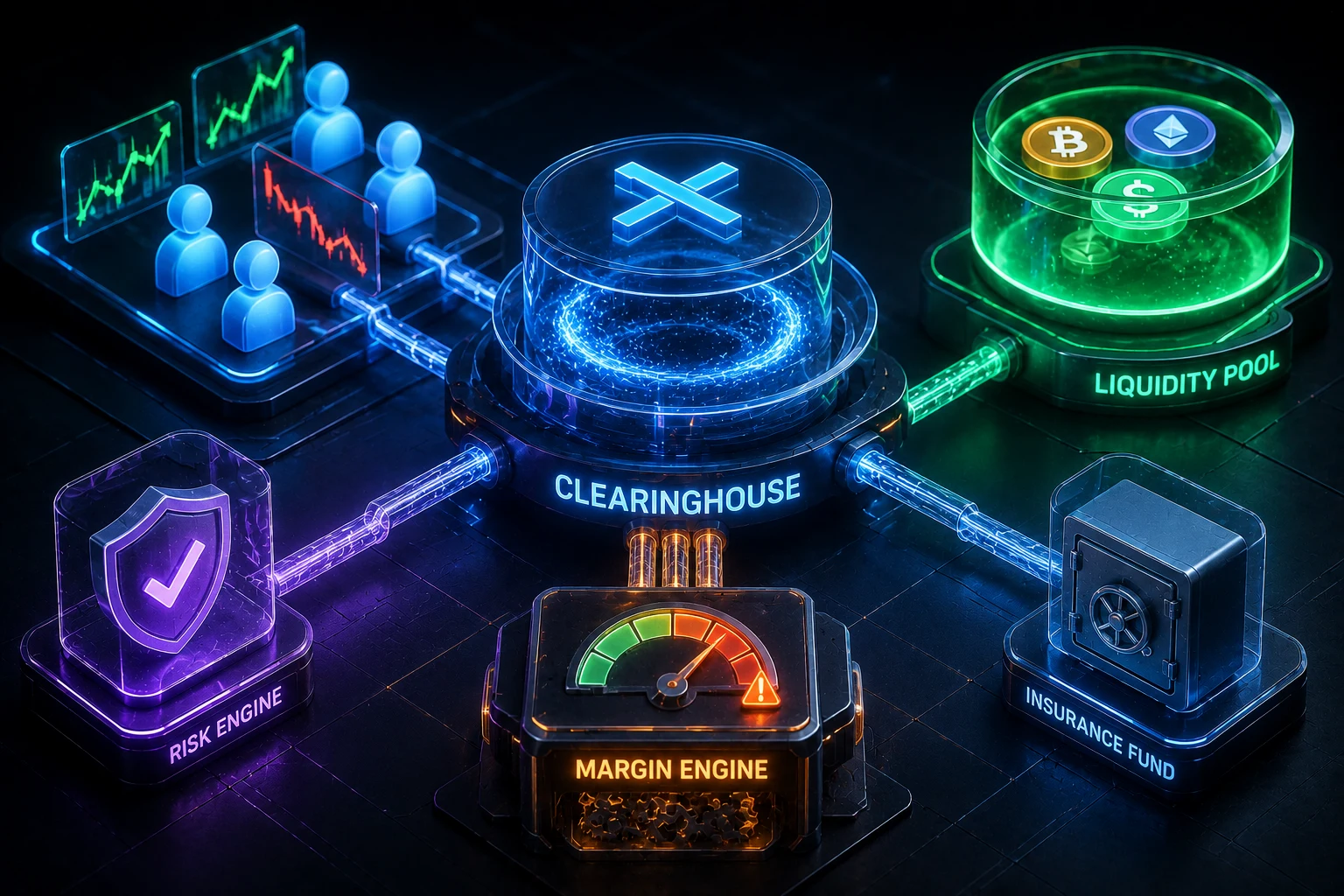
What are these three perpetual DEXs actually trying to do?
Perpetual futures, or perps, are derivative contracts that track an asset's price without an expiry date. They let traders open leveraged long or short positions using crypto as collateral, paying or receiving periodic funding payments to keep contract prices tethered to the underlying. A perpetual DEX (decentralized exchange) tries to deliver this same instrument without a traditional intermediary like Binance or Bybit doing the matching in a black box.
Hyperliquid, Apex, and Vertex all sit in the "on-chain perps" category, but they each describe themselves differently. Hyperliquid calls itself a "high-performance L1 built for finance" and runs its own blockchain with HyperBFT consensus, where every order, cancel, fill, and liquidation settles on-chain. Apex positions itself as a "self-custodial perp exchange" that combines a centralized order matcher with on-chain custody and settlement through its Layer-2 rollup architecture. Vertex started as an aggregated DEX and has shifted toward offering a hybrid order-book plus AMM (Automated Market Maker, a pool-based pricing model) design where multiple liquidity sources route through one router.
What the three have in common is the goal: self-custodial margin trading with no human gatekeeper signing off on withdrawals. What they diverge on is the path: how orders meet, who keeps them honest, who pays for liquidations, and what happens when something breaks. The rest of this article walks through those differences.
How does each venue's matching engine actually work?
The matching engine is the heart of any perp venue, whether centralized or on-chain. It decides who gets filled at what price. Hyperliquid, Apex, and Vertex take three distinct routes.
Hyperliquid: fully on-chain CLOB on a custom L1
Hyperliquid runs a CLOB (Central Limit Order Book, the same structure that Binance, Coinbase, and Nasdaq use) directly on its own blockchain. Orders, cancels, fills, and liquidations are all transactions on Hyperliquid's L1, which means they inherit the chain's block time and validator set. The L1 uses HyperBFT, a customized variant of HotStuff-style consensus tuned for sub-second finality, and the chain currently produces blocks roughly every 0.2 to 0.4 seconds with a stated throughput comfortably above 100,000 orders per second in synthetic benchmark conditions.
This design has real consequences. Latency-sensitive strategies like market-making and cross-exchange arbitrage can run from colocated servers close to the chain's validator set, which is why Hyperliquid has attracted professional market makers. Self-trade prevention, the practice of not letting your own buy and sell orders fill against each other and skim rebate fees, is built into the matcher at the chain level. On the negative side, the matcher inherits whatever the L1 does under stress, including validator downtime, sequencer hiccups, and mempool-level MEV (Maximal Extractable Value, meaning the profit block producers can extract by reordering transactions).
Apex: off-chain matching, on-chain settlement
Apex uses a different architecture. Its order book runs on an off-chain matching engine that signs user orders cryptographically and then settles the resulting trades on-chain through an Optimism-based rollup. Trades feel fast because the matching happens in a familiar centralized-style engine, and gas costs are compressed because Apex batches settlement to its rollup.
The trade-off is trust and operational risk. Users are exposed to the matcher behaving honestly, the Oracle network returning clean prices, and the rollup producing valid state roots. Apex addresses this with cryptographic attestations between the matcher and its settlement contract and by publishing a proof of reserves plus a Merkle-tree-based reserve attestation that anyone can verify. Even so, the matcher itself is a privileged component. If it were compromised, an attacker could manipulate who gets filled and at what price before on-chain settlement, and the time window can be tight.
Vertex: unified router over order book and AMM
Vertex takes a third path. Its front end surfaces a single unified book, but liquidity comes from multiple sources: a native on-chain order book and an integrated AMM that acts as a passive market maker on the other side of every trade. The protocol's router picks the best execution path at any moment, splitting orders between the book and the AMM as conditions warrant.
The advantage is continuous liquidity, especially on long-tail pairs where a pure order book might run thin. The disadvantage is that the AMM side carries inventory risk. When the AMM ends up on the wrong side of a fast move, that loss is socialized, historically through an insurance fund, ADL tiers, or both. Vertex also offers a quote-token model that uses USDC plus its own quote asset depending on the market, which spreads liquidity routing decisions across more contracts.
How are funding rates calculated, and why does it matter?
Funding is the periodic payment between longs and shorts that keeps a perp's mark price (the reference price used for PnL and liquidation purposes) lined up with the underlying spot price. Funding is also one of the biggest costs for traders over a leveraged position's lifetime, so small differences in funding-rate calculation can compound into large PnL swings.
Hyperliquid calculates funding as the average of an order-book mid-price and an oracle-driven mark price, blended over an eight-hour cycle by default but with tighter cycles on volatile pairs. The exact formula is documented in Hyperliquid's Hyperps whitepaper, and the platform publishes all current funding rates on-chain, which means anyone can verify what was charged without trusting a centralized ledger. Funding payments are settled in the same transactions as the trades themselves, removing separate settlement windows.
Apex computes funding primarily from oracle mid-prices, blended across Pyth and Switchboard feeds, with an eight-hour cadence and configurable caps. The choice of oracle-driven funding means Apex does not need to publish order-book state on-chain to compute the mark price. It does, however, make funding quality depend on the freshness and accuracy of the underlying Pyth and Switchboard feeds. If an oracle stalls or returns a stale price, funding can drift away from reality for a window until the feed recovers.
Vertex is the only one of the three that explicitly advertises zero funding on a wide range of pairs. Where funding is charged, Vertex uses an oracle-based mark with a one-hour funding cycle on certain markets. The zero-funding pitch is a real edge for swing traders, because funding can be the single largest cost on a leveraged position held for weeks. The catch is that without funding, the venue has to rely on its AMM inventory, ADL, and tighter spreads to keep the book consistent with spot. That has been a stress point during volatile episodes.
What is the real risk surface: liquidation engines, insurance funds, and oracles?
This is where these venues have actually hurt users. Perp DEXs do not fail in the matching engine, by and large. They fail during liquidation events when positions cannot be closed cleanly, oracles return bad prices, or insurance funds prove too small to absorb bad debt.
Liquidation engine differences
Hyperliquid's liquidation engine is two-sided: a liquidator bot network competes to close underwater positions, and the HLP vault steps in when no external bidder wants the position. A successful external liquidation pays a fixed fee plus a percentage penalty from the liquidated user to the liquidator. When a position cannot be absorbed externally, the HLP vault takes over, which means losses are absorbed by the HLP depositors rather than the trader being liquidated directly. This is a "book the loss" approach, and Hyperliquid's HLP TVL (Total Value Locked, meaning the value of assets deposited in the vault) has fluctuated notably as it has absorbed and recouped such positions.
Apex relies on oracle-triggered liquidations. When an account's margin ratio (the user's collateral value divided by their position's notional value, expressed as a percentage) drops below the maintenance threshold, the position can be taken over by a liquidator or absorbed by the protocol's insurance pool. Apex does not run a passive vault like HLP, so liquidation penalties are the primary mechanism for keeping accounts whole during volatile markets.
Vertex runs liquidations through a combination of a liquidator network plus a chain of insurance funds. Vertex has historically used ADL as the last resort. When ADL activates, profitable opposing positions are forcibly closed against the loser's liquidating position at the mark price. ADL is unpopular with profitable traders because it means your winning trade can be closed without your consent.
Oracle dependencies
Hyperliquid sources its mark price using its own precompile oracle combined with aggregated CEX (centralized exchange) feeds run by its validators. The chain does not natively use Chainlink for spot feeds, although some integrations sit alongside it. This design means the venue controls its own price discovery, which is a feature during normal markets and a risk during episodes when CEX prices diverge from each other.
Apex uses Pyth and Switchboard as its primary oracle stack. Both are pull-based: an on-chain contract requests an update, signed by data publishers, and the latest aggregate is consumed on demand. Pull oracles reduce idle gas costs but introduce a step where stale prices can persist if no one requests an update fast enough.
Vertex uses a mix of Pyth and internal AMM-based pricing. Long-tail pairs sometimes lean on AMM inventory as the price reference, which can flag during stress because an AMM price is only as trustworthy as the pool's last swap.
Insurance funds and ADL
All three maintain an insurance fund for absorbing bad debt when liquidators cannot close positions at or better than the bankruptcy price. The size of the fund, the publishable track record of how much it has paid out, and the rules for topping it up are the real reputation markers for each venue.
What incidents have actually shaped each venue's reputation?
A repo is not just a product. It is also the scar tissue from past incidents.
Hyperliquid and the JELLY depeg (March 2025)
In late March 2025, the JELLYJELLY/USDC market on Hyperliquid suffered a coordinated depeg event in which a single large account built a massive short position on a thin, illiquid token and then dumped the spot side to manipulate the price. At its peak, the position's unrealized loss threatened to exceed the HLP vault's capacity. Hyperliquid's team intervened by delisting the JELLY market, forcing the position to close at its pre-incident mark and refunding affected counterparties from the HLP vault. The decision was praised by some as protecting users, and criticized by others as centralization by another name, because a protocol-admin key made the choice in real time. The episode became a referendum on whether perp DEXs that run their own L1 are obligated to intervene when a single trader taxes the system.
Apex and the November 2023 token-drain exploit
In November 2023, Apex suffered an exploit that drained roughly $2 million from its liquidity pools after a contract upgrade and a related access-control vulnerability. The team paused contracts, negotiated with the exploiter to recover roughly $2 million, and patched the issue. Reputation damage lingered for months, and Apex has since invested heavily in third-party audits and proof-of-reserves-style attestations.
Vertex withdrawal pauses and oracle spikes
Vertex has experienced multiple short withdrawal-pause episodes in 2023 when oracle prices moved sharply during thin-volume sessions, triggering circuit-breaker logic that locked withdrawal pathways until prices normalized. Vertex also absorbed losses from the Euler Finance exploit chain because of its integration of Euler markets, and at least part of those losses were managed through insurance-fund payouts rather than ADL.
How do fees, slippage, and trader experience actually compare?
Fees are not everything, but they are what traders feel every day. Hyperliquid charges no gas for trades on its L1, with taker fees that currently start around 0.035 percent and maker rebates that can go negative to encourage liquidity provision. Apex charges gas for its rollup settlement and runs taker fees higher than Hyperliquid's, but rebates liquidity through a VIP tier plus token-incentive program. Vertex has competed aggressively on fees, with a free-of-funding pitch and no gas fees on its integrated book in many markets.
Slippage is where the experience separates. A pure CLOB gives you the depth of the book as it stands. An AMM-hybrid book gives you continuous depth but at the cost of inventory risk that can widen spreads when the AMM is stressed. Apex's off-chain matcher offers high throughput but can front-run users on its own engine in ways a transparent on-chain CLOB cannot.
For advanced traders, the deciding factor is usually latency and the cost of self-trade prevention. Hyperliquid has invested in validating infrastructure that supports colocated market makers. Apex's matcher is faster in raw terms but exposes traders to its own routing logic. Vertex sits in the middle.
Which venue should you actually choose?
If you are a serious trader evaluating where to deploy meaningful capital, the architectural differences above should matter more than the trading pairs each venue lists. Pure on-chain CLOBs like Hyperliquid are strongest for traders who care about verifiable clearing and are willing to trust the L1's validator set. Off-chain matchers like Apex are strongest for traders who want central-exchange-class speed plus self-custody and accept some operational trust. Hybrid order-book plus AMM venues like Vertex are strongest for traders who want broad market access and the lowest funding cost, and are willing to absorb ADL and insurance-fund tail risk.
None of these venues eliminates counterparty risk. Each one redistributes it. As always with derivatives and leverage, position sizing and an honest understanding of liquidation mechanics matter more than venue choice. Nothing in this article is investment advice.
Follow Hyperliquid, Apex, and Vertex news the smart way
Hyperliquid, Apex, and Vertex all move fast, and so does the news around their funding rates, oracle upgrades, and incident reports. Tracking each venue's strategy changes, oracle migrations, and insurance-fund movements by hand is a losing game. Zippfeed's Zipp Learn library surfaces perp DEX headlines with sentiment scoring (bullish, neutral, or bearish) and an importance rating, so you can filter the noise and focus on the changes that actually affect your positions.

 Lookonchain
 WuBlockchain
 TheBlock
 CoinTelegraph
 CoinDesk