What does perp DEX vs CEX actually compare?
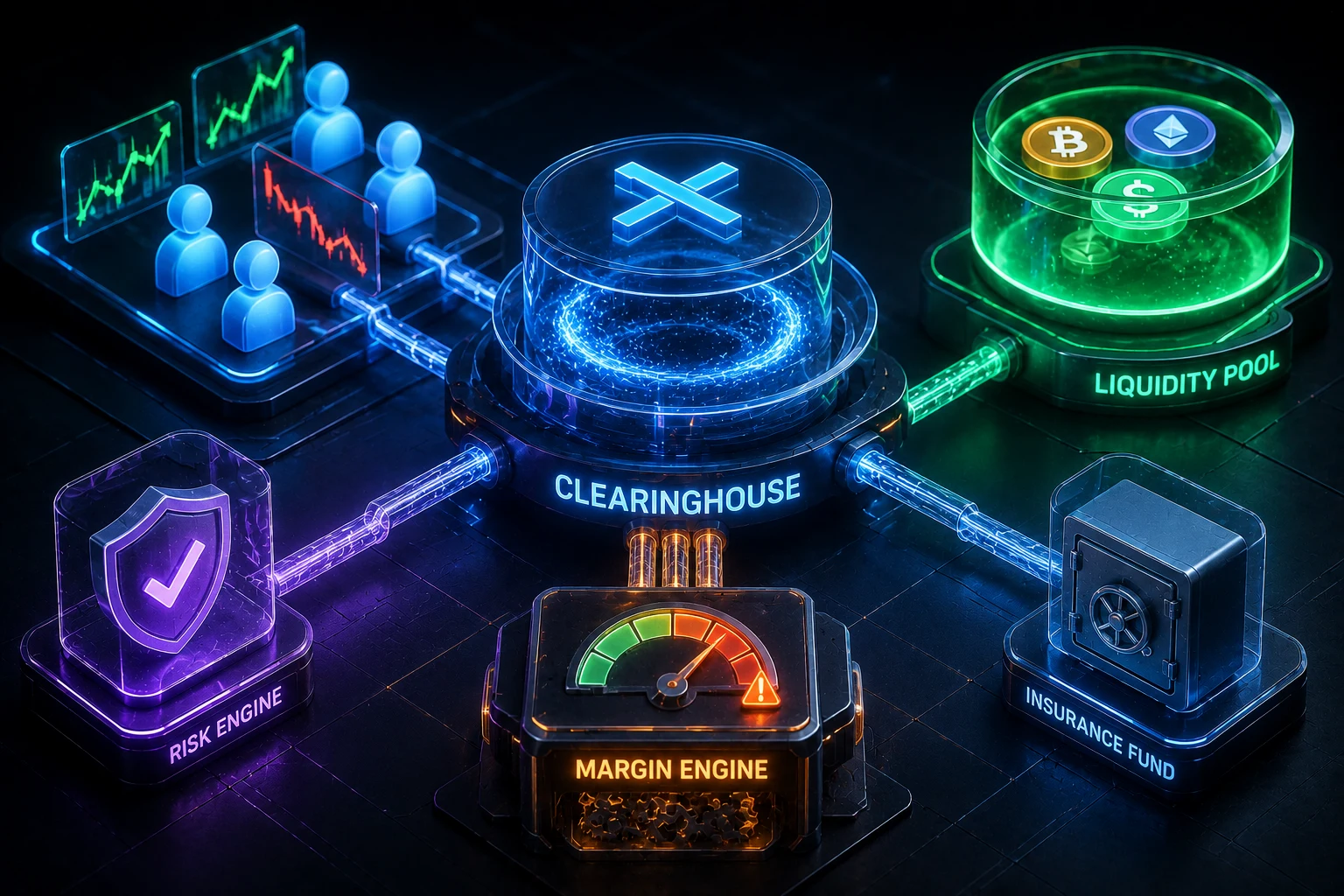
The phrase perp DEX vs CEX sounds like a simple custody debate, but perpetual futures have several separate risk layers. A centralized exchange, or CEX, usually holds your collateral, runs the matching and liquidation systems, and controls access to its platform. An on-chain perpetual exchange, often called a perp DEX, moves some of those functions into smart contracts and public blockchain transactions. The exact design varies widely, so the label alone does not tell you how safe a venue is.
A perpetual contract is a derivative that tracks an asset without an expiry date. Traders post collateral, take long or short positions, and pay or receive a funding rate that helps keep the contract near a reference price. You may trade BTC, ETH, SOL, HYPE, ASTER, or other markets without owning the underlying token. That leverage creates the possibility of losing your collateral quickly, regardless of whether the venue is centralized or on-chain.
The useful comparison is therefore not decentralized versus centralized. It is who controls the assets, who determines the price used for liquidation, who matches or takes the other side of trades, who absorbs a shortfall, and what happens when the system is congested or wrong. A venue can be transparent on-chain and still expose you to code, oracle, liquidity, or governance risks that a CEX handles differently.
For a trader moving volume from Binance or OKX to an on-chain book, the decision should be treated as a risk migration rather than a risk elimination. You may shed one failure mode and pick up another. The important question is whether the new risks are visible, tested, and acceptable for your position size and operational ability.
Which risks disappear, and which ones move?
On a CEX, your deposited assets are generally an unsecured claim on the exchange until you withdraw them, although the legal and contractual details differ by jurisdiction and platform. You rely on the company to safeguard funds, process withdrawals, maintain accurate books, and keep operating during market stress. Insolvency, fraud, a frozen account, a security breach, or a regulatory action can prevent access even if your trade idea was correct. This is the core counterparty risk.
A perp DEX can reduce the need to leave collateral with a single company. Funds may remain in a wallet or in a smart contract whose balances and rules are publicly inspectable. That does not mean the assets are automatically safe. A contract can contain a bug, an administrator can retain upgrade or pause powers, a bridge can fail, and a blockchain can become congested. If the protocol depends on a front end, sequencer, relayer, or external keeper, those dependencies can also affect your ability to trade or withdraw.
The trade is often counterparty risk for smart-contract risk. Counterparty risk comes from an institution that can mismanage funds, break a promise, or restrict your account. Smart-contract risk comes from software that may execute exactly as written while producing a harmful result, or from code that contains an exploitable mistake. Public code and audits can improve visibility, but neither proves that a contract is secure. Audits are point-in-time reviews, and they may not cover every integration, upgrade, oracle path, or economic attack.
There are also risks that both venue types share. Leverage magnifies losses, thin order books can cause slippage, funding can become expensive, and a liquidation can occur before a trader can react. A CEX may hide more of the machinery behind a user interface, while a perp DEX may expose more of it through transactions and dashboards. Visibility is useful, but it transfers more responsibility to the trader.
Why oracle manipulation is a distinct on-chain risk
An oracle is a system that supplies external data, such as an asset price, to a blockchain application. Perpetual exchanges use oracles or index calculations to determine mark prices, margin requirements, funding, and liquidation conditions. On-chain venues cannot simply assume that the last trade on their own market is a fair price, because a trader could move a thin market and trigger liquidations against other users.
Oracle design is therefore one of the most important differences in a perp DEX vs CEX comparison. A venue might use a weighted index from several spot exchanges, a decentralized data network, a time-weighted average, or a combination of its own order book and external prices. Each choice creates trade-offs. A slow average can resist a brief price attack but lag during a genuine crash. A fast index can respond quickly but may be influenced by a bad feed, a thin constituent market, or a temporary exchange outage.
Oracle manipulation risk is especially important for long-tail assets and markets with limited liquidity. An attacker may borrow or control a large amount of an asset, move a reference market, exploit a pricing discrepancy, and profit from liquidations or mispriced perpetual positions. The attack does not need to look like a traditional hack. It can be an economic attack that uses valid transactions and a weakness in the price methodology. A CEX also has pricing and liquidation risks, but the on-chain oracle path can make this attack surface more specific and composable.
Traders should look for the source of the index, the fallback feeds, the delay between price updates, the circuit breakers, and the authority that can change these settings. Ask whether the venue has handled a sharp move while its oracle remained available and representative. A high trading volume number is not evidence that the oracle is robust. Nor is a smooth chart evidence that the market could survive a disorderly event.
What Mango and JELLY teach
Mango Markets became a widely discussed example of how oracle design, market liquidity, collateral rules, and governance can interact. In 2022, an attacker used large positions and movements in the price of MNGO on Mango's markets to increase the apparent value of collateral and borrow assets. The incident led to major losses and legal and governance consequences. The details are specific to Mango, but the broader lesson is general: a public market price can still be an unsafe basis for credit if the market is too easy to move.
JELLY, a thin and volatile token market on Hyperliquid, became another important stress example in 2025. A trader reportedly built a position that created a severe pricing and liquidation problem, after which the venue took emergency action and delisted the market. Accounts and the platform disputed aspects of the event and its resolution, so traders should not reduce it to a simple story of either attacker or exchange fault. The episode showed that even a prominent on-chain venue can face difficult questions about oracle inputs, liquidation, socialized losses, and emergency intervention.
These cases do not prove that every perp DEX is unsafe, and they do not make CEXs safe by comparison. They show why a venue's response to stress matters more than its decentralization branding. A trader should examine whether the protocol has published postmortems, changed vulnerable parameters, clarified insurance or loss procedures, and demonstrated that markets can remain open without allowing a bad price to cascade through the system.
ADL versus a CEX liquidation engine
Liquidation begins when a leveraged position no longer has enough collateral to meet the venue's margin requirements. The venue closes some or all of the position, usually at a mark price rather than the last traded price. If the position closes with a loss larger than its collateral, an insurance fund, the venue's capital, or other traders may absorb the deficit. This basic problem exists on both CEXs and perp DEXs.
A CEX usually operates a proprietary liquidation engine. It may partially close positions, place them into an order book, use an insurance fund, or transfer a remaining position to an auto-deleveraging system. The exchange controls the sequencing and can sometimes pause a market, adjust margin parameters, or intervene manually. This can be efficient during ordinary conditions, but users must trust the exchange's internal systems, records, and published rules. You may not be able to independently reconstruct every decision in real time.
Many on-chain venues use an automated market maker, an order book with on-chain settlement, or a hybrid structure. If losses exceed available insurance, the protocol may use ADL, meaning auto-deleveraging. ADL reduces selected profitable or highly leveraged positions to cover a deficit. The selection formula may use profit, leverage, or a ranking score. It can be more transparent than a private exchange process, but transparency does not make the outcome harmless. A profitable position can be forcibly reduced even when its owner used conservative intentions.
The terms and triggers vary. Some venues maintain an insurance fund, some use a backstop liquidity provider, and some socialize losses through fees or position reductions. Read the documentation for the exact venue rather than assuming that ADL works like an exchange liquidation engine. Check whether profitable positions can be closed, whether the venue can cancel trades, whether it has a pause switch, and whether users can appeal a result. These rules become economically important only when markets are already moving too quickly for normal execution.
Funding-rate arbitrage is not free money
Funding is a periodic transfer between long and short traders that helps a perpetual contract track its underlying market. When longs pay shorts, a trader may try to short the expensive venue and go long on a cheaper venue. The positions can appear market neutral, meaning broad price movement should affect both sides in similar ways. In practice, the two contracts can have different indexes, mark prices, margin rules, liquidation thresholds, and settlement behavior.
Funding-rate arbitration between venues also introduces execution risk. A funding rate displayed on a dashboard is not necessarily the rate you will receive for the full holding period. It can change rapidly as positioning changes. Your hedge may fill at different prices, a withdrawal may be delayed, or one venue may cap funding. Trading fees, gas costs, spread, slippage, borrow costs, and the cost of moving collateral can consume the difference.
There is a more serious risk when one side of the trade is liquidated. A small basis divergence can force a position out even while the other leg remains open. If the on-chain venue uses an oracle that differs from the CEX index, the hedge may fail at exactly the moment it is needed. A blockchain outage or congested network can prevent you from adding margin, closing the losing leg, or withdrawing funds. Market neutrality is an objective, not a guarantee.
HYPE and ASTER may appear in funding comparisons because they are associated with active on-chain trading ecosystems, but a ticker does not tell you whether a funding trade is attractive. Check the contract specification, open interest, daily volume, funding history, index components, maximum leverage, and depth near the mid-price. Compare realized funding after every cost rather than selecting the largest current headline rate. If the rate looks unusually generous, investigate what risk the market is pricing.
Can an on-chain book handle a real stress event?
Normal-day volume is a weak test of resilience. A venue can process many trades when block space is available, prices are orderly, and liquidations are small. A real stress event combines a rapid price move, a surge in order cancellations, rising gas or network fees, large liquidation demand, oracle updates, and traders trying to move collateral at the same time. The question is whether the venue remains usable and whether its loss allocation rules behave as documented.
On-chain order books offer a useful form of auditability. You can inspect fills, positions, liquidations, and some collateral movements without relying entirely on an exchange's report. But the chain itself may not provide unlimited capacity. If a venue uses an app-specific chain or a separate execution layer, you must also understand the sequencer, validator, bridge, and data-availability assumptions. If transactions cannot be included promptly, on-chain transparency may arrive after the opportunity to manage risk has passed.
Hyperliquid has processed substantial activity and has experienced periods of intense market use, which provides more observable operating history than a newly launched venue. That history is evidence of usage, not proof that it will handle every future event. The JELLY episode is particularly relevant because it tested how the platform handled a market that became difficult to price and liquidate. The emergency delisting and resulting disputes mean traders should study the venue's intervention powers, not assume that a permissionless market will always be left untouched.
For ASTER and other newer or fast-growing venues, the same standard applies. Review uptime records, the age and scope of the contracts, the identity and powers of administrators, the insurance fund, prior incidents, and the published rules for bad debt. Ask what happened during the largest observed price shocks, not only what the marketing page says about decentralization. Limited stress history is uncertainty, not a positive safety signal.
A practical stress checklist
- Find the venue's rules for oracle failure, market pauses, stale prices, and emergency delisting.
- Check whether insurance funds and loss reserves are independently verifiable and how deficits are allocated.
- Review the chain, sequencer, bridge, and wallet dependencies required to add margin or exit.
- Compare depth and slippage during volatile periods instead of relying only on reported volume.
- Read incident reports for Mango, JELLY, and the venue you plan to use, including unresolved disputes.
Self-custody adds an operational risk budget
Self-custody means you control the wallet keys instead of leaving signing authority with a CEX. That can reduce the risk of an exchange freezing withdrawals or misusing customer funds. It also means you are responsible for signing the right transaction, protecting the key, maintaining backups, and understanding what the wallet is authorizing. A mistaken transaction is usually irreversible, even if the mistake was caused by a familiar interface.
Common errors include signing on the wrong chain, sending collateral to the wrong address, connecting to a fake front end, approving an unlimited token allowance, or signing a transaction that grants a malicious contract permission to move assets. A wallet may show a short symbol that looks correct while the underlying contract or network is different. When bridging funds, you can also face delayed messages, unsupported assets, smart-contract bugs, and bridge insolvency.
Separate trading risk from wallet risk. Use a dedicated wallet for derivatives rather than exposing your long-term holdings to every trading site. Test with a small amount before depositing meaningful collateral. Verify the chain, contract address, settlement token, leverage setting, and destination address from independent documentation. Hardware wallets and transaction simulation can help, but they do not make a malicious or misunderstood transaction safe.
A CEX is not operationally risk-free either. You can misconfigure leverage, use the wrong contract, lose access to two-factor authentication, or miss a liquidation while the platform is unavailable. The difference is who can correct the error. A CEX support team may reverse or investigate some actions, while a self-custody wallet usually cannot. Treat signing skill, key management, and incident response as part of your trading strategy.
How should a trader choose between a perp DEX and CEX?
There is no universal winner in a perp DEX vs CEX decision. A CEX may suit a trader who values deep liquidity, a familiar liquidation interface, fast execution, and support, while accepting custody, account, and institutional counterparty exposure. An on-chain venue may suit a trader who values transparent settlement, wallet-based access, and reduced dependence on a single custodian, while accepting code, oracle, chain, and operational risks.
Start with the position you can afford to lose, not the maximum leverage the interface offers. Examine how much collateral would be exposed if withdrawals stopped, the chain became congested, the oracle froze, or the market were delisted. Consider whether you can monitor funding, margin, and liquidation prices across venues at all hours. If the answer is no, a supposedly more sophisticated strategy may simply create more ways to fail.
Questions to answer before migrating volume
- Who holds the collateral, and can you verify the balance and withdrawal path?
- Which price feed triggers liquidation, and what happens if it becomes stale or manipulable?
- Can the venue pause trading, change parameters, delist a market, or reverse an outcome?
- Does ADL, an insurance fund, or another mechanism cover bad debt, and who bears the final loss?
- What are the real costs after funding, fees, gas, slippage, bridge delays, and failed transactions?
- Can you close a position and add margin during a network or venue outage?
Use small test positions and staged transfers when evaluating a new venue. Record the transaction hashes, read the contract permissions, and learn how the wallet displays approvals and network changes. Do not treat a high APY, a favorable funding rate, a large volume figure, or a popular ticker such as HYPE or ASTER as a substitute for due diligence. These are market signals, not safety certifications.
Most importantly, decide which failure you understand better. A centralized exchange can fail through insolvency, censorship, account restrictions, or an opaque liquidation process. An on-chain venue can fail through code, oracle manipulation, chain congestion, wallet mistakes, or an automated loss mechanism. Education can improve your choices, but it cannot make leveraged derivatives safe. This is general information, not financial advice.
Stay ahead of perp DEX risk with better signals
Perpetual markets move quickly, and the news that changes a venue's risk profile can be harder to track than the price itself. Zippfeed brings together headlines around perp DEXs, CEXs, HYPE, ASTER, oracle incidents, liquidations, and protocol changes, then labels sentiment as bullish, neutral, or bearish and adds an importance rating. That helps you separate routine market noise from developments that may affect liquidity, solvency, or access before changing your risk plan.
Follow the evidence, not the decentralization premium. When a venue changes its oracle, reports an outage, alters ADL rules, or faces a dispute like those surrounding Mango or JELLY, Zippfeed can help you see the relevant coverage in one place. Use those signals as a research aid, and verify important claims against the venue's documentation and on-chain data before acting.


 Crypto News
 Altcoin Daily
 CryptoSlate
 WuBlockchain
 Lookonchain
 TheBlock