What are Hyperliquid, Aster, and dYdX actually competing on?
All three are perpetual futures DEXs, which means traders deposit collateral, take leveraged long or short positions on an asset, and pay or receive a funding rate that keeps the contract price anchored to the spot market. None of them require a custodian to hold your collateral, and none of them run a traditional order book through a centralized matching engine. That is where the similarities end.
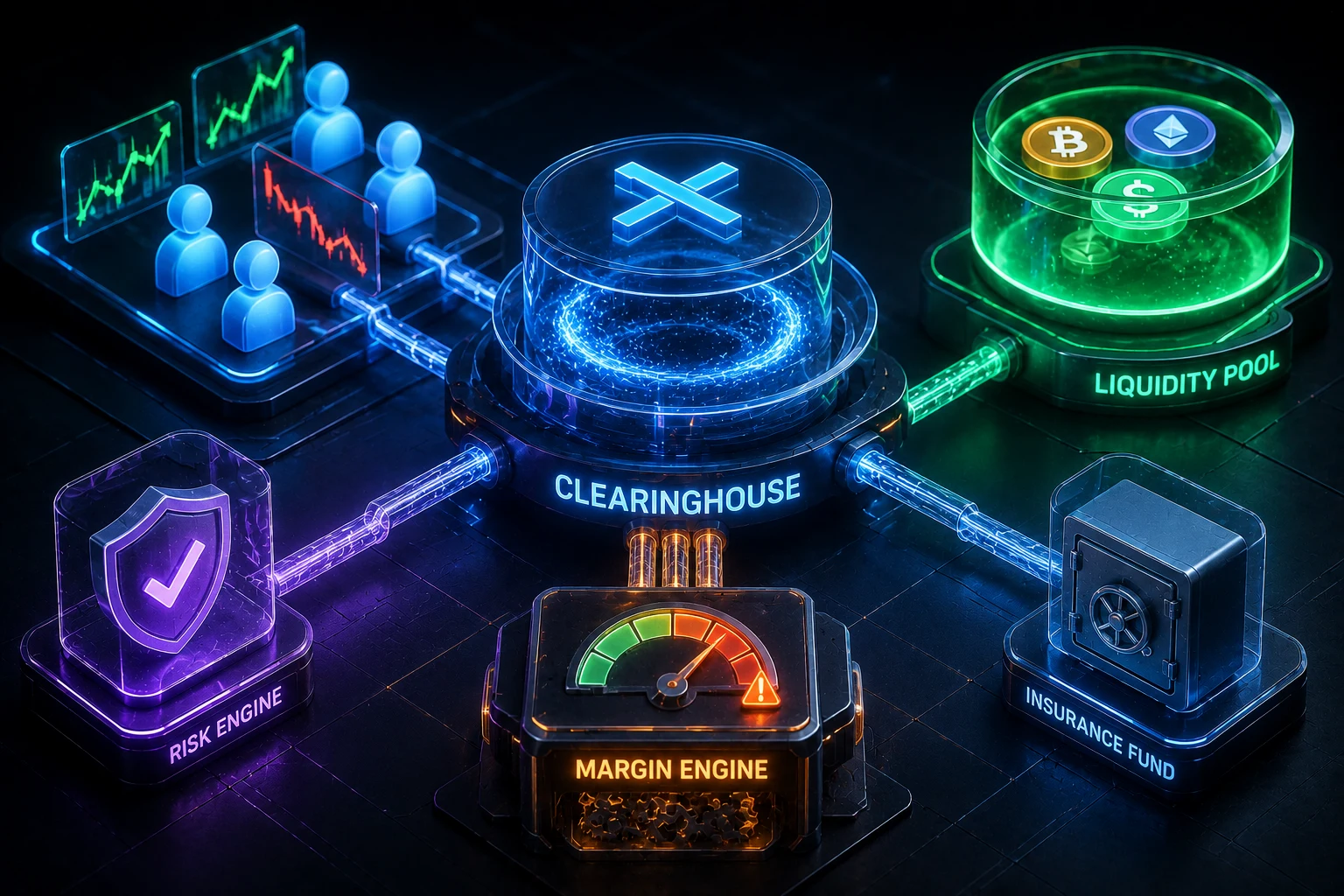
The interesting comparison is not which one has the slickest interface or the biggest airdrop. It is how each protocol decides three things that materially affect a trader's P&L: who matches the orders, who runs the validators, and what happens when a trader blows up and the protocol has to absorb the loss. Those three questions map onto order book architecture, validator decentralization, and the insurance fund plus ADL design.
Hyperliquid's pitch is that you get an order book experience comparable to a centralized exchange without giving up self-custody. dYdX's pitch is that you get a dedicated app-chain whose validators are financially aligned with traders through the dYdX token. Aster's pitch is that you can deposit collateral on multiple chains, get some of the lowest fees in the space, and earn aggressive rebates as a maker.
Risks before rewards: where each protocol can hurt you
Before looking at fees or token economics, it is worth being explicit about the failure modes. Perp DEXs are not savings accounts, and the differences between protocols often only matter when something goes wrong.
Validator and bridge risk
Every order you place on Hyperliquid is settled on Hyperliquid's own L1, which uses a HyperBFT consensus and a relatively small validator set. dYdX v4 runs on a Cosmos app-chain with its own validator set that is somewhat larger but still much smaller than Ethereum. Aster uses an order matching layer that, depending on the version, may rely on different components, and the protocol's documentation should be checked for the current architecture. In all three cases, a validator compromise or a chain halt can freeze withdrawals, and a bridge bug on Aster can put cross-chain collateral at risk.
Insurance fund and ADL
When a trader's position is liquidated at a worse price than their collateral can cover, the shortfall has to come from somewhere. Perp DEXs use an insurance fund as the first backstop, and when that fund is exhausted, they trigger auto-deleveraging (ADL), which forcibly closes profitable traders on the opposite side of the book. Hyperliquid's insurance fund is denominated in USDC and has been tested through several large liquidation events. dYdX's insurance fund similarly sits on-chain and has historically absorbed shocks, though ADL events have occurred. Aster's insurance fund and ADL design are newer and have not been stress-tested to the same degree.
Smart contract and oracle risk
All three protocols depend on price oracles to mark positions and trigger liquidations. A manipulated or stale oracle price can liquidate healthy traders or fail to liquidate unhealthy ones. Hyperliquid and dYdX use their own oracle designs with decentralized price feeds, while Aster relies on third-party oracle infrastructure. In each case, oracle failure is a tail risk that traders should price in.
Order book architecture: on-chain CLOB vs off-chain matching
The biggest architectural difference between these three protocols is where orders are matched and where the order book lives.
Hyperliquid runs an on-chain central limit order book (CLOB) directly on its L1. Every resting order, every cancel, and every fill is settled on-chain, which means anyone can reconstruct the book and verify fills. The trade-off is throughput: Hyperliquid's L1 is purpose-built, but it still has a finite block space, and during volatility, gas fees for cancels can spike. Hyperliquid mitigates this with batched cancels and a high throughput ceiling relative to most L1s.
dYdX v4 took a different route. The exchange itself runs as a Cosmos app-chain using CometBFT consensus, and its order book lives on that app-chain. Validators run the matching engine and propose blocks. This is closer to an app-specific chain than a general-purpose L1, which means dYdX has full control over throughput and fee design but inherits the smaller validator set risk that comes with Cosmos app-chains.
Aster occupies a middle ground. Its matching layer handles orders off the main chain and settles them through a mix of on-chain components and cross-chain messaging. The exact implementation has evolved, and traders should review Aster's current documentation for the precise architecture. The practical effect is that Aster can offer features like multichain collateral and aggressive rebates, but the transparency of the order book is lower than Hyperliquid's, and the matching layer is a more centralized component than dYdX's app-chain.
Fees and funding rates: where the P&L actually leaks
Fees on perp DEXs come in three flavors: trading fees, funding rates, and the implicit cost of slippage on liquidations.
Trading fees
Hyperliquid charges a maker-taker fee schedule with rebates for high-volume makers. dYdX v4 has a similar maker-taker model, though fees have historically been slightly higher than Hyperliquid's for retail traders. Aster's headline pitch is the most aggressive fee and rebate structure of the three, including zero maker fees for certain tiers and rebates that can exceed other protocols.
Funding rates
Funding is the periodic payment between longs and shorts that keeps the perp price close to spot. All three protocols run a funding rate that adjusts based on the premium of the perp over the index, but the cadence and the smoothing differ. Hyperliquid applies funding every hour, dYdX runs funding on a similar schedule, and Aster has experimented with shorter funding intervals. During one-sided markets, funding can be the largest cost on a leveraged position, and traders should compare funding rates across venues before sizing up.
Slippage and liquidation mechanics
Liquidation price is a function of oracle price, maintenance margin, and the depth of the order book at the moment of liquidation. Hyperliquid and dYdX both use on-chain liquidation engines that attempt to close positions at the best available price, with the shortfall absorbed by the insurance fund. Aster's liquidation engine is newer and uses a similar design, but traders should expect more variance in slippage during volatile markets until the protocol accumulates more volume.
Self-custody and token economics
Self-custody is the headline promise of every perp DEX, but the way each protocol handles collateral and token accrual differs in ways that matter.
Hyperliquid holds collateral in on-chain vaults controlled by smart contracts. Deposits and withdrawals are permissionless, and the HYPE token accrues value through a protocol fee switch that periodically buys back HYPE from the market using protocol revenue. Traders do not custody HYPE to trade, but holding HYPE gives governance rights and a claim on protocol cash flow.
dYdX v4 holds collateral on its app-chain and uses the dYdX token for validator staking and fee discounts. Validators stake dYdX and earn a share of protocol revenue, which means token holders who delegate to validators receive a yield that is partly funded by trading fees. The trade-off is that the app-chain has fewer validators than a general-purpose chain, which is part of the app-chain bet.
Aster uses the ASTER token for fee discounts, governance, and a portion of buyback economics. Collateral can come from multiple chains, which is convenient for cross-chain users but adds bridge risk. The token model has been the focus of significant attention because of its large float and aggressive unlock schedule, and traders should review the current tokenomics carefully before sizing positions around ASTER-denominated rewards.
Regional access and KYC
None of the three protocols run traditional KYC at the protocol level, but each operates under geographic restrictions that change over time. Hyperliquid blocks users from sanctioned jurisdictions through its frontend. dYdX similarly restricts access from certain regions, and the app-chain's validator set is geographically concentrated. Aster's regional policy is the newest and the least settled, with periodic updates as the protocol expands. In every case, using a VPN to bypass restrictions can result in frozen funds, and traders should check the current restricted-region list before depositing.
Practical implications: which one should a trader actually use?
There is no single right answer, and the choice depends on what a trader optimizes for. Hyperliquid is the strongest choice for traders who want on-chain transparency, deep liquidity, and a battle-tested insurance fund. dYdX is a reasonable choice for traders who prefer app-chain architecture and want exposure to a token model where validators are explicitly staked. Aster is worth a look for traders who care about multichain collateral and the lowest possible fees, but the protocol's insurance fund and order matching are less proven under stress.
For most active traders, the practical answer is to size positions across more than one venue, monitor funding rates across all three, and keep enough collateral off-platform that a single insurance fund failure or ADL event does not create a liquidity crisis. The headline lesson is that perp DEXs have moved past the question of whether they can replace centralized exchanges, and the comparison is now about which set of trade-offs a trader is willing to accept.
How to follow perp DEX drama the smart way
Perp DEX markets move fast, and the news around insurance fund draws, ADL events, validator changes, and token unlocks can move prices within minutes. Tracking all of that manually is a losing game for any trader who is also trying to execute. Zippfeed surfaces perp DEX headlines across Hyperliquid, Aster, and dYdX with sentiment scoring (bullish, neutral, or bearish) and an importance rating, so you can spot the kind of news that actually changes your execution before it hits your P&L.



 WuBlockchain
 Crypto Capital Venture
 Lookonchain
 TheBlock