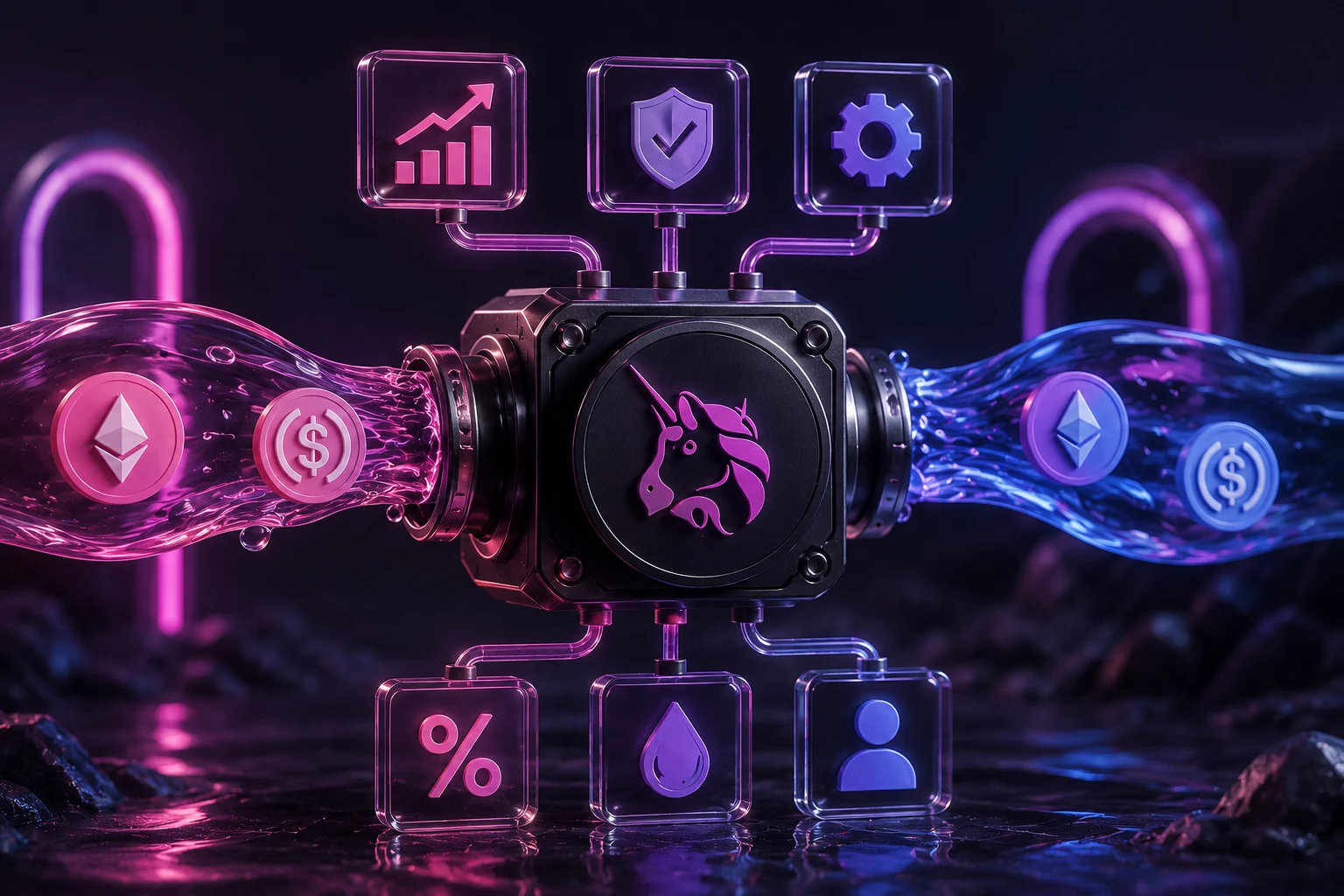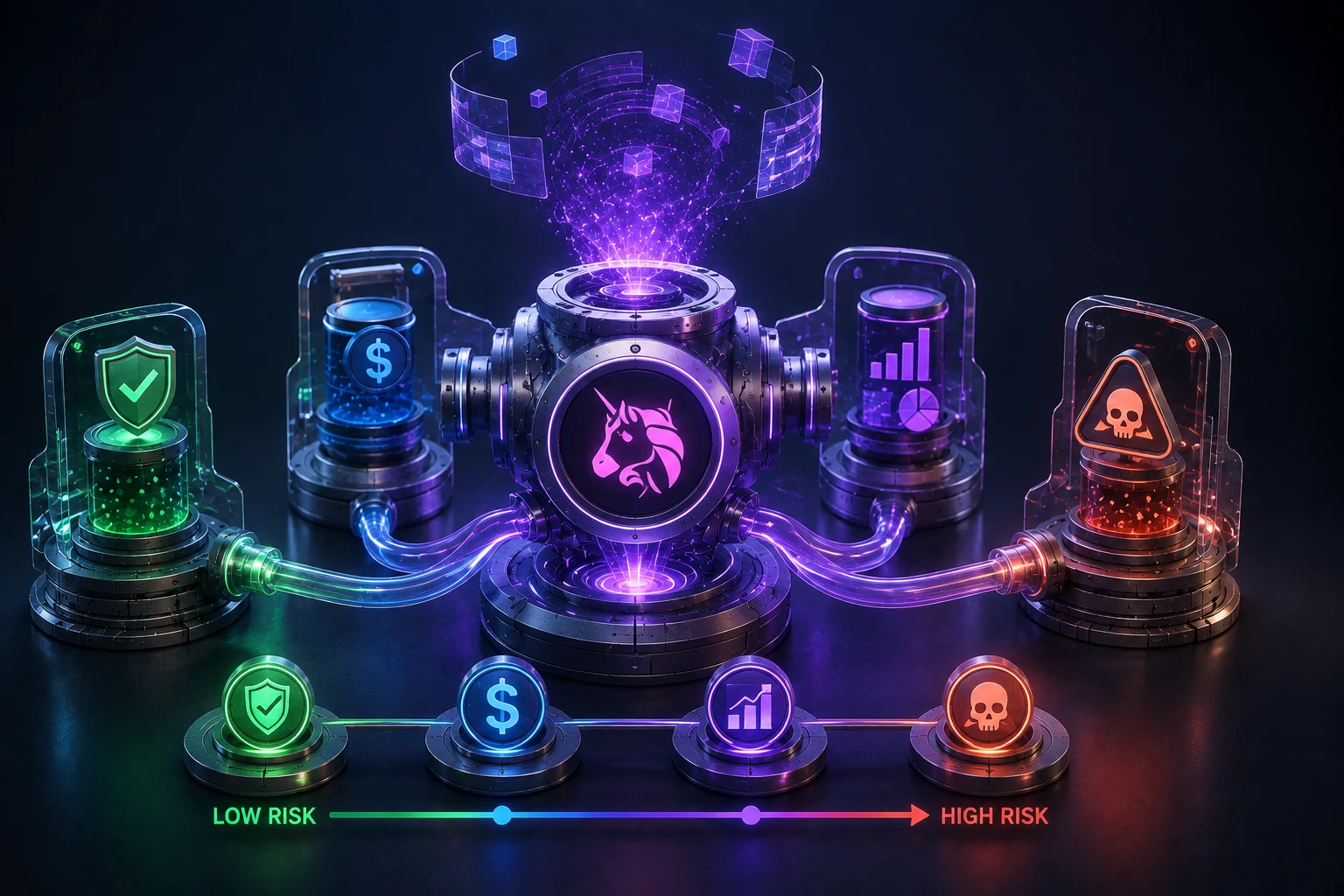
What problem V3 concentrated liquidity was designed to solve
Uniswap V2, launched in May 2020, used a simple model: any LP who deposited into the ETH/USDC pool had their capital spread from a price of zero to infinity. That meant at any given moment most of the capital was sitting far from the current price, doing nothing. A pool with $100 million of liquidity might only have a few million actively earning fees around the spot price.
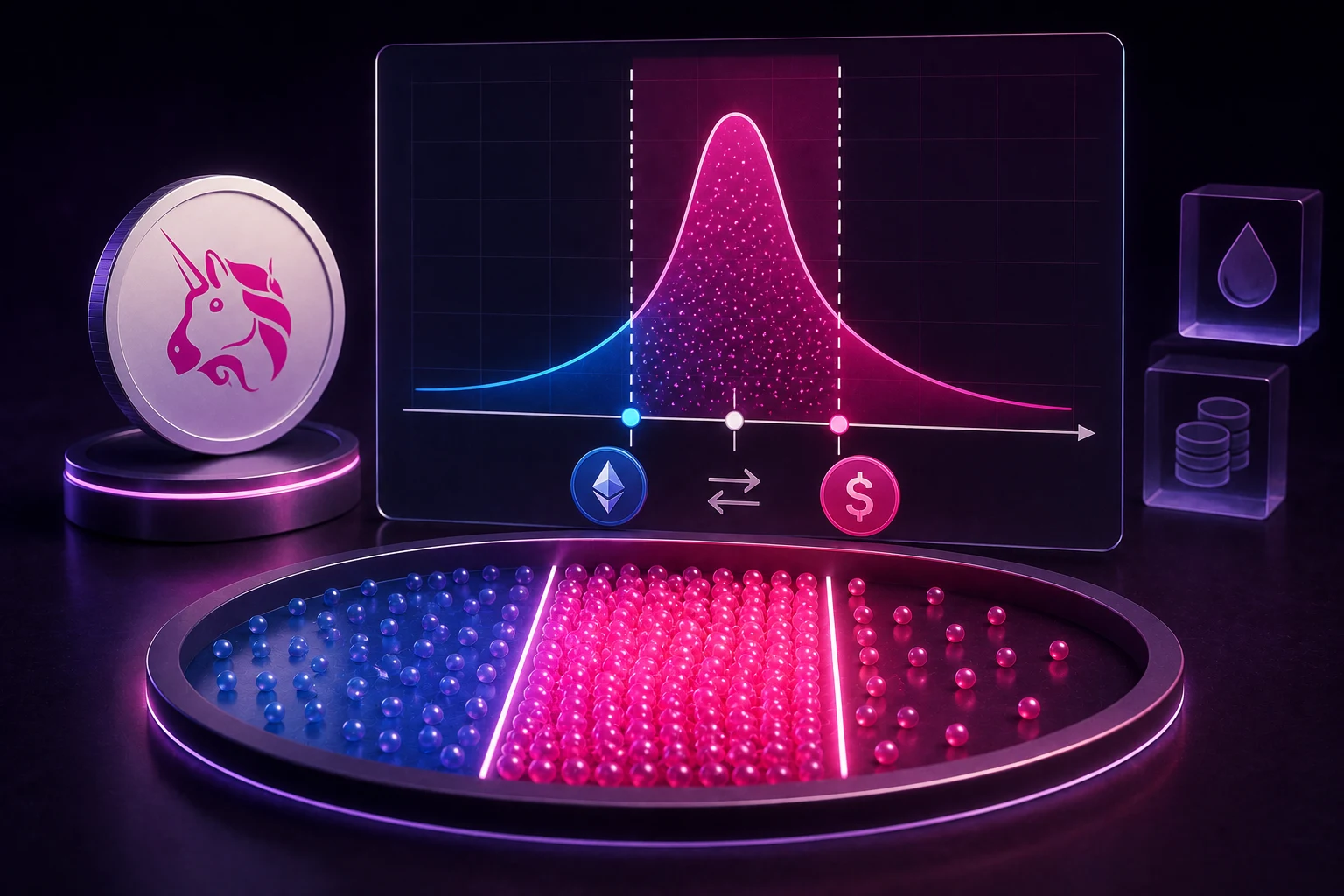
V3, deployed on Ethereum mainnet in May 2021, let LPs pick a price range for their deposit. Concentrate your ETH/USDC between, say, $1,800 and $2,200, and your capital is effectively many times more efficient inside that band. In exchange for that focus, the protocol rewards you with a larger share of the trading fees collected while price stays inside your range.
This is the core trade the rest of the article keeps coming back to. More efficiency means more fees per dollar when you are right. It also means sharper losses when you are wrong, because the moment price leaves your band, your position stops earning fees and starts behaving like a single-sided holding.
The real risks of V3 liquidity provision
Before any math, the uncomfortable part first: most V3 LPs do not beat simply holding the two tokens. A widely cited 2021 analysis from the Bancor team, and follow-up work from independent researchers including Resynth and others, found that the typical V3 position underperformed a HODL benchmark once IL and gas were netted out, especially for LPs running narrow, actively-managed ranges.
The risks fall into a few concrete buckets.
Impermanent loss amplification. IL is the difference between holding two tokens and providing them to a pool. In V2 it was relatively gentle. In V3 it scales with the square root of the price move, scaled again by how concentrated the range is. A narrow range that earns 5x the fees can also lose 5x the IL relative to a passive position, and the two do not always cancel out.
Range risk. When price leaves your chosen band, your position becomes 100% of the lower-priced token. Above your range, you hold only one side; below it, the other. You are no longer earning fees and you are exposed like a directional bet. Rebalancing means swapping back, which is itself another trade, another tax event in many jurisdictions, and another gas payment.
Gas and rebalance drag. Every adjustment to a V3 position costs gas on Ethereum mainnet. In bull markets with rising prices, sophisticated LPs chase their range upward, paying gas each step. A 2022 study from the Ethereum research community estimated that an active V3 strategy on mainnet needed average fee income of several percentage points per rebalance just to break even on transaction costs. On L2s like Arbitrum and Base, gas is cheaper, but the math still matters.
Smart contract and oracle risk. V3 is one of the most audited contracts in DeFi, but it is not risk-free. Bugs, governance attacks, or a flawed third-party vault that wraps V3 positions can and have wiped out user funds.
Token-specific risk. Pairs with thin order books, low volume, or volatile long-tail assets amplify every risk above. A 1% fee pool exists for a reason: those tokens move a lot, and the pool needs extra fees just to compensate LPs for the extra risk.
How V2 and V3 positions actually differ
In V2, depositing ETH and USDC into the pool is one transaction. Your LP token represents a proportional share of the entire reserves curve, from zero to infinity. Fees are distributed pro rata based on that share, and IL is symmetric and bounded.
In V3, an LP specifies a lower tick and an upper tick. Inside that range, the LP's virtual reserves are scaled up so the effective liquidity is many times the deposited amount. The trade-off is direct: more virtual liquidity means a bigger share of trades that occur inside the band, but the moment price crosses either tick the position becomes single-asset and stops earning fees until the price re-enters.
Concretely: a V2 LP with $10,000 might earn a baseline fee yield. The same $10,000 in V3 concentrated tightly around the current price can earn 4x, 10x, or even higher multiples, but only while price stays put. The risk-adjusted return depends on how often price stays inside the band, which depends on volatility, on the LP's rebalance discipline, and on the fee tier chosen.
This is why so much V3 strategy content reads like an options-pricing problem. In spirit, it is one. A narrow range is a long volatility position: you earn when price stays put and lose when it moves.
Fee tiers: 0.05%, 0.3%, and 1%
Uniswap V3 ships three fee tiers per pair, and the choice is not arbitrary.
The 0.05% tier is built for correlated or near-par assets: USDC/USDT, wstETH/ETH, and similar pairs. Price rarely moves, so the pool does not need much IL compensation, and traders get the cheapest possible execution. LPs earn modest fees on high volume, which is why stablecoin pools can still be attractive for passive LPs who do not want to manage ranges aggressively.
The 0.3% tier is the default and the most liquid. Pools like ETH/USDC and WBTC/USDC sit here. Volatility is moderate, volume is high, and the fee tier balances the two. Most V3 LPs start here.
The 1% tier exists for exotic or highly volatile pairs. Long-tail tokens, memecoins, and small-cap assets trade in this tier. The high fee is meant to compensate LPs for the IL risk that comes with bigger price swings. Even so, many 1% pools are unprofitable for LPs because volume is thin and price moves are violent.
Choosing a fee tier is a bet on volume versus volatility. Stablecoin pools assume volume will be enormous and volatility near zero. Exotic pools assume the opposite. ETH/USDC sits in the middle because that is roughly where ETH trades.
The math of a narrow versus a wide range
Imagine depositing 1 ETH and 2,000 USDC at an ETH price of $2,000, total value $4,000.
Full-range V2 baseline. Roughly 0.3% APR from fees, IL close to zero if price stays put. Simple, but inefficient.
V3 concentrated around $1,800 to $2,200 (±10%). Capital efficiency is several times higher, so the same trade volume yields several times the fee share. A reasonable backtest suggests fee APR in the 3% to 15% range during active periods, before IL. If ETH drifts to $2,300 and stays there, IL is modest and fees still cover it.
V3 concentrated around $1,950 to $2,050 (±2.5%). Capital efficiency can be 20x or higher. Fees look spectacular in the short term, but a 5% move in either direction takes the position out of range. IL in that scenario is amplified by the concentration factor, and rebalancing means swapping at a worse price plus paying gas.
The lesson the math keeps teaching is that fee multiples and IL scale together. There is no free lunch in the range; there is only a bet on how long price stays put and whether your rebalance discipline is fast and cheap enough to capture the fees before they leak to IL and gas.
Independent researchers, including Resynth and Steakhouse, have published dashboards tracking realized LP performance versus HODL for major V3 pools. The recurring finding: a small minority of sophisticated LPs beat HODL by enough to justify the effort, and the median LP does not.
Practical implications if you are still considering V3
If, after all of the above, V3 still fits your goals, a few principles tend to hold up across the research.
Use wide ranges for blue-chip pairs like ETH/USDC or WBTC/USDC. The fee APR is modest but the IL risk stays bounded, and you avoid paying gas every week to chase the price.
Use narrow ranges only when you have a directional view or a clear rebalancing strategy. Treating V3 like a yield product without an active plan is one of the most reliable ways to underperform HODL.
Prefer L2 deployments on Arbitrum, Base, or Optimism. Gas is the silent killer of active V3 strategies, and the same logic that works on mainnet scales much better on a rollup.
Consider managed vaults from established protocols that wrap V3 positions and rebalance programmatically. They charge a performance fee but they handle the gas math and the range discipline for you. Read the smart-contract risk section of their docs, not just the headline APY.
Avoid long-tail and memecoin pools unless you are deliberately speculating on volatility. The 1% fee tier sounds generous, but thin volume and violent price moves eat the margin faster than the tier can compensate.
None of this is financial advice. These are patterns observed across public data, not a strategy for any specific reader.
What Uniswap V4 hooks change
Uniswap V4, launched on Ethereum mainnet in early 2025, keeps the concentrated liquidity model and adds a powerful new primitive: hooks. A hook is a piece of custom code attached to a pool that runs at specific lifecycle events: before a swap, after a swap, on liquidity changes, on price updates.
That sounds abstract, but in practice hooks let builders do things V3 cannot. They can build dynamic fee pools that raise fees during volatility. They can build on-chain limit orders directly inside the AMM (automated market maker). They can build TWAP (time-weighted average price) oracles, MEV-capturing pools, lending integrations, and custom rebalancing logic that used to require an external vault.
For LPs, the honest read is mixed. V4 hooks enable smarter strategies, but they also raise the complexity ceiling. The LPs who do well in V4 are likely to be teams running bespoke hook strategies, not retail users clicking through a UI. V3 LPs who were already struggling with IL and gas may not find V4 easier; they may find it harder, because the competitive benchmark has shifted upward.
For Uniswap as a protocol, hooks are the strategic response to competitor DEXs (decentralized exchanges) like Curve, Balancer, and PancakeSwap that have already offered customizable pool logic. Whether V4 recaptures that lead is something the on-chain data over the next several quarters will reveal.
How to follow Uniswap and DeFi liquidity the smart way
Uniswap and DeFi liquidity shift quickly. Fee tier volumes rotate, new hook strategies launch every month, and LP profitability numbers change with every cycle of volatility. Tracking which pools are actually paying LPs, and which are quietly leaking to IL, is hard to do by hand. Zippfeed surfaces Uniswap and DeFi headlines with sentiment scoring (bullish, neutral, or bearish) and an importance rating, so you can separate the signal from the launch announcements and decide where, if anywhere, your capital belongs.


 WuBlockchain
 Crypto Capital Venture
 Lookonchain
 TheBlock