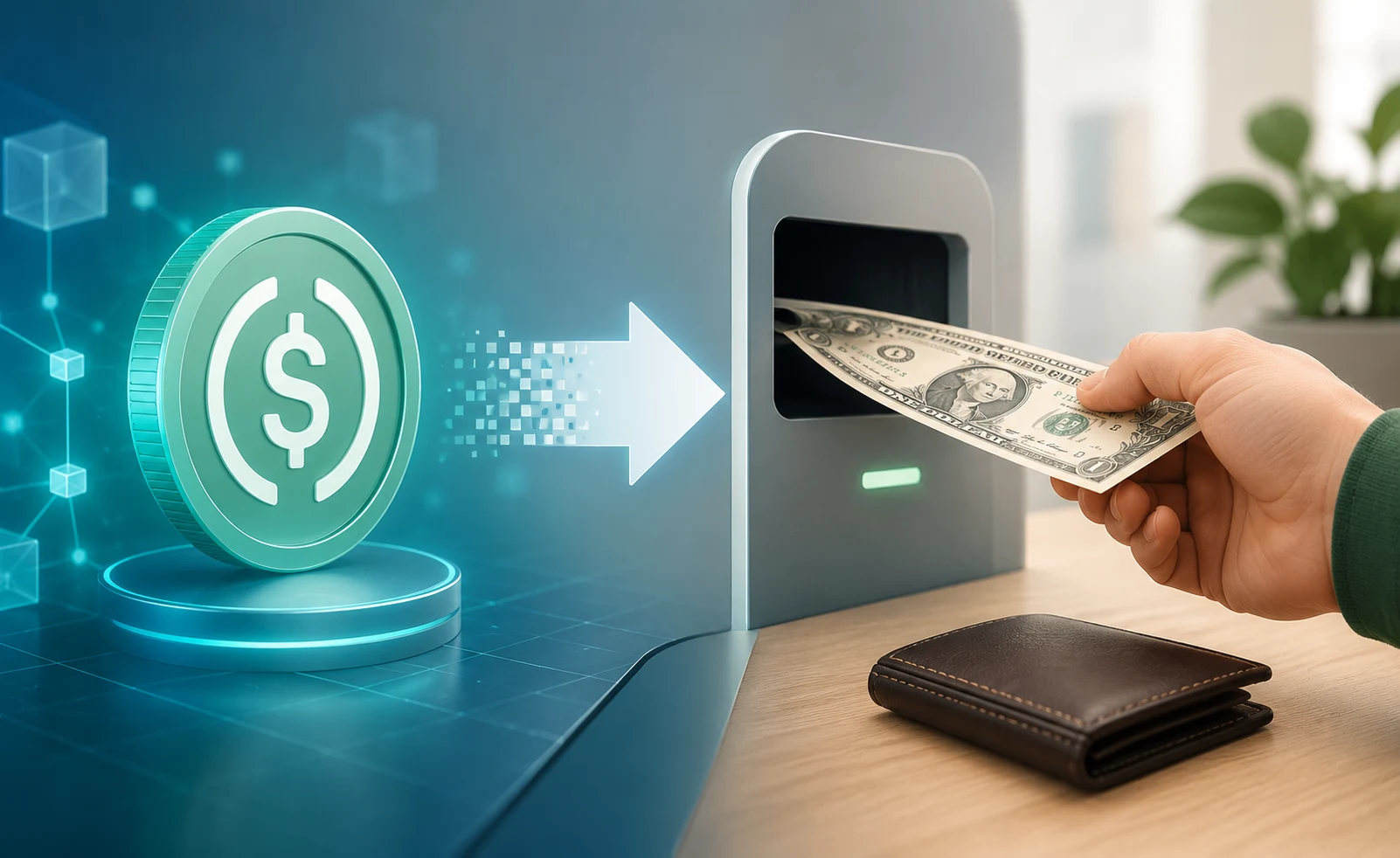
What does "redeem a stablecoin for $1" actually mean?
When a stablecoin's marketing page says it is redeemable 1-for-1 for US dollars, the word "redeem" is doing a lot of work. In the strict sense, redemption means sending the token back to the issuer, having the issuer destroy it, and receiving US dollars in return through a real bank wire. That is the path that anchors the price to $1 in the first place. Without it, the token would only be worth whatever someone else on the open market is willing to pay for it.
Two practical facts narrow this for almost everyone. First, the issuer sets minimums, KYC requirements, and supported jurisdictions, and these are not negotiable from a wallet. Second, the issuer itself usually does not move the dollars. A bank partner does, and that bank can be slow, expensive, or temporarily shut out of dollar clearing. So the headline "1:1 redeemable" claim is best read as a description of a process that only some users can actually trigger, not a guarantee that a token you hold in a MetaMask wallet can be swapped for cash on demand.
This is why the answer to "can you redeem stablecoin for USD" depends on three things at once: which token you hold, how much of it you hold, and whether you have a verified account with the issuer or a venue that does. The rest of this article walks through each of those gates and shows where the assumption that you can always get a dollar back breaks down.
Who can actually redeem, and at what size
The list of stablecoins that publish formal redemption terms keeps growing. Circle's USDC, Tether's USDT, PayPal's PYUSD, TrueUSD (TUSD), Sky's USDS (formerly DAI), the World Liberty Financial USD1, Ethena's USDe, and Ripple's RLUSD all describe some form of redemption, but the conditions are not the same. Circle, for example, requires a minimum redemption of $100,000 for most users and only wires to bank accounts in jurisdictions it has onboarded. Tether historically set a $100,000 minimum for direct redemption and has, at times, imposed additional paperwork for sums above that floor. PayPal's PYUSD is unusual in that redemption is built into the PayPal and Venmo apps for ordinary consumer accounts, but it is processed in fiat through PayPal's own banking rails, not through a public token burn.
Below those minimums, the door is effectively closed to direct redemption. A holder of $500 in USDC cannot call Circle and ask for a wire. The same is true of USDT for most individuals. The honest way to read the marketing is that the redemption right is designed to support the price for large market makers and institutional users, who arbitrage any discount back to the peg, not to give every wallet holder a personal cash machine.
There is a second tier of users who get access to redemption at lower minimums because they hold a license. Crypto-native issuers like Sky (with USDS) and formerly MakerDAO (with DAI) built on-chain redemption through smart contracts, which lets a user burn DAI against collateral without ever touching a bank. That model has different risks, because the redemption value depends on the value of the underlying crypto collateral at the moment of the trade, not on a dollar reserve. Ethena's USDe is similar in spirit: its "redemption" is a delta-neutral trade of spot crypto and a perpetual futures position, so the dollar claim is only as good as the perp leg, the exchange it trades on, and the funding rate at the time.
Bank rails, geography, and the partner problem
Every fiat-backed stablecoin ultimately depends on a bank. The issuer holds dollar deposits, often Treasury bills bought through money market funds, at one or more partner banks, and those banks are the ones doing the wires. When the banking partner is healthy and well connected to dollar clearing, redemption is a one-to-two business day process. When the partner is in trouble, every claim on the issuer turns into a waiting game.
This is the single most common cause of a depeg. In March 2023, USDC lost its peg after Silicon Valley Bank failed. Circle held a meaningful portion of USDC's reserves at SVB, and until regulators clarified that uninsured deposits would be made whole, USDC traded as low as about $0.87 on the open market. The peg recovered within days once the Federal Reserve backstop was announced, but for that window, USDC was not trading at $1 even though Circle's contractual promise to redeem at $1 was unchanged on paper. A holder who tried to sell USDC on a regular exchange during that period took the loss, not Circle.
Geography is a quieter version of the same issue. Tether has, at various points, restricted redemptions or onboarding for users in certain US states and other jurisdictions. PYUSD is only available to PayPal and Venmo users in the United States, which means a user in Europe or Asia cannot redeem it through the issuer at all. Some issuers refuse wires to banks in countries on sanctions lists, and several will block accounts that cannot pass enhanced KYC. For a retail user, this is the boring but important reason a token that claims to be globally dollar-redeemable can still feel locked in their home country.
What actually happens when a stablecoin depegs
Depegs are usually short, sharp, and confusing. The most useful way to think about them is as a stress event on the banking and market-making layer, not on the underlying promise. The issuer's legal obligation to redeem at $1 is rarely the thing that breaks; it is the issuer's ability to actually move dollars at a given moment, and the willingness of market makers to trust that ability, that drives the price on a crypto exchange.
The textbook sequence looks like this. A piece of negative news hits, often a rumour about a bank partner, a regulator, or a counterparty. Market makers widen spreads and pull back from two-sided quoting. Users rush to redeem directly with the issuer, which can flood the bank partner with withdrawal requests. On exchanges, the price drops to a discount because no one is willing to buy at $1 when settlement is uncertain. Once the issuer or its partners put out a credible statement, and any pending wires clear, the price snaps back. The cost of the event is borne by whoever sold at the bottom of that dip, often ordinary retail users.
Historical examples make this concrete. The TerraUSD (UST) collapse in May 2022 was a different failure mode, since UST was an algorithmic stablecoin with no direct dollar redemption, and it never recovered. The USDC depeg in March 2023 was the bank-rail failure case. USDT has traded at small discounts during periods of stress around Tether's banking relationships, particularly in mid-2022, and has traded at small premia during regional crises when local demand for dollar access spiked. PYUSD briefly traded off peg on a thin-liquidity venue in its first weeks of trading, which was a market microstructure problem rather than a reserve problem. Each of these is a reminder that the $1 price is a function of trust and plumbing, not a law of nature.
Bankruptcy, run risk, and the stablecoin holder's place in line
This is the question most retail holders do not ask, and the one that matters most in a bad scenario. If the issuer of a fiat-backed stablecoin becomes insolvent, where do token holders sit in the creditor waterfall? The honest answer, reflected in the terms of service of every major issuer, is that token holders are unsecured creditors. They do not have a special claim on the reserves. They have the same standing as any other vendor or depositor who is owed money by the issuer.
In practice, this has not been tested in a real bankruptcy of a major stablecoin issuer, because the firms behind USDC, USDT, PYUSD, and the others have so far avoided that outcome. The closest reference point is the failure of smaller issuers, where recoveries to token holders have been partial and slow, and the wind-down of some crypto lenders that held stablecoin-like liabilities. The pattern is that the reserve assets, mostly cash and short-dated US Treasuries, get divided pro rata among unsecured creditors after any preferred claims are settled, and that process can take months or years.
Two design choices can shift the risk. Some stablecoins hold their reserves directly at regulated custodians with segregated accounts, which makes it harder for a bankruptcy administrator to mix those assets with the issuer's general estate. Tether has, at times, also held reserves in a mix that includes secured loans to affiliated parties, which has drawn scrutiny from regulators and auditors because it makes the recovery story less clean. For a retail holder, the practical takeaway is that the safest position is to hold stablecoins issued by companies that publish regular attestations from a reputable accounting firm, hold reserves at high-quality custodians, and operate in jurisdictions with a clear legal framework for digital assets. Even then, the holder is still an unsecured creditor, not a depositor with FDIC insurance.
What this means for the holder who just wants to cash out
Pulling the threads together, a retail holder has three realistic exit paths, and they all have a cost. The first is to sell on a centralized exchange, where the price will be very close to $1 in normal conditions, but where spreads, withdrawal fees, and the exchange's own banking issues can leak a small percentage on the way out. The second is to swap on a decentralized exchange or through a swap service, where the trade is for another token, not for dollars, and the user has to go through a separate off-ramp to actually get cash. The third is to use the issuer's own redemption flow, which is only available above the minimum and only with a verified account, but which gives the cleanest dollar-for-token settlement.
For amounts under a few thousand dollars, the exchange route is the default. For amounts in the tens of thousands, the choice between an exchange and direct redemption becomes a real comparison of fees, speed, and counterparty risk. For very large amounts, direct redemption with the issuer, or a negotiated block trade with an OTC desk, is the only realistic way to avoid moving the market. The risk that the $1 promise turns out to be a haircut rather than a guarantee is small in normal times and rises sharply in a stress event, which is why keeping a chunk of an emergency fund in a stablecoin during a banking scare is a different bet than keeping it there during a quiet week.
There is also a question of jurisdiction and tax. In the United States and many other countries, swapping a stablecoin for dollars is a taxable event in the same way that selling a stock is, and it can trigger a capital gain or loss even if the token is meant to track the dollar exactly. Some exchanges will not let a user withdraw dollars to certain banks or in certain states, and the user only finds out at the moment of the withdrawal. None of this changes the dollar amount on the screen, but it changes the amount that lands in a bank account.
Read the fine print before you trust the label
The cleanest summary is that the label "redeemable 1:1 for US dollars" is a description of a process, not a universal right. The process is open to large, verified, geographically eligible users who can meet minimums. For everyone else, the $1 price is a market price maintained by professional arbitrageurs, and the cost of being wrong about a redemption, even briefly, is paid by whoever sells at the worst moment.
For an individual user, the practical checklist is short. Find the issuer's redemption page, read the minimums, the supported jurisdictions, the KYC requirements, and the fees. Find the most recent reserve attestation and check which custodian holds the assets. Decide whether you are willing to be an unsecured creditor of that issuer for the size of your position. If the answer to any of those is uncomfortable, treat the token as a market-traded asset, not as a dollar in disguise.
Stay ahead of stablecoin moves with Zippfeed
Stablecoin news moves fast, and the gap between a quiet reserve report and a 10 percent depeg can be a single weekend. Tracking issuer attestations, banking partner changes, regulatory updates, and exchange-level liquidity by hand is a losing game. Zippfeed surfaces stablecoin headlines with sentiment scoring, tagged bullish, neutral, or bearish, and an importance rating, so you can see at a glance whether a story is routine or a warning, and act before the price does.









 Crypto News
 CryptoSlate
 CoinDesk