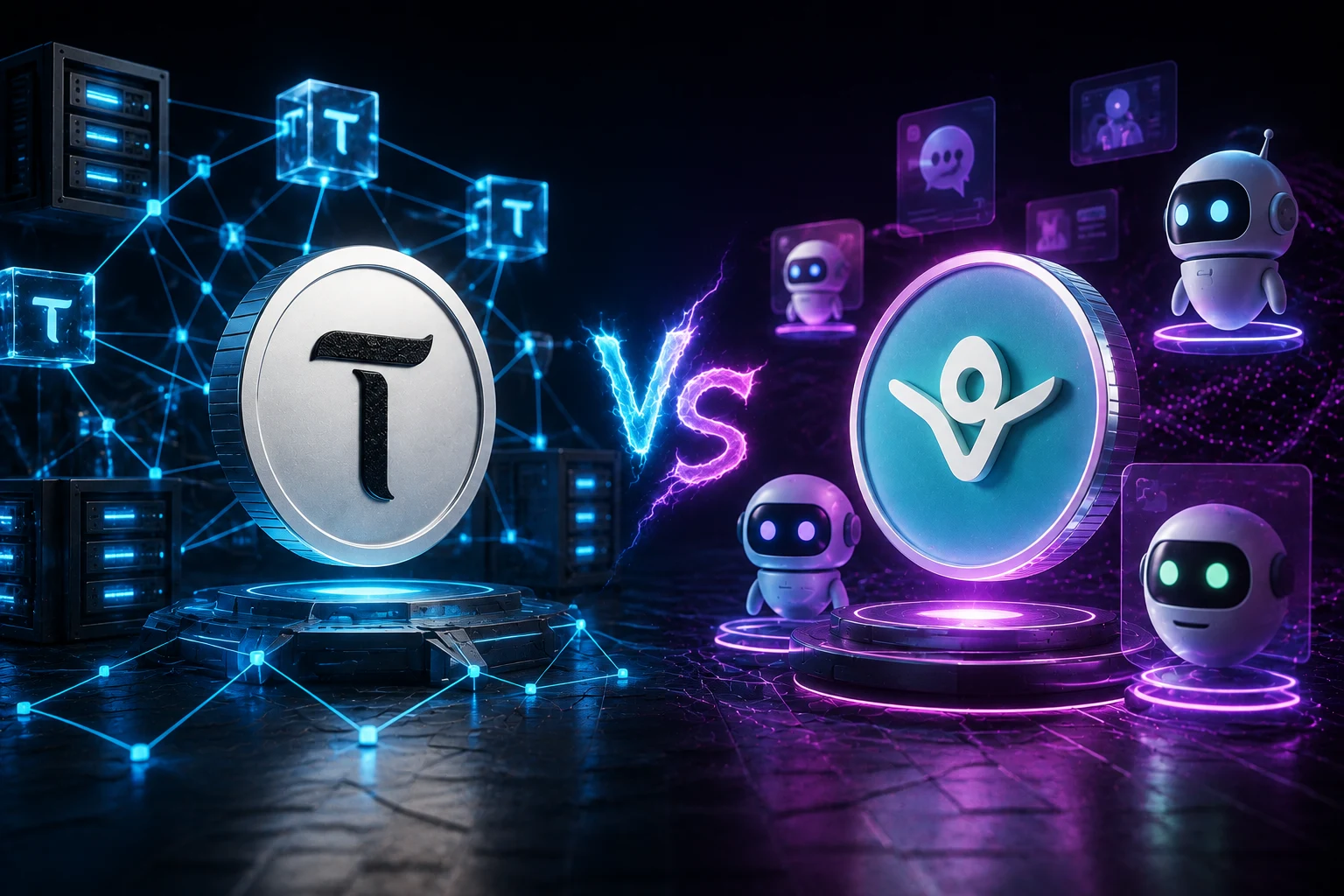
Why these two ecosystems look identical from the outside
If you only watch token counts, Bittensor and Virtuals tell the same story. By late 2025 the Bittensor network had dozens of live subnets, each with its own token, and Virtuals had launched thousands of agent tokens, each one tied to a specific AI agent. Both narratives use the same vocabulary: AI, decentralization, open markets, permissionless launches. Headlines happily mash them together.
Underneath the marketing, the two systems measure success with completely different rulers. A subnet on Bittensor exists inside a larger competition for the network's attention budget, denominated in TAO. An agent token on Virtuals exists inside a marketplace where the only judge is whether anyone pays for the agent's output, denominated in USDC or VIRTUAL. Calling both "AI tokens" is like calling both a software company and a hedge fund "finance": technically true, structurally misleading.
This matters because the risks you take when you buy a subnet token are not the risks you take when you buy an agent token. The first is closer to a venture bet on a team that must keep producing useful work to keep getting paid. The second is closer to a royalty stream that may or may not ever exist. Treating them as the same instrument is how retail traders end up holding bags they do not understand.
The real risks before you touch either model
Both ecosystems have produced genuine losses, and the failure modes are not the same.
Subnet failure modes. Subnets depend on a registration mechanic. The subnet owner stakes TAO to reserve a slot, then validators and miners earn emissions by ranking the subnet's output. If a subnet stops producing signal, emissions migrate to better-ranked subnets. Registrations have expired, teams have abandoned projects, and the tokens left behind have lost most of their value because buy demand disappeared. The cleanup is real, but the losses for late entrants are real too. In several cases subnet tokens pumped on launch, then drifted to fractions of a cent as miners left.
Agent-token failure modes. Virtuals agent tokens do not expire automatically. Some agents launched with no real product, generated near-zero fees, and still trade on the open market. Liquidity is often thin: a few thousand dollars can move the price by double-digit percentages. The classic rug patterns (developer sells into thin liquidity, agent goes silent, chart goes vertical the wrong way) have appeared on agent tokens the same way they appear on any low-float token launch. The lack of a forced sunset is not a feature; it is a graveyard.
The shared risk. In both systems, child tokens are issued against a parent token that may capture very little of the upside. If you buy a long-tail subnet token and the parent TAO does well, you may still lose money. If you buy a long-tail agent token and VIRTUAL rallies, the agent token can still drift to zero. Token count grows in bull markets; the dispersion of outcomes grows with it.
How dTAO emission-curve design for subnets actually works
The dTAO redesign rolled out in early 2025 changed how subnets are funded. Before dTAO, a few large TAO holders could direct emissions by staking into specific subnets, which concentrated power. After dTAO, every subnet gets its own market where holders swap TAO for the subnet token (and back). The root network allocates TAO emissions to subnets based on the relative prices of those subnet tokens: the more demand for a subnet's token, the more TAO flow that subnet receives to distribute to its miners and validators.
This is essentially an on-chain vote, denominated in capital, that decides which subnets get paid. It is elegant, but it has a sharp edge. A subnet token's price is partly a measure of usefulness and partly a measure of speculation. If hype pushes a subnet's token price up, that subnet receives more emissions, which attracts more miners, which can either produce genuine signal or produce noise that briefly looks like signal. The system rewards what the market says it values, not what an oracle says is useful.
The emissions curve itself is the second lever. Subnet tokens tend to emit heavily to early participants and taper over time, which means early insiders can earn back their registration stake plus a multiple if the subnet takes off, but late entrants often buy tokens whose marginal emission is already small. Reading a subnet token chart without understanding the emission schedule is like reading a startup cap table without reading the vesting terms.
How Virtuals revenue-share model via agent tokens works
Virtuals took a different route. Each agent on the platform gets its own ERC-20 token, and holders of that token are entitled to a share of the fees that the agent earns. If the agent is a trading bot that charges a 1% fee on volume, holders receive a pro-rata cut of that 1%. The promise is direct: buy the token, own a slice of one agent's revenue.
The reality depends on three variables that are easy to underestimate. The first is whether the agent actually generates revenue at all. Many agents launched with competent teams and still produced modest fee income, because the underlying product had no clear market fit. The second is how much of the agent's fees are captured by the token versus routed back to the team, treasury, or liquidity operations. The third is whether the token's float is so small that any revenue inflow is overwhelmed by token unlocks and selling pressure from early holders.
The revenue-share framing also creates a specific kind of investor trap. Buyers tend to project revenue forward as if it will compound. In practice, AI agent markets are brutally competitive. A new agent can launch with a better model or a better distribution channel and siphon demand away from an existing one within weeks. Revenue is not a contract; it is a ranking, and rankings in AI shift quickly.
Liquidity and float differences that decide who actually gets out
Liquidity is where most retail losses occur, and the two ecosystems have very different liquidity profiles.
Subnet tokens typically list on decentralized exchanges after the dTAO swap pools go live, with liquidity that scales roughly with how much TAO the community has committed. The largest subnets can attract meaningful liquidity; mid-tier subnets often sit in a zone where a few thousand dollars of selling can move the price significantly. The smallest subnets are essentially illiquid, and their charts are mostly artifacts of traders trading against themselves.
Virtuals agent tokens tend to launch with similar small pools, and a meaningful subset never graduate to deeper liquidity. The platform has introduced mechanisms aimed at rewarding tokens that build real liquidity, but the incentive to provide liquidity is weaker when the underlying fee revenue is thin. For traders, the practical lesson is the same: assume you are the exit liquidity unless the order book tells you otherwise.
Float is the second leg of the same stool. Many subnet and agent token allocations vest over months or years, which means the circulating supply at launch is a small fraction of the eventual supply. Charts that look healthy in week one can deteriorate rapidly as vesting cliffs unlock. Neither ecosystem publishes a standard, comparable float metric, which forces every buyer to do their own dilution math.
How the parent token captures value, or fails to
Both ecosystems rely on a parent token that is supposed to absorb the upside of all this activity. The mechanisms differ.
For TAO, value capture comes from the root network itself. Every subnet swap routes through TAO. Every emission is paid in TAO. Every validator and miner stakes TAO to participate. If subnets collectively produce useful work, demand for TAO rises because participants need TAO to register, swap, and stake. The dTAO design is explicitly an attempt to make TAO the asset that every subnet participant must touch, even if the subnet itself fails.
For VIRTUAL, value capture comes from the protocol's role as the settlement layer for agent fees. Holders of VIRTUAL can stake into the protocol and receive a share of platform-wide fees, and certain platform functions require VIRTUAL. If the agent economy grows, VIRTUAL accrues activity; if the agent economy shrinks, VIRTUAL feels it directly. The risk is that if agents migrate to other frameworks or fee routes, VIRTUAL's claim on activity weakens.
The honest answer is that in both systems, parent-token value capture is a thesis, not a guarantee. Subnets could, in theory, route more activity through side channels that bypass TAO. Agents could, in theory, settle on other chains or with stablecoins only. The parent token wins when the parent protocol remains the cheapest place to coordinate; it loses when cheaper coordination layers emerge.
Practical implications if you are evaluating either
If you are a trader or allocator, the practical question is not "which model is better" but "which bet am I actually making."
For subnet tokens, ask who the miners are, what signal they produce, and how emissions taper. A subnet with a credible team, a measurable output (price predictions, storage proofs, coding evaluations), and a sane emission schedule is a different bet from a subnet that exists primarily to capture TAO emissions and recycle them to insiders. Look at the swap pool depth on the dTAO market, not just the token price.
For agent tokens, ask what the agent actually does, who pays it, and whether revenue is growing or shrinking. A trading bot that prints consistent fees with a clear edge is a different bet from a chatbot whose only users are the team's friends. Treat the revenue-share claim as audited only when you can see the on-chain fee data yourself.
In both cases, the largest position should usually be the parent token, not the child token, unless you have a specific reason to believe the child will outperform. The parent captures the option value of the whole ecosystem; the child captures the option value of one bet inside it. Most of the time, the diversification argument favors the parent.
Track AI-token launches with Zippfeed
AI-token launches move fast and so does the news around them. Tracking emissions, revenue claims, and float changes across dozens of subnets and thousands of agents manually is a losing game. Zippfeed surfaces Bittensor and Virtuals headlines with sentiment scoring (bullish, neutral, or bearish) and an importance rating, so you can separate protocol-level signal from token-level noise before you size a position.

 Altcoin Daily