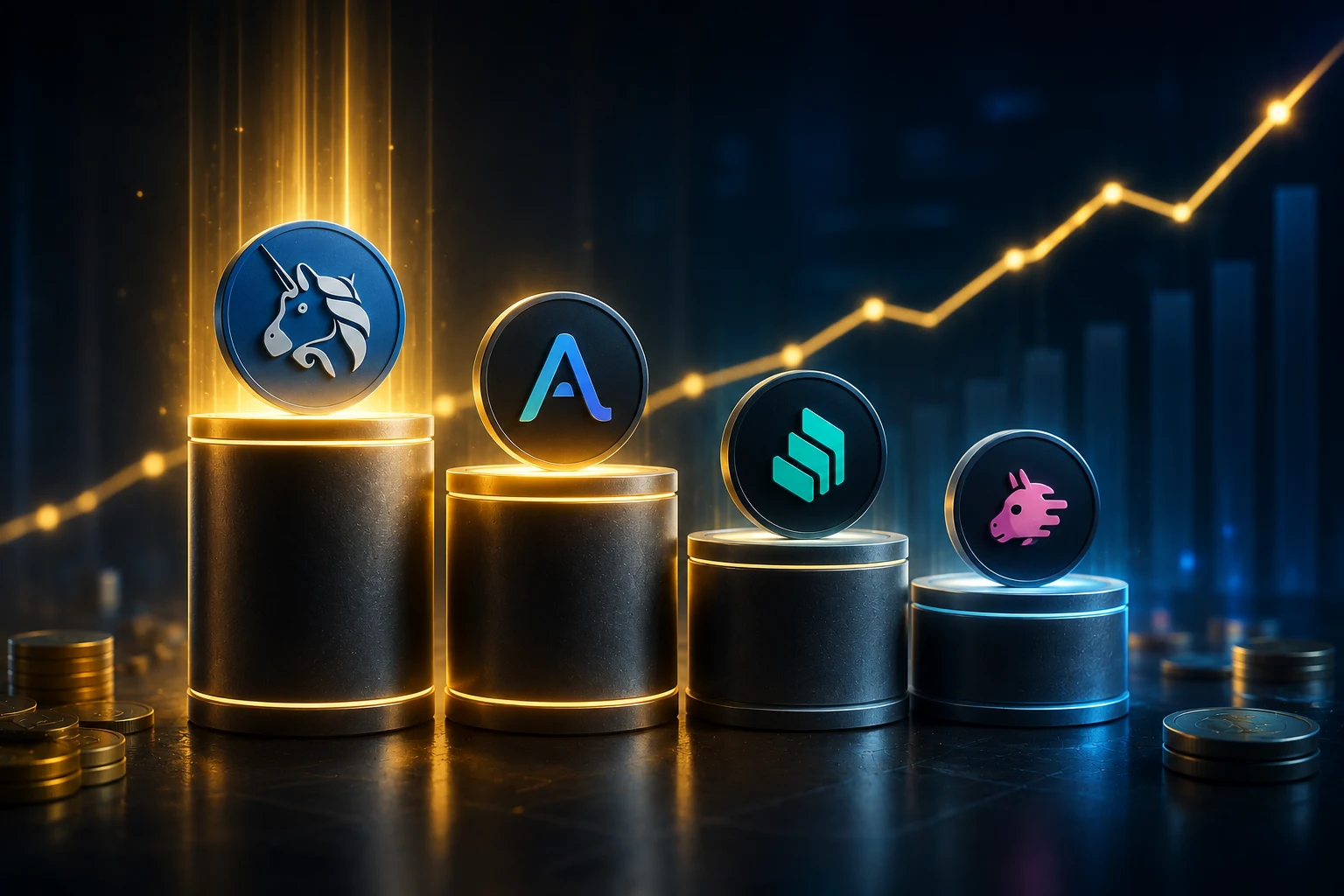
What "top DeFi protocol" actually means
The phrase "top DeFi protocol" gets thrown around as if there is one official ranking. There is not. The closest thing to a source of truth is DeFiLlama, a free analytics site that tracks total value locked (TVL) across thousands of smart contracts. TVL is the dollar value of crypto assets users have deposited into a protocol. It is a useful proxy for trust and usage, but it is not the same as revenue, number of active users, or safety.
For a beginner, a more useful question than "what is number one?" is: "which protocol leads each category, and what is the one risk I should know about that category?" A protocol that ranks eighth overall might be the most important protocol in its niche, and a protocol that ranks second might be one bad oracle update away from a wipeout.
This article picks ten protocols that consistently appear in DeFiLlama's top ranks and span the major DeFi categories. It is a snapshot, not an endorsement. Rankings shift, exploits happen, and yesterday's leader can be tomorrow's cautionary tale.
The real risks of "just using top protocols"
Chasing the top of a TVL leaderboard is one of the most common beginner mistakes, because TVL tells you nothing about safety. Here are the failure modes that have cost users real money across multiple "top" protocols.
Smart contract exploits
DeFi protocols are run by code, and code has bugs. History is full of leading protocols that lost tens or hundreds of millions in a single incident. The Ronin bridge hack, the Wormhole exploit, the Curve Finance stable pool manipulation, and the Multichain drain are not edge cases. They are normal events in the industry. Even audited code from respected teams has failed.
Stablecoin depegs
Several of the protocols on this list are stablecoins or depend on them. A "stablecoin" is a token designed to track the value of a fiat currency, usually the US dollar. When a stablecoin loses its peg, the contagion spreads fast. The TerraUSD collapse in 2022 wiped out over $40 billion in value in days, and the Dai/Sky system itself has come close to its peg during stress events. Even large, long-running stablecoins are not risk-free.
Oracle manipulation
Many DeFi apps need a price feed for the assets users deposit. They get that price from oracles, which are services that push external data on-chain. If an oracle is manipulated, a lending protocol can think your collateral is worth more than it is, or a derivatives protocol can liquidate you at the wrong price. Several major incidents trace back to a single manipulated price print.
Governance and centralization risk
Most DeFi protocols are governed by a token, meaning holders of the token vote on changes to the code, fees, and treasury. That sounds democratic, but in practice a small group of large holders, the team, or a venture firm often controls enough votes to push through changes. A governance attack, where an attacker buys enough tokens to pass a malicious proposal, has happened and remains a live risk for protocols with low token distribution.
Chain and bridge risk
If a protocol lives on a chain you have to bridge to, the bridge is part of your risk surface. Bridges have been the single most attacked part of DeFi, and several of the largest hacks in history were bridge exploits. Holding assets on the chain where the protocol actually lives, usually Ethereum mainnet, removes one major source of risk.
How the top 10 are organized
Rather than a flat leaderboard, this list is grouped by category so the picks are not ten DEXs. Each category has a clear job, and the leader in each is the one that has held the most TVL, generated the most volume, or shown the most staying power through multiple market cycles.
DEXs (decentralized exchanges)
A DEX is an app that lets users swap one token for another directly from their wallet, without a company holding the funds. The dominant model is the automated market maker, or AMM, which uses pools of token pairs and a formula to set prices.
Lending markets
Lending protocols let users deposit crypto to earn interest or borrow against deposits. Interest rates are set algorithmically based on how much of each asset is supplied versus borrowed. The leader in this category has been Aave for years.
Liquid staking and restaking
Liquid staking turns a staked asset, like Ethereum locked to secure the network, into a tradeable token you can use elsewhere. Restaking, pioneered by EigenLayer, lets users reuse that staked ETH to secure additional services in exchange for extra yield. The original liquid staking token, Lido's stETH, is still the largest by TVL.
Stablecoins and synthetic dollars
Stablecoins are the working currency of DeFi. Most are issued against crypto collateral held in smart contracts, a few are backed by real-world assets like Treasury bills, and one, Ethena's USDe, uses a delta-neutral strategy that shorts perpetual futures to maintain its peg.
Yield and structured products
This newer category wraps yield in a tradeable token, often using a primitive called a yield token or a principal token. Pendle is the clearest example: it lets users split a yield-bearing asset into a principal piece and a yield piece, and trade them separately.
The top 10 DeFi protocols in 2026
Each pick below includes a one-line description, the chain(s) it lives on, and the single biggest risk a user should know. TVL context refers to DeFiLlama's all-time ranking and where the protocol has typically sat over the last two years.
1. Lido (LDO): the largest liquid staking protocol
Lido lets users stake ETH and receive stETH, a token that represents the staked ETH plus accumulated rewards. It runs on Ethereum mainnet and is by far the largest liquid staking protocol by TVL, with billions of dollars in deposits. Risk: stETH briefly traded below peg during the 2022 crypto crisis, and Lido's governance has been criticized for concentration of voting power with the LDO team and early backers.
2. Aave (AAVE): the largest lending market
Aave lets users supply crypto to earn interest or borrow against their deposits, with rates set algorithmically. It runs on Ethereum and several Layer 2s, including Arbitrum, Base, and Polygon. Aave has been a top-3 protocol by TVL for years and is the most-copied lending codebase in DeFi. Risk: lending protocols rely on liquidations working correctly during crashes. If oracles lag or gas fees spike, users can be liquidated at worse prices than expected.
3. Uniswap (UNI): the largest DEX by volume
Uniswap is an AMM-based DEX that lets users swap tokens directly from their wallet. It runs on Ethereum mainnet, Base, Arbitrum, Optimism, Polygon, and others, and routinely processes more trading volume than every other DEX combined. Risk: smart-contract risk in the core contracts, plus the well-known "rug pull" risk of any random token on the platform. Uniswap does not vet listings.
4. Sky (formerly MakerDAO) (SKY): the original decentralized stablecoin
Sky, the rebranded version of MakerDAO, issues the DAI stablecoin (now called USDS) against crypto collateral locked in vaults. It runs on Ethereum mainnet and has survived multiple market crashes. Risk: the system is only as safe as its collateral mix. If a major collateral type, including its real-world assets, fails, USDS can lose its peg. It came close during the 2023 USDC depeg.
5. Ethena (ENA): the fastest-growing synthetic dollar
Ethena issues USDe, a dollar-pegged token backed by crypto collateral and a short perpetual futures position. The short offsets the price exposure of the collateral, in theory giving you a dollar with a yield funded by perpetual funding rates. It runs on Ethereum and has rapidly climbed the TVL ranks. Risk: the model depends on positive funding rates and liquid derivatives venues. If funding turns negative for an extended period, or if a venue it relies on fails, USDe can depeg.
6. Pendle (PENDLE): the leader in yield tokenization
Pendle splits a yield-bearing asset into two parts: a principal token that returns the underlying at maturity, and a yield token that captures the variable yield. Users can buy either piece and trade yield directly. It runs primarily on Ethereum, with deployments on Arbitrum, BNB Chain, and Mantle. Risk: the assets wrapped inside Pendle carry their own risks. A depeg in the underlying yield-bearing token, such as a liquid restaking token, flows straight through.
7. Morpho (MORPHO): a lending optimizer on top of Aave
Morpho is a lending protocol that improves on Aave's pool-based rates by matching lenders and borrowers peer-to-peer, and falling back to Aave pools when no direct match exists. It runs on Ethereum and Base and has rapidly grown TVL. Risk: Morpho's blue (peer-to-peer) layer adds its own matching logic and oracle dependencies, and the protocol is younger than the lending markets it sits on top of.
8. Curve (CRV): the stablecoin and like-asset DEX
Curve is an AMM optimized for swapping assets that should have similar prices, especially stablecoins. It runs on Ethereum and many other chains and remains the deepest liquidity venue for USDC, USDT, and DAI. Risk: Curve suffered a major reentrancy exploit in 2023 due to a vulnerability in a specific pool's code, and governance attacks on Curve's veCRV model have been a recurring concern.
9. EigenLayer and restaking
EigenLayer is the protocol that introduced "restaking", the ability to reuse staked ETH (or LSTs like stETH) to secure additional services, called actively validated services (AVSs), in exchange for extra rewards. It runs on Ethereum mainnet. The native token is EIGEN. Risk: restaking stacks slashing conditions on top of slashing conditions. If an AVS you have restaked into is exploited or behaves badly, your underlying ETH can be slashed multiple times over.
10. Spark: Sky's native lending protocol
Spark is the lending protocol built and operated by the Sky (formerly MakerDAO) ecosystem. It is one of the largest lending markets on Ethereum by deposits and serves as the primary on-chain venue for Sky's DAI/USDS liquidity. Risk: Spark's risk profile is tied directly to Sky's governance and collateral decisions, so users are exposed to the same centralization and governance concerns as the issuer itself.
Why rankings shift after exploits and governance changes
A TVL leaderboard is a measure of user trust expressed in dollars. When that trust breaks, the dollars leave, sometimes in minutes. The clearest pattern is the post-exploit outflow. After a hack, even a contained one, users tend to migrate to perceived safer alternatives, and the protocol's TVL can take months or years to recover, if it ever does.
Governance changes can shift rankings just as dramatically. When a protocol raises fees, changes its reward emissions, or pushes through a controversial vote, large token holders and depositors often rebalance. Aave v3, Uniswap v4, and the Sky rebrand all caused short-term TVL shuffles as users and liquidity providers moved to the new version or to competing protocols.
New chain launches matter too. When a popular protocol deploys to a new Layer 2, some liquidity follows. Conversely, when a protocol winds down a deployment because the chain is no longer strategic, TVL can drop by hundreds of millions in a single quarter.
For a beginner, the lesson is that any list of "top" protocols is a snapshot of a moving target. The protocols above are picked because they have held their category leadership across multiple cycles, not because they are guaranteed to be on top in 2027.
Practical implications: how to actually use this list
A list is only useful if it changes how you behave. Here is how to translate this shortlist into action without taking on more risk than you realize.
Pick by use case, not by rank
Decide what you actually want to do first. If you want to swap tokens, you only need a DEX. If you want to earn yield on a stablecoin, a lending market or a yield protocol is the right primitive. Buying the governance token of a top protocol because it ranks well, without using the protocol, is speculation on a token, not on DeFi.
Check the chain before you deposit
Every protocol above runs primarily on Ethereum mainnet. Some have deployments on Arbitrum, Base, Optimism, Polygon, BNB Chain, or Solana. The chain you choose changes your bridging risk, your gas costs, and the set of audits the contracts have been through. A protocol on its home chain, with the longest deployment history, is usually the safer choice.
Read the latest audit report, not the marketing page
Every reputable protocol publishes audit reports from firms like Trail of Bits, OpenZeppelin, or Spearbit. Read the most recent one, paying attention to the "unresolved" or "acknowledged" issues. Audits do not prevent exploits, but they tell you what the team has chosen to ship despite known risk.
Size your deposits to what you can afford to lose
Even Aave and Lido have non-zero risk. Treat every deposit as a position you are willing to see go to zero. Many experienced DeFi users keep the bulk of their funds in self-custody wallets with no smart contract exposure, and only a working balance in protocols.
Track TVL, but not just on the protocol page
DeFiLlama is the most reliable source. Watch the TVL trend for the specific protocol you use. A slow bleed over months can be a warning sign of an upcoming governance change or a team that is winding down. A sudden spike can be a short-term incentive that will reverse.
How to follow DeFi protocol news the smart way
DeFi moves fast, and the news around it moves faster. Tracking exploits, governance votes, and TVL shifts across ten protocols, plus the chains they live on, is more work than any one person can do well. Zippfeed surfaces DeFi protocol headlines with sentiment scoring, bullish, neutral, or bearish, and an importance rating, so you can tell at a glance whether a story is a routine announcement or a real warning sign for a position you hold.







 Lookonchain
 Crypto Rank News
 TheBlock
 CoinTelegraph