Why payments teams and issuers are comparing TRON and Solana
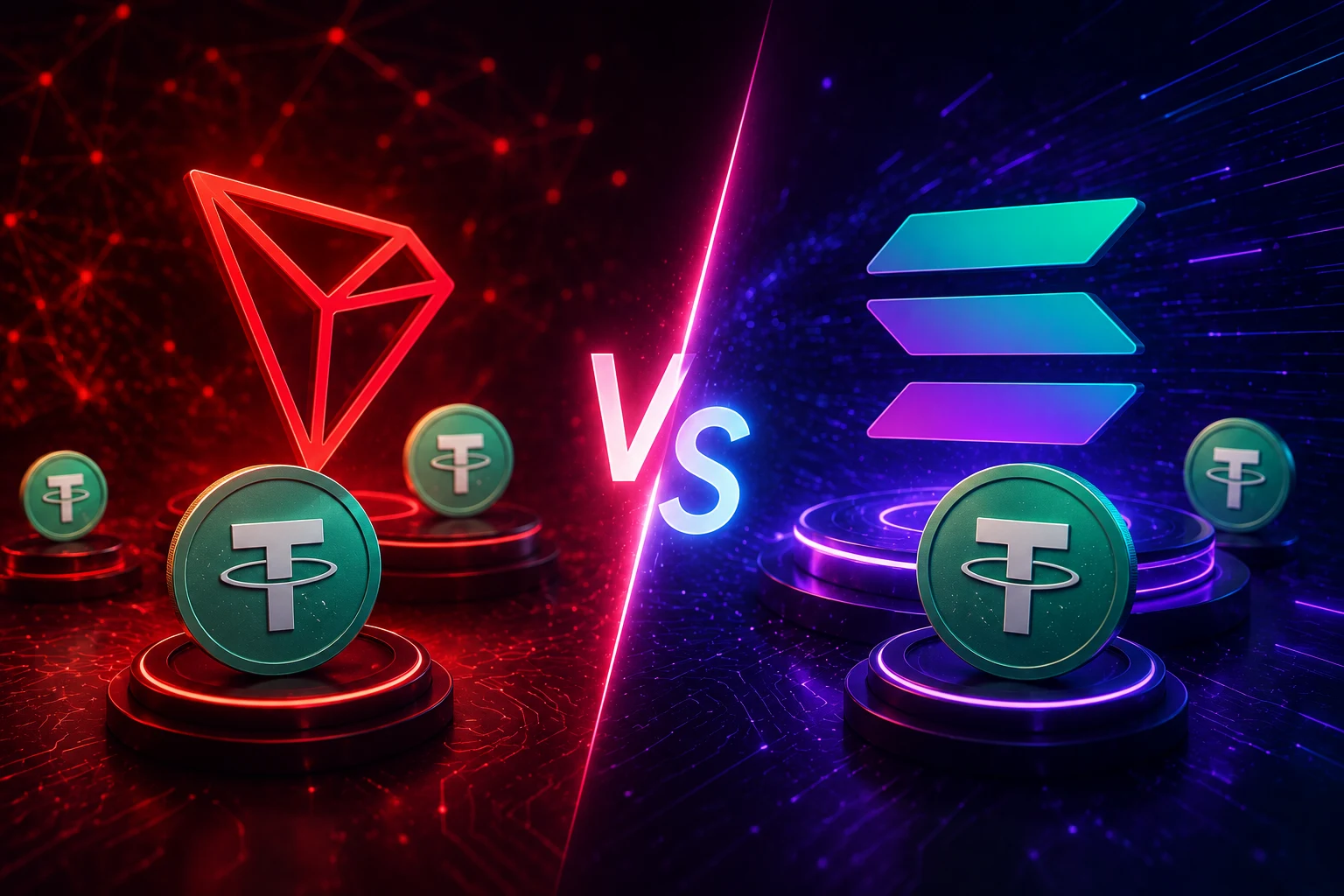
For most of the last decade, issuing or moving a stablecoin meant building on Ethereum. That default no longer holds. As of 2025, the two chains that move the most dollar-denominated value are not Ethereum mainnet at all. They are TRON, a network originally pitched as a content platform, and Solana, a high-throughput chain designed for consumer apps and trading.
For payments teams, the question is rarely philosophical. It is operational. Which chain settles a USD transfer cheaply, fast, and reliably enough to underwrite a remittance corridor, a card program, or a B2B settlement layer? Which one will a compliance officer sign off on? Which one will an engineer actually be able to integrate and monitor?
That is why a head-to-head matters. A payments architect who defaults to Ethereum in 2025 is paying $1 to $5 per transfer and waiting minutes for finality. An architect who defaults to the cheapest chain is accepting a different bundle of risks, from validator concentration to sanctions exposure to network downtime. There is no neutral choice, only a trade-off that needs to be explicit.
Risks before the rose-tinted comparison
Before any technical comparison, the failure modes need to be on the table. Stablecoin corridors are a place where weak assumptions get expensive fast.
TRON's specific risks. TRON's validator set is small and highly concentrated, with a meaningful share of block production controlled by the Tron Foundation and its partners. That means the network is fast and cheap precisely because it is not as decentralized as it markets itself. The other risk is regulatory. TRON has been named in U.S. Treasury OFAC enforcement actions and is associated with elevated volumes of illicit finance, including flows linked to sanctioned actors. For a regulated issuer, that association is not abstract. It affects banking relationships, partner screening, and audit posture.
Solana's specific risks. Solana's mainnet has suffered multiple full-network outages since launch, including several multi-hour halts in 2022 and 2023. A payments corridor cannot tolerate a chain that stops producing blocks. Client diversity is improving but still thinner than Ethereum's. The ecosystem is also more volatile, with sharp swings in transaction fees during congestion events, which complicates user-facing pricing.
Risks shared by both. Neither chain has Ethereum's depth of audit firms, formal verification track record, or decade of adversarial testing. Stablecoins issued on either chain inherit the underlying asset's smart-contract risk, the issuer's reserve risk, and the chain's settlement risk. A fast, cheap chain is not a free lunch.
How TRON became the de facto USDT rail
TRON's stablecoin dominance is not a mystery once you look at the incentives. Tether, the issuer of USDT, chose TRON as its second issuance chain after Ethereum in 2019, when TRON was actively subsidizing volume and courting issuers with zero-fee transfers. Eighteen months later, TRX-denominated TRC-20 USDT had become the highest-volume USDT format by transaction count, particularly for retail-sized transfers in emerging markets.
Three mechanics explain why. First, fees. A typical TRC-20 USDT transfer costs a fraction of a cent in TRX, and bandwidth and energy can be staked for free transfers for high-volume users. Second, finality. TRON's 27-super-representative consensus produces blocks every three seconds, and transactions are considered practically final within a minute. Third, liquidity. Because USDT is so widely held on TRON, recipients can move, swap, or off-ramp the token without bridging to another chain.
The result is a network effect that compounds. The more USDT sits on TRON, the more useful TRON is for dollar transfers. The more useful TRON is, the more issuers and exchanges integrate it. By 2024, multiple analytics firms reported that TRON carried between 40 and 55 percent of all USDT transfer volume by transaction count, with even higher shares in corridors like Vietnam, the Philippines, and parts of Latin America.
Why Solana is a credible alternative
Solana's pitch for stablecoin issuers is different. It is not winning on raw USDT volume, at least not yet. It is winning on technical capabilities that matter for new product designs.
Throughput and finality. Solana's mainnet processes thousands of transactions per second in normal conditions and achieves sub-second confirmation. Finality, defined as the point at which a transaction cannot be reverted except by a 51 percent attack, lands within a few seconds. For card payments, micropayments, and machine-to-machine settlement, that latency difference is the feature.
Programmable money. Solana's runtime supports a richer transaction model than TRON's, including on-chain program composability, oracle integrations, and token extensions. That makes it easier to build features like programmable yield, conditional transfers, or automated compliance hooks directly into a stablecoin.
Stablecoin diversity. While USDT dominates TRON, Solana hosts a more diverse mix of stablecoins, including USDC, PYUSD, and several emerging issuers. That diversity can be a feature or a bug depending on the use case, but it does mean issuers and integrators have more optionality.
The honest caveat is that Solana's USDT volume, while growing, remains a small share of total USDT flow. A payments corridor that needs deep USDT liquidity today is still likely to land on TRON or Ethereum.
Fee structure and finality, side by side
The headline numbers are useful, but the user experience is shaped by edge cases.
Cost per transfer
- TRON (TRC-20 USDT): Fractions of a cent. Users who stake TRX for bandwidth and energy can send USDT for free. Even casual users pay well under $0.01 per transfer.
- Solana (SPL stablecoins): A small fraction of a cent in SOL during normal conditions. Priority fees can spike during congestion, especially during NFT mints or liquidation cascades.
- Ethereum mainnet (ERC-20 USDT): Variable, typically $1 to $5 depending on L1 gas prices. Layer-2 rollups reduce this to a few cents, but add bridging complexity.
Finality
- TRON: Roughly 60 seconds to practical finality. 19 block confirmations are the standard exchange requirement.
- Solana: Roughly 12 to 13 seconds to confirmed finality, with optimistic confirmation in under a second.
- Ethereum: Roughly 12 to 15 minutes for full probabilistic finality, with L2 finality measured in minutes once messages settle to L1.
Outage history
TRON's mainnet has had a clean uptime record since 2021. Solana's mainnet has had at least seven significant outages in its history, including a five-hour halt in February 2023 and a multi-hour halt in September 2021. Outage frequency has dropped sharply in 2024 and 2025, but the risk is non-zero.
Validator count, decentralization, and censorship
Decentralization is not a vibe. It is a measurable property that affects censorship resistance, single points of failure, and regulatory exposure.
TRON operates with 27 super representatives producing blocks, with a smaller ring of candidates standing by. That is a small validator set by modern standards and meaningfully concentrated compared to chains with thousands of independent block producers. The practical consequence is faster consensus and lower fees, paired with a smaller set of entities that could in theory be pressured to censor transactions.
Solana runs with a much larger validator count, on the order of 1,500 to 2,000 active validators, though the Nakamoto coefficient (the minimum number of validators needed to halt the chain) is lower than that headline number suggests. Client diversity has improved with the rise of alternative validator clients like Jito-Solana and Firedancer in testing.
Neither chain comes close to Ethereum's roughly 1 million distributed validators, but Solana's setup is meaningfully more decentralized than TRON's, and that matters for issuers who want to argue their chain is credibly neutral.
Sanctions, OFAC exposure, and compliance posture
For any regulated issuer or payments team, this is the section that determines the decision.
TRON has been the subject of multiple U.S. Treasury actions tied to the use of USDT on TRON by sanctioned actors, most notably in connection with the Garantex exchange takedown. While TRON itself is not sanctioned, the chain carries a documented association with elevated illicit finance volume relative to its share of total crypto activity. Banks and payment processors handling TRON-routed flows typically apply enhanced transaction monitoring.
Solana has had fewer high-profile enforcement entanglements, though it has hosted sanctioned-address activity like every major chain. Its compliance tooling is more aligned with U.S. regulatory expectations, partly because the Solana Foundation is U.S.-based and engages directly with policy makers.
For a stablecoin issuer subject to U.S. jurisdiction, the practical difference is that Solana is easier to defend in a compliance memo. For a corridor serving regions where TRON is dominant by user demand, that audit posture may not matter. The risk lives in the institution, not the chain.
Developer tooling and integration costs
Technical elegance means little if a team cannot ship. Integration cost is where many of these decisions are actually made.
Solana's developer stack is rich and well-documented. The Anchor framework, a mature SDK ecosystem, and a large pool of Rust and TypeScript developers shorten the path from prototype to production. Indexing, oracles, and wallet integrations are standardized, and the SPL token standard is well understood. Hiring is easier because the developer community is larger and more active.
TRON's tooling has improved meaningfully, with TronWeb, TronStudio, and a Java-friendly VM, but the developer community is smaller and the documentation thinner. Hiring experienced TRON developers is harder. Integration with broader Web3 infrastructure, such as major wallets, custody providers, and cross-chain bridges, has closed the gap but still lags Solana.
For a small team with a tight timeline, the integration cost difference can be decisive. For a team optimizing purely for transaction economics, it is not.
How to choose between TRON and Solana in practice
The right answer depends on what the team is actually building.
If the use case is high-volume, low-value retail transfers in corridors where USDT is already dominant, TRON is the pragmatic default. The fee savings are real, the liquidity is deep, and the user expectation is set. Accept the centralization and regulatory trade-offs in writing.
If the use case is a new stablecoin product, a card program, or a use case that needs sub-second finality, Solana is the stronger foundation. Build for the capabilities you need, not the cheapest possible rail.
If the use case requires deep DeFi composability or access to the broadest liquidity, Ethereum or an Ethereum Layer-2 remains the right starting point, and TRON or Solana can be added as a second or third chain for specific corridors.
Most serious issuers in 2025 run multi-chain. The interesting question is not which single chain wins, but which chains earn their slot in the issuance map and on what terms.
Track stablecoin flows with Zippfeed
Stablecoin corridor decisions move with the news, and the news moves with regulation, exchange listings, and on-chain events that change the calculus overnight. Tracking which chain is gaining share, where the volume is migrating, and how the regulatory picture is shifting is a full-time job. Zippfeed surfaces stablecoin and chain headlines with sentiment scoring, bullish, neutral, or bearish, paired with an importance rating, so payments and treasury teams can see the signals that actually shift the trade-off. tron vs solana stablecoin coverage, USDT volume shifts, and OFAC actions are all tagged and ranked, so the next corridor decision is built on current evidence, not last quarter's assumptions.


 Lookonchain
 WuBlockchain
 TheBlock
 CoinTelegraph