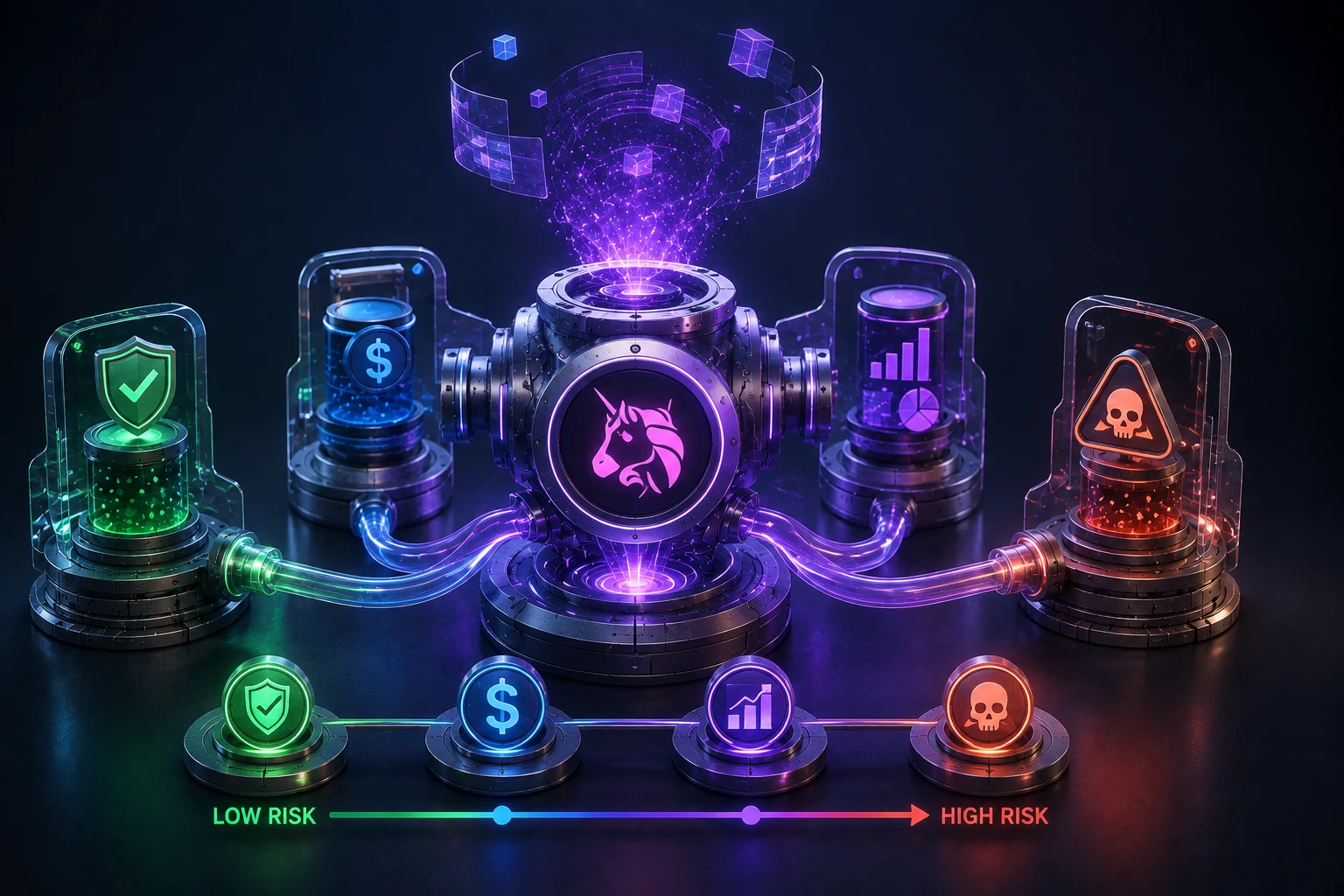
What problem v4 hooks are actually trying to solve
Uniswap v3 gave liquidity providers fine-grained control over what price range their capital sat in. That was a meaningful leap over v2's flat curve, but it left every pool stuck with the same fixed fee tier, the same simple swap logic, and the same exposure to a class of attacks called maximal extractable value, or MEV, where block producers and bots reorder, insert, or censor transactions to skim profit from traders and LPs.
v4's hook system is the answer to a single underlying frustration: if you wanted to do anything custom in v3, you had to fork the contracts, redeploy a parallel AMM, and fragment your liquidity away from the main pools. There was no clean way to bolt on a custom fee curve, an oracle, or a rebalancing rule without abandoning Uniswap's brand and liquidity network effects.
Hooks change that by letting a pool attach external smart contracts that the core router calls at well-defined points in the pool's lifecycle: before a swap, after a swap, before liquidity is added, after liquidity is removed, and around price changes. The pool owner picks a hook address when creating the pool, and that hook can read the pool's state, perform its own logic, and in some cases modify how the swap executes. The core math stays the same Uniswap concentrated-liquidity curve, but the wrapper around it can now do things that previously required a separate project.
Risks that come with hook complexity
Before walking through the use cases, the risks need to be front and center, because hooks move the failure modes. Several real wipeouts have already happened in the hook-style custom-contract world, and the pattern repeats: a smart contract that runs privileged logic against user funds gets exploited, often via a logic bug rather than a known cryptographic flaw.
The first risk is audit surface. Every hook is essentially a separate smart contract that can move tokens or alter swap behavior. When you deposit liquidity into a v4 pool with an exotic hook, you are trusting the pool creator, the hook developer, and any auditor they hired. A bug in the hook can drain the pool, freeze user funds, or let an attacker extract value from every swap that flows through it.
The second risk is centralization of code review. v3 had limited customization, which meant every pool could be reasoned about with the same mental model. v4 lets anyone ship a hook, and many of them ship fast. The Uniswap team reviews the core contracts, but hooks are largely a third-party free-for-all. Anyone reading a pool's hook address still has to treat the hook as a black box unless they read the code themselves or trust an audit report from a reputable firm.
The third risk is MEV when hooks are missing. Most pool creators will deploy a vanilla hook or none at all, which means the majority of v4 volume will probably flow through pools with the same sandwich-attack exposure as v3. Sandwich bots detect large pending trades, place a buy just before, and sell just after, capturing the price impact as profit at the LP's and trader's expense. Hooks can mitigate this, but only the pools that actually enable that protection get the benefit.
The fourth risk is rug patterns. Because creating a hook and pointing a pool at it costs little, scam projects can spin up a token, deploy a flashy hook promising some dynamic fee miracle, take user deposits, and disappear. The user has no recourse, and the Uniswap brand gives the surface a veneer of legitimacy that older fork-DEX scams never had.
Real use case 1: dynamic and custom fee curves
The most concrete win for hooks is replacing v3's flat fee tiers (0.05%, 0.30%, 1.00%) with logic that adjusts based on pool conditions. This is not a theoretical feature. Projects such as PancakeSwap's v4 deployment and several independent hook studios have already shipped fee hooks that respond to volatility, time-of-day, or volume bands.
The economic argument is straightforward. Stablecoin-to-stablecoin pools handle mostly small price movements and benefit from fees as low as 0.01%, while a long-tail token launch might see 20% moves in an hour and benefit from a fee closer to 1% to compensate LPs for the inventory risk. v3 forces every pool to pick one number. A hook can charge 0.01% during calm hours, ramp up to 0.50% during a volatility spike, and decay back when the market normalizes.
This also enables asymmetric fees, where the fee charged when buying a token differs from the fee charged when selling. That sounds odd, but launchpads and programmatic-token issuers genuinely want to subsidize sells (to ease post-launch exit liquidity) while taxing buys more heavily (to slow speculative inflows). v3 simply could not express that. v4 hooks can, by inspecting the swap direction and the token reserves before the trade settles.
Real use case 2: on-chain limit orders via hooks
In v3, the only way to place a true limit order was to add concentrated liquidity in a narrow range. Anyone could effectively become a micro-LP whose position would convert to one asset when price crossed into their range. That worked, but it locked capital into a position that no longer earned fees once filled.
v4 hooks let a pool implement a cleaner limit-order pattern. A hook can watch price, and when a user-specified price level is crossed, it executes a swap on the user's behalf, transfers output tokens to the user, and removes the now-empty position. From the user's perspective, it behaves like a limit order on a centralized exchange, but everything stays on-chain and the trade happens inside the same liquidity network as the rest of the pool.
This matters because it pulls activity that previously leaked to centralized order books back into on-chain venues. It also matters because it is genuinely composable: a hook can chain a limit-order fill with another action, such as routing the proceeds into a lending vault or swapping into a stablecoin. The trade-off is that the user is trusting the hook developer to faithfully execute the fill logic, and a bug in the hook can let an attacker front-run the fill or skip steps.
Real use case 3: MEV and sandwich resistance
The third category is where hooks have the strongest technical case, because MEV is a real, measurable tax on every on-chain trade. Hooks that are explicitly anti-MEV do a few things differently from a vanilla pool. They encrypt or commit to transaction contents before the swap settles, they batch and randomize execution order, or they detect sandwich patterns and reject the trailing leg of the attack.
The classic sandwich attack depends on the attacker seeing a victim's trade in the public mempool, buying first, and selling immediately after. If a hook introduces a commit-reveal scheme, where the trader submits a hashed intent first and only reveals the parameters inside the block, the attacker can no longer observe the trade in time to front-run it. The hook could also revert transactions whose surrounding gas pattern looks like a sandwich, at the cost of some false positives.
This category is real-world proven in adjacent designs. CoW Protocol and other batch-auction venues have demonstrated for years that batching and uniform clearing prices dramatically reduce the value available to extract. Hooks bring similar ideas to a single-pool structure rather than requiring a separate aggregator. The honest caveat is that anti-MEV hooks are themselves smart contracts, and the logic they use to detect and block attackers is itself attack surface. A poorly designed filter can be griefed, DoS-ed, or used to censor legitimate trades. The defensive code has to be at least as well-written as the offensive code it is trying to beat.
Real use case 4: TWAP oracles and LP rebalancing
Two adjacent ideas round out the practical list. The first is using a hook to publish a time-weighted average price, or TWAP, for the pool. Oracles are how DeFi protocols get price information on-chain, and Uniswap v3 TWAPs are already among the most-used price feeds in the space. A v4 hook can compute and expose a TWAP more cheaply than v3's external contract pattern, because the calculation can run inside the same hook execution as the swap.
The second is automated rebalancing. A hook can monitor a user's concentrated-liquidity position and, when price drifts out of the selected range, slowly migrate the position back into the active range, ideally using a sequence of small swaps to minimize the rebalancing cost. This is the closest thing v4 has to an active LP strategy, and it is genuinely useful for LPs who would otherwise have to manually rebalance every week.
These are less flashy than dynamic fees or anti-MEV, but they are useful, durable, and low-drama. They will probably ship in many pools without users ever noticing them, which is the mark of successful infrastructure.
Where hooks are mostly cosmetic
Social, governance, and reputation hooks
Every v4 cycle has produced a wave of pitches for hooks that implement novel social or governance behavior: fee rebates for long-term holders, weighted fees based on a user's on-chain history, or pools that distribute part of the fee to a community treasury. These are clever in design docs and almost always fail in practice.
The reason is simple economics. Adding a community treasury cut to a pool's fee mechanics makes the pool strictly worse for traders and LPs than an identical pool without that hook, unless the social mechanism produces some compensating flow. In a space where traders route to whichever pool gives them the best execution, a 5% fee skim to a treasury will simply be un-routed. The pool will sit empty, and the project will blame the market for not appreciating the value of the social layer.
Reputation hooks that pretend to gate access (KYC, sybil-resistance, geographic restrictions) are even worse. They can't actually verify identity on a public chain, they deter exactly the legitimate traders the pool needs, and they invite regulatory trouble that no anonymous hook developer wants.
\h3>Novel AMM math hiding inside hooks
A second cosmetic category is hooks that wrap a "new AMM curve" around the standard concentrated-liquidity math. The pitch is usually that a hook implements a stableswap invariant, a constant-mean curve, or some hybrid formula inside a hook layer. The math is real, but the result is a pool that competes with established stableswap venues such as Curve andBalancer on volume terms, and loses, because those venues have years of liquidity and integrations stacked on top of them.
Hooks are a powerful way to extend an existing liquidity network. They are a poor way to launch a competing one. Builders who want truly novel math should publish their own audited AMM and earn liquidity organically rather than renting the Uniswap brand for a hook that ships the wrong curve.
What this means for v3 LPs and builders
For existing v3 liquidity providers, the practical question is whether and how to migrate. The Uniswap team has signaled that v3 will remain supported, and v4 runs in parallel rather than as a forced upgrade. There is no official deadline to move, and the v3 pools still earn fees today. The honest answer is that a v3 LP should not migrate into a v4 pool just because v4 exists. They should migrate only when a specific v4 pool demonstrably offers better expected returns for their risk tolerance, whether through a dynamic-fee curve that suits their pair, an anti-MEV hook that reduces their sandwich losses, or an automated rebalancer that saves them manual work.
For builders, v4 lowers the cost of trying ideas that previously required a fork. That is the upside and the trap. Most hook ideas will not find product-market fit. The economic test is simple: does the hook make the pool better for the person actually routing trades through it, compared to a vanilla v4 pool at the same fee tier? If not, the hook is a feature for a marketing page, not a feature for users.
The audit calculus matters more than for almost any other DeFi primitive. A hook that touches token transfers or modifies swap execution has privileged access to user funds. The reputation of the hook developer, the quality of the audit report, whether the code is open source, and whether the deployer address has a history of clean launches are all signals an LP should weigh before depositing.
How to follow Uniswap v4 hooks the smart way
v4 hook development is moving fast, and so is the news around it: audit announcements, hook launches, exploits, and fee-tier experiments land every week. Zippfeed surfaces the most relevant UNI, Uniswap v4, and broader DeFi-AMM headlines with sentiment scoring (bullish, neutral, or bearish) and an importance rating, so you can filter signal from hype and track the hooks that genuinely change the economics for LPs and traders.

 CoinDesk
 Crypto Rank News
 Altcoin Daily
 Lookonchain