What problem Uniswap v4 is trying to solve
Uniswap v3 was a step forward in capital efficiency. Concentrated liquidity let LPs concentrate their deposits inside a chosen price range, so the same dollars could earn more fees than a v2-style full-range position. The trade-off was complexity: managing ranges, watching for impermanent loss, and paying gas to rebalance.
The v3 design also had a structural limitation that few retail users ever thought about. Every new pool was a new smart contract, deployed by the v3 factory. Hundreds of pools meant hundreds of contracts, each with its own storage, and each swap had to hop between contracts to route across pairs. That made gas expensive at exactly the moment Ethereum was trying to scale Layer 2.
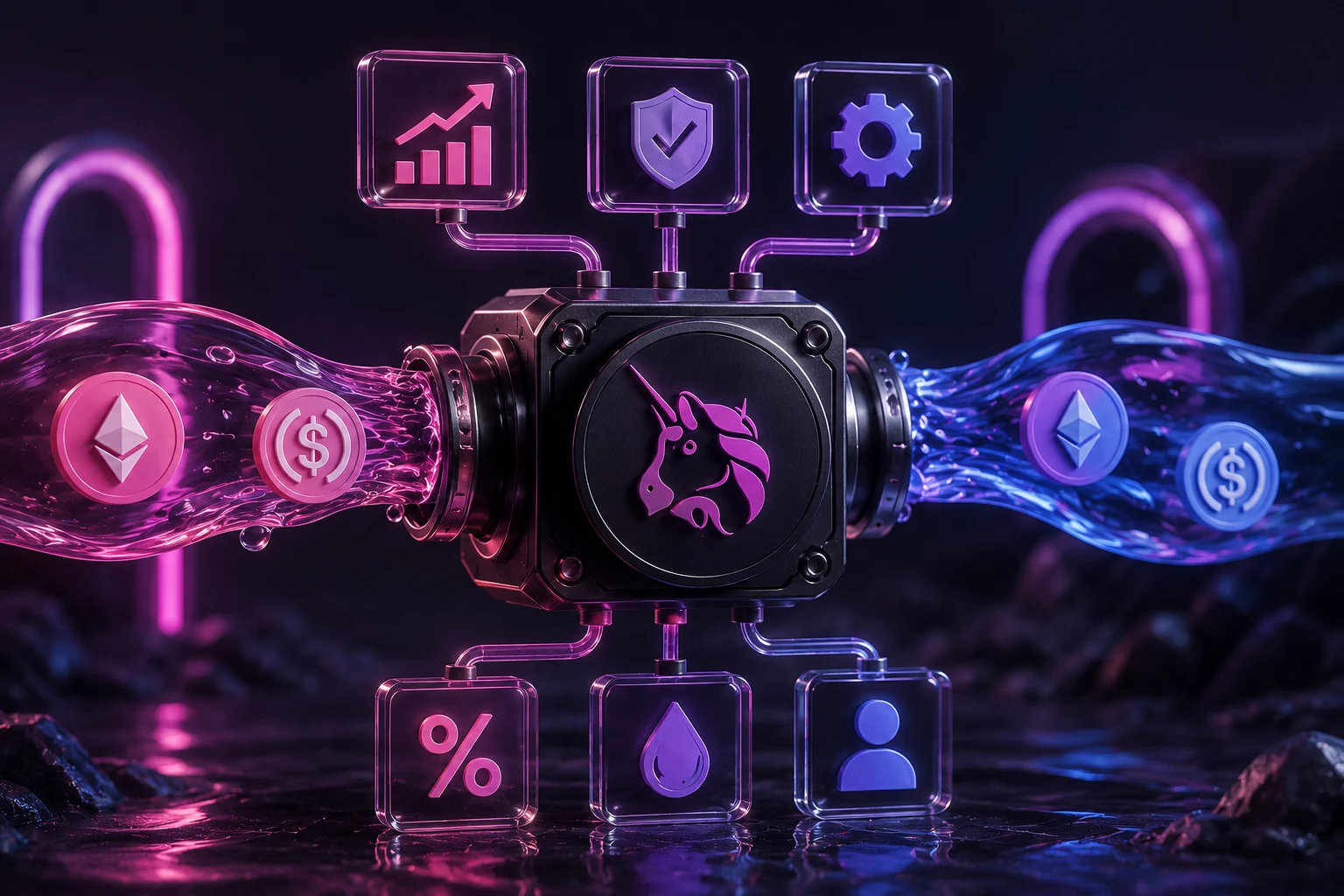
Uniswap v4 redesigns the plumbing around that problem. Instead of one contract per pool, the protocol collapses nearly everything into a single contract, the singleton, that holds all the liquidity and dispatches every action through one entry point. Hooks are the feature that makes that redesign flexible enough to keep the variety that v3 had, without the deployment overhead.
How the v4 singleton design changes the protocol
The headline architectural change in v4 is the singleton. In v3, deploying a new pool meant deploying a new contract. In v4, pools are effectively records inside one contract, and the same contract handles every swap, mint, and burn. This has three practical consequences for users.
First, multi-hop swaps become cheaper. A swap that goes USDC to WETH to UNI used to touch two or three pool contracts. In v4, it touches one. That sounds like plumbing, but on mainnet it can be the difference between a swap being economically viable and a user being pushed to a Layer 2 or a centralized exchange.
Second, the singleton can hold native ETH instead of wrapped WETH. Pool accounting was previously a story of wrapped tokens because every action needed a contract that could receive ERC-20 transfers. With one contract and a flash-accounting model, the singleton can credit and debit ETH directly, saving users the wrap and unwrap gas.
Third, gas is further reduced by a transient storage pattern the team calls "flash accounting." Instead of moving tokens in and out of the pool on every action, the singleton tracks deltas internally and only settles token balances at the end of a transaction. The end result is that v4 is meaningfully cheaper to swap on than v3, which matters for active LPs and for strategies that rebalance often.
There is, however, a tradeoff that is easy to miss. Concentrating the entire DEX into one contract also concentrates the blast radius of a bug. A serious vulnerability in the singleton would be a vulnerability across every pool on v4 simultaneously. That is the architectural mirror image of v3's fragmented risk, and it is part of why the team spent more than a year on audits before the broader rollout.
What a Uniswap v4 hook actually is
A hook is a smart contract that the singleton calls at specific points in a pool's lifecycle. The lifecycle events the protocol exposes include beforeSwap and afterSwap, beforeModifyLiquidity and afterModifyLiquidity, and beforeDonate and afterDonate. A hook registers itself with a pool, and the singleton dispatches to that hook at the relevant step.
You can think of a pool in v4 as having hooks and a liquidity position. The pool still uses the constant-product math that Uniswap is known for, unless the hook changes it. The hook is allowed to read the swap parameters, read the pool state, and write back a result that the singleton then uses. Crucially, the hook can also reject the action by reverting the transaction.
To make this work, the v4 team introduced a hook permission system. Each hook address encodes which lifecycle events it implements, and the singleton uses the low bits of the hook's address to look up a flag indicating which callbacks to fire. This is a gas-optimization trick, but it also means a hook's permissions are visible from its address alone, which is helpful for integrators and dashboards.
For builders, the practical model is this: you deploy a contract that implements the callbacks you care about, you register it with the pool you want to customize, and from that point on, every action on the pool passes through your code. You are essentially building a small AMM, or an automated market manager, on top of Uniswap's settlement layer.
What hooks actually enable: custom AMMs and dynamic fees
The marketing pitch around hooks is that "Uniswap becomes a platform instead of a product." That is mostly true, and the easiest way to see why is to walk through what hooks can actually do.
Dynamic and tiered fees. A hook can change the fee charged on a swap based on conditions. For example, a stablecoin hook could charge a fraction of a basis point when the price is close to peg, and a higher fee when volatility is high. A hook could also charge a different fee depending on whether the swap moves the price up or down, which is a primitive form of MEV capture for LPs.
Custom AMM curves. The default v4 pool still uses the x*y=k constant-product formula, but a hook can effectively run any pricing model. You can build a stableswap invariant for low-volatility pairs, a Curve-style hybrid curve, a Gaussian or mean-reverting curve for synthetic assets, or even a hook that follows an external oracle entirely. The pool becomes a general-purpose liquidity venue, with Uniswap providing the settlement, the routing, and the security model of the singleton.
Onchain limit orders and TWAMM. A beforeModifyLiquidity hook can convert single-tick liquidity additions into limit orders: the LP specifies a price range, and the hook mints and burns positions as the market price crosses that range. Time-weighted average market maker strategies, where a large order is sliced into many small swaps over hours, can also be expressed as a hook.
Onchain oracles and LP protections. A hook can write a TWAP, a VWAP, or any other statistic to storage on every swap, which other contracts can read cheaply. Hooks can also enforce rules like "no swaps in the last block of a 1-minute window," which is a crude but useful form of anti-MEV protection, or implement kill switches that pause a pool if certain conditions are met.
Native ETH and gas refunds. Because the singleton holds ETH, hooks can implement gas rebates in ETH for LPs, or pay out MEV rewards in ETH rather than in the swappable token. This is small for an individual user, but it is a structural lever for protocol designers trying to attract liquidity.
None of this is automatic. Every feature above requires a developer to build, deploy, and maintain a hook. Uniswap is shipping a toolkit, not a feature list.
The security risks of unaudited hook code
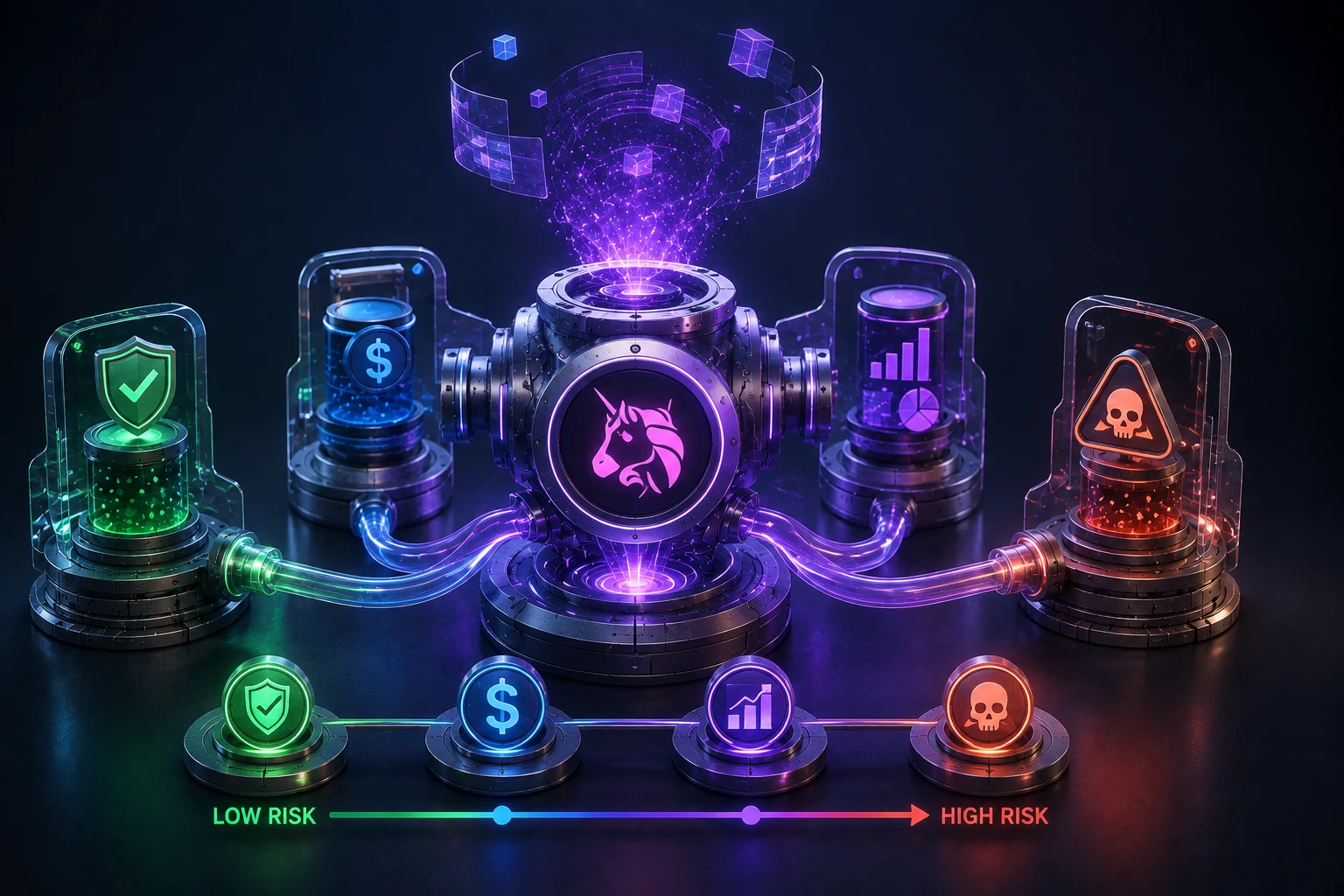
Every new hook is a new smart-contract surface, and that is the part of the v4 story that deserves the most attention. In v3, the contracts that held liquidity were a relatively small, well-audited set. In v4, anyone can register a hook with a pool, and that hook gets to run code in the critical path of every swap, mint, and burn on that pool.
The risks fall into a few categories, and LPs should know each one before they deposit into a hook-enabled pool.
Logic bugs in the hook. A bug in beforeSwap or beforeModifyLiquidity can corrupt the pool's accounting, allow withdrawals that exceed deposits, or freeze the pool entirely. Because the singleton is the source of truth, the hook cannot directly steal tokens, but it can still leave the pool in a state that is exploitable by a follow-on transaction, often within the same block.
Reentrancy and cross-hook interference. Hooks are external contracts, and a malicious hook can reenter the singleton or call other hooks on the same pool. The protocol has reentrancy locks, but the surface for cross-hook interaction is novel and not all of it has been battle-tested. Two hooks attached to the same pool, for example, can compose in ways that no individual audit covered.
Admin keys and upgradeability. Many hooks are deployed with an owner address that can change parameters, pause behavior, or upgrade the contract. An admin key is a single point of failure: a compromised key can change the hook's behavior while the pool is still live, and LPs may have no clean way to withdraw before the change takes effect. A multisig with a timelock is better than an EOA, but it is still trust.
Oracle manipulation. Hooks that read external oracles, or that change fees based on price, are only as safe as the oracle. A manipulated oracle can trick a hook into charging a zero-fee swap that drains LPs, or into locking the pool in a state that benefits the attacker.
Concentrated risk inside the singleton. A hook bug that affects one pool still affects one pool. But certain classes of bug, especially those that interact with the singleton's accounting of native ETH, could in principle ripple across many pools at once. This is not unique to v4, but the singleton makes the topology more dangerous than v3's per-pool design.
The honest summary is that hooks are the part of v4 that a casual user cannot evaluate on their own. "This pool uses a hook" is not a label that should be ignored. The safer assumption is to treat any hook as a third-party smart contract that has custody of the swap path, and to weigh the additional risk against the additional yield.
MEV, LP protection, and the realistic upside
Maximal extractable value, the profit that block producers and searchers can capture by reordering, inserting, or censoring transactions, is one of the persistent background costs for LPs. Sandwich attacks, in particular, extract value from swaps by trading ahead of and behind the user's transaction. LPs absorb the loss because the pool's effective price is worse than the price the user agreed to.
Hooks are a credible tool for reducing that cost. A beforeSwap hook can check whether the transaction is part of a sandwich, using commit-reveal schemes, signed memos, or private transaction paths, and revert the swap if it detects one. A hook can also enforce that swaps only land in certain block positions, charge higher fees to transactions that look like sandwiches, or split large swaps into smaller atomic chunks that are harder to sandwich.
On the other side, hooks are also a new MEV surface. A hook with privileged access to swap parameters and pool state can be used by its operator to front-run users on that pool. The protocol cannot prevent this in the same way it cannot prevent an oracle operator from manipulating an oracle. The mitigation is the same as in the rest of DeFi: reputation, audits, public monitoring, and a community willing to pull liquidity when a hook behaves badly.
The realistic upside for serious LPs is real but bounded. A well-designed hook on a deep pool can meaningfully reduce adverse selection, which is the technical term for "my trade got picked off." That translates into higher net APR, sometimes several percentage points. It is not a magic trick, and it is not a substitute for understanding the pool you are in.
What this means for liquidity providers and builders
If you are an LP, the v4 world demands a slightly different workflow than v3. Before depositing, you should be able to answer four questions. Which hook is attached to this pool, and what does it actually do? Who can change the hook's parameters, and on what timeline? Has the hook been audited, and by whom? What is the failure mode if the hook stops working entirely, is your position still withdrawable?
If the answer to any of those is "I don't know," the pool is not the right place to park the majority of your capital. Yield that comes from a hook you cannot reason about is yield that can disappear overnight. The same advice that applied to v3 applies more so to v4: size positions to what you would be willing to lose in a worst-case smart-contract bug, not to the headline APY.
If you are a builder, hooks are a genuine expansion of the design space. You can ship a custom AMM in weeks rather than months, you can iterate on pricing curves without forking Uniswap, and you can compose with the existing v4 router, which gives you liquidity access you would otherwise have to bootstrap yourself. The catch is that you are also shipping a security product. The most thoughtful hook teams in the v4 ecosystem are treating audits, bug bounties, and incident response as part of the product, not as overhead.
One practical note for both groups: v4 is intentionally more permissionless than v3, and the team has been clear that they will not curate a default list of "approved" hooks. The market is expected to do that work through reputation, dashboards, and aggregators. Until those signals mature, every hook decision is a personal risk decision.
How to follow Uniswap v4 hooks the smart way
Uniswap v4 hooks move fast, and so does the news around them. New hook designs, audits, exploits, and migrations are announced across research forums, governance threads, and project blogs, and reading each one in isolation is a losing game. Zippfeed surfaces Uniswap v4 hook headlines with sentiment scoring (bullish, neutral, or bearish) and an importance rating, so you can separate genuine protocol developments from hype and track which hooks are gaining real liquidity versus marketing share.

 CoinDesk
 Crypto Rank News
 Altcoin Daily
 Lookonchain