What Uniswap v4 hooks actually turn a pool into
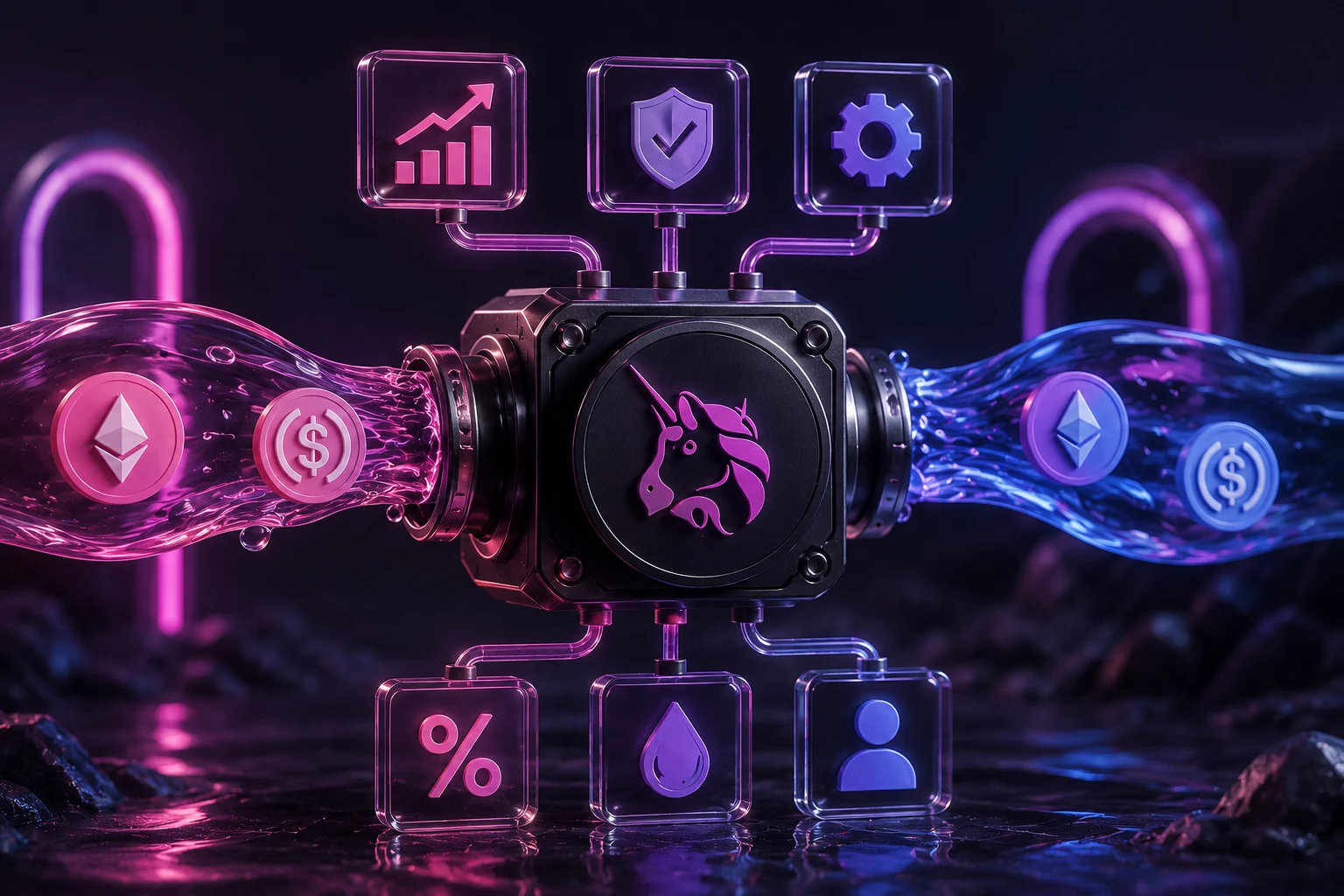
Uniswap v4 hooks are smart contracts that can run at defined points in a pool's lifecycle. A hook may execute before or after a pool is initialized, liquidity changes, a swap occurs, or a donation is made. This lets a developer add logic such as dynamic fees, limit-style orders, time-sliced trades, access controls, oracle updates, or external lending activity without modifying Uniswap v4 core.
That description can make hooks sound like plug-ins. Financially, they are closer to programmable policy engines. A basic Uniswap pool follows known accounting rules, while a hooked pool can impose additional rules, move assets, calculate its own deltas, or interact with another protocol. Two pools holding the same tokens may therefore have completely different security and liquidity profiles.
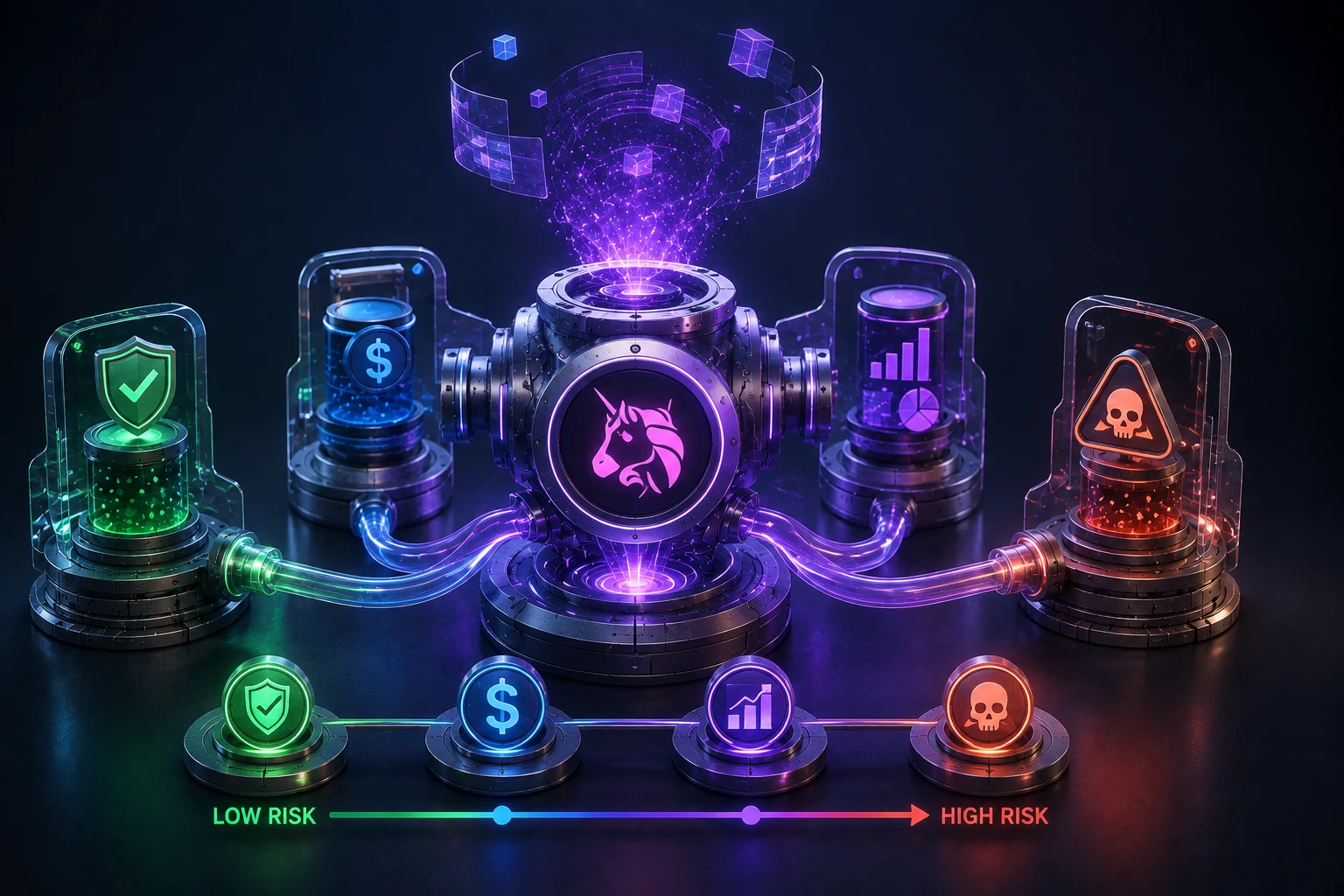
The useful question is not whether hooks are good or bad. It is how much authority a particular hook has, how many external assumptions it introduces, and what happens when those assumptions fail. The ranking below treats simpler hooks with limited permissions as relatively lower-risk, not safe, and places custody, leverage, credit, complex accounting, or upgrade powers toward the high-risk end.
How the hook system works and where risk enters
Uniswap v4 uses a singleton architecture, meaning many pools are managed through one central PoolManager contract rather than each pool being deployed as a separate contract. Flash accounting records net token obligations during a transaction and settles them before the operation completes. This can reduce gas use and make multi-pool operations more efficient, but it also means hook developers must understand lock, settlement, and balance-delta rules precisely.
A pool chooses its hook contract when the pool is created. The hook address encodes which callbacks are enabled, and those permissions cannot simply be treated as descriptive labels. Code running in callbacks can reject an action, alter fees, return custom token deltas, update internal records, or call another contract. A mistake in any of those paths may affect swaps, liquidity withdrawals, or settlement.
Hooks can also use custom accounting to change the economic result delivered by the PoolManager. That is powerful enough to reproduce features associated with other automated market maker designs, but it expands the trusted code base. If a hook maintains virtual balances, accrued fees, order claims, debt positions, or reward shares, users depend on both Uniswap's accounting and the hook's accounting remaining consistent.
The singleton does not mean one malicious hook can automatically rewrite every Uniswap v4 pool. Pools remain logically separated, and callback permissions constrain when hook code runs. Still, integrations that batch calls, reuse routers, approve broad token allowances, or assume all v4 pools behave alike can create shared failure paths. Developers should model the complete transaction route, not just the hook's callback function.
The risks developers and LPs should examine first
Hook reentrancy is a primary concern. Reentrancy occurs when an external call returns into a contract before the original operation has finished updating its state. Uniswap v4 has locking and settlement rules, but a hook may call tokens, routers, lending markets, or other hooks with their own callback behavior. A local reentrancy guard is not enough if the design allows cross-function or cross-protocol state changes in an unexpected order.
Singleton-pool risk is partly an integration risk. The audited PoolManager may enforce its invariants while an application miscalculates what it owes during a lock, confuses one pool's state with another, or accepts a maliciously configured pool. Routers and position managers must validate currencies, fee settings, hook addresses, callback senders, and returned deltas. A hook should never trust user-supplied pool identifiers merely because a call originated somewhere in the v4 system.
Early hook-based deployments have already shown that real losses do not require a flaw in Uniswap v4 core. Cork Protocol, which used custom market and AMM machinery connected to the v4 ecosystem, suffered an exploit reported at roughly $12 million in 2025 after an attacker abused protocol-specific accounting and market logic. Bunni v2, a hook-based liquidity system, later suffered a reported loss of about $8.4 million linked to custom liquidity and withdrawal accounting. Exact classifications and recovered amounts can change as postmortems develop, but both cases reinforce the same point: custom financial logic can fail while the underlying PoolManager behaves as designed.
Other recurring failure modes include rounding errors that can be repeated for profit, stale or manipulable oracle inputs, denial of service that traps normal operations, fee calculations that overflow economic expectations, privileged keys that can change parameters, and tokens with unusual transfer behavior. Scam risk also remains straightforward. A deployer can publish copied hook code, advertise an audit that covered a different commit, retain an upgrade key, or create a pool whose withdrawal conditions are intentionally hostile.
Lower-risk patterns: fees, ranges, and narrow automation
Relative risk: lower to medium. Dynamic-fee hooks. A dynamic-fee hook changes the swap fee according to a stated rule, such as recent volatility, trade size, inventory imbalance, or an external oracle. The pattern has precedent in automated market makers outside v4, and a fee update does not inherently require the hook to custody user assets. A simple bounded formula using onchain observations is among the more defensible Uniswap v4 hooks use cases.
The qualification is important. A dynamic fee can still be manipulated if an attacker can distort the observation used by the formula, and a badly tuned fee can make execution unexpectedly expensive. Fee rules should have explicit minimums and maximums, predictable update intervals, protection against single-block manipulation, and tests for inactive or illiquid markets. LPs also need to know whether an administrator can replace the formula or override the fee.
Relative risk: medium. Concentrated liquidity and range-order hooks. Concentrated liquidity lets an LP provide assets only within selected price ranges. A range-order hook can automate adding, removing, or claiming liquidity when a price boundary is crossed, producing behavior similar to an onchain limit order. This can reduce manual management, but it does not guarantee execution at a chosen price because price can cross a range and reverse, transactions can be reordered, and fees or slippage can change the outcome.
The safer versions use narrow permissions, avoid leverage, keep claims fully collateralized, and make cancellation and withdrawal available even when automation fails. More complex versions continuously rebalance positions, compound fees, issue vault shares, or depend on an offchain keeper. Those additions move the design toward a managed vault and raise its risk. Readers comparing this pattern should also review concentrated liquidity risks for LPs, including impermanent loss, inactive liquidity, and adverse selection.
Higher-risk patterns: anti-MEV, TWAMMs, and lending
Relative risk: medium to high. Dynamic-fee and anti-MEV hook patterns. MEV, or maximal extractable value, is value gained by controlling transaction ordering. An anti-MEV hook may use batch auctions, encrypted orders, private order flow, commit-and-reveal steps, speed bumps, or fees that rise when trading behavior looks predatory. These mechanisms can reduce a particular attack under specific assumptions, but no generic callback can remove all MEV.
An anti-MEV design may simply move trust elsewhere. A private relay can censor orders, a sequencer can retain ordering power, a batch auction can depend on a solver, and a detection formula can punish legitimate arbitrage while missing a sophisticated attacker. MEV-capture hooks go further by attempting to redirect arbitrage value to LPs or another recipient. That creates questions about oracle accuracy, auction competition, transaction inclusion, rebate accounting, and who controls the captured revenue. These designs need adversarial economic testing as well as a conventional code audit.
Relative risk: high. TWAMM hooks. A time-weighted average market maker, or TWAMM, splits a large order into smaller virtual trades executed over time. The idea predates v4 and can reduce the immediate price impact of a large trade. A hook can keep long-term order state and settle portions of those orders when pools are touched, but it must handle sparse activity, cancellation, partial claims, rounding, fee growth, and price movement between execution intervals.
Relative risk: very high. Lending hooks using Uniswap v4 with Aave or Compound. A lending hook might deposit idle liquidity into a lending market, borrow against LP assets, route swaps through collateral positions, or automatically adjust debt. The potential capital efficiency comes with stacked risk: the hook, Uniswap v4, the lending protocol, its oracle, liquidation mechanics, supported tokens, and governance controls can each fail. Aave or Compound may be extensively reviewed, but integration code can still approve the wrong asset, misread interest-bearing balances, exceed safe collateral limits, or make withdrawals unavailable when lenders need them most.
How to decide whether a hook is ready to deploy
Start with authority, not the product description. Identify every callback, external call, asset approval, administrative role, upgrade mechanism, oracle, keeper, and emergency control. Determine whether the hook can take custody, create debt, return custom deltas, block withdrawals, change fees without delay, or redirect revenue. If documentation cannot answer those questions at the deployed-address level, LPs do not have enough information to assess the pool.
Audit labels require careful reading. Uniswap v4 core and official periphery components have received reviews from multiple security teams and extensive testing, but those reviews do not extend automatically to third-party hooks. Major libraries such as OpenZeppelin's v4 hook utilities can provide reviewed building blocks, yet repository status, scope, version, and exclusions must be checked at the time of deployment. Experimental examples from hackathons, incubators, template repositories, or research projects should not be described as production-audited unless a published report covers the exact commit and configuration.
A credible deployment should provide source verification, tests for callback and settlement invariants, fuzz testing, an independent audit, remediation evidence, and a meaningful bug bounty. Stateful fuzzing is especially useful because it generates long sequences of swaps, deposits, withdrawals, cancellations, and external calls to find states ordinary unit tests miss. For lending or MEV systems, the review should also include economic attacks, oracle manipulation, liquidation stress, and periods when external infrastructure stops responding.
LPs should still size exposure around failure, not around audit marketing. Prefer immutable or tightly delayed controls, capped deposits during early operation, isolated token approvals, and a clear exit path. Avoid unaudited hooks with meaningful custody or borrowing powers. UNI ownership does not provide direct insurance against a hook failure, and governance visibility should not be mistaken for responsibility for third-party code. This is a technical risk framework, not financial advice.
Track Uniswap v4 hook risk with better context
Uniswap v4 development changes quickly, and a headline about a launch, audit, exploit, pause, or integration rarely tells LPs which contract and assumption are affected. Zippfeed organizes Uniswap, UNI, DeFi, and hook-related coverage with bullish, neutral, or bearish sentiment scoring plus an importance rating, helping you separate material security updates from routine promotion before reviewing the primary code and reports yourself.

 Lookonchain
 Altcoin Daily
 CryptoSlate
 Benjamin Cowen