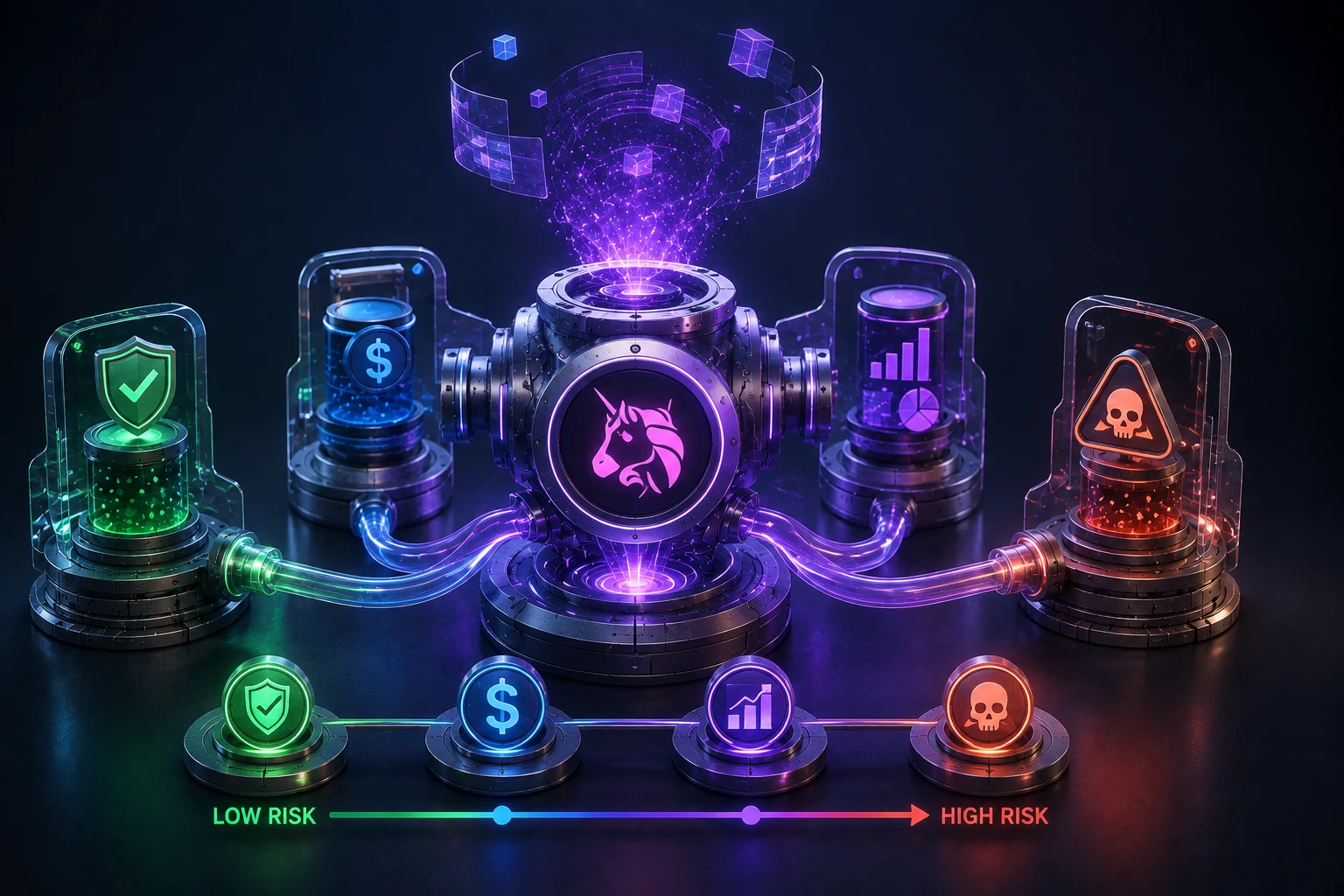
What Uniswap V4 hooks actually change
Uniswap V4 hooks are smart contracts that a pool can call at specific moments, such as before or after a swap, before adding liquidity, or after removing liquidity. A hook can adjust a fee, record price data, reject an action that breaks a rule, or run custom accounting. The important distinction is that a hook is not a setting inside a standard pool. It is separate code, with its own logic and its own security profile.
That flexibility addresses a long-running limitation in automated market makers, or AMMs. Earlier Uniswap designs gave pool creators a narrow set of built-in choices, while more specialized market designs required a separate protocol. V4 makes experimentation easier, but it also means that two pools holding the same tokens can have materially different behavior. A familiar token pair does not mean a familiar risk profile.
V4 combines pools under a singleton architecture, meaning one central PoolManager contract manages many pools rather than deploying a separate core contract for each one. This can reduce deployment and transaction overhead. It also makes hook interactions more composable, but a bug in a hook remains a risk to users of the pool attached to it, even when the underlying PoolManager is sound.
Why hooks raise the risk bar for liquidity providers
A hook is another smart contract in the path of a trade or liquidity action. That creates classic technical risks: reentrancy, where an external call unexpectedly re-enters code; faulty access controls; incorrect token accounting; denial of service; and bad assumptions about price or timing. An audit is evidence that reviewers looked for problems, not a guarantee that none remain. New hook patterns have less battle testing than long-used pool templates.
Crypto history gives little reason to treat complexity casually. The 2023 Euler Finance exploit affected roughly $197 million before much was later returned, while a Vyper compiler issue contributed to losses across several Curve pools in 2023. These incidents were not Uniswap V4 hook failures, but they show how a small interaction or implementation error can put large balances at risk. A pool can have a reputable interface and still rely on vulnerable code underneath.
Control risk matters as much as code risk. A hook may have an owner who can change fees, pause swaps, alter an oracle source, upgrade implementation code, or redirect collected fees. Some teams use multisignatures and timelocks, which can reduce unilateral control but do not eliminate it. A malicious or compromised administrator can turn a seemingly neutral pool into a trap, particularly if users approve tokens or deposit before reading the hook’s permissions.
Scam patterns can also be more subtle than an obvious rug pull. A hook might advertise low fees but charge an unusual fee during volatile blocks, block withdrawals under vague conditions, or use an upgrade proxy that later points to new code. Liquidity providers should treat unaudited hooks, anonymous administrators, and opaque upgrade paths as high-risk conditions, not minor disclosures.
Use case one: dynamic fees that respond to market conditions
Dynamic fees are one of the clearest Uniswap V4 hooks use cases. Instead of charging a fixed percentage on every swap, a hook can set a higher fee when short-term volatility rises and a lower fee when trading is calm. The basic economic idea is reasonable: liquidity providers face more adverse selection when price is moving rapidly, because informed traders are more likely to trade against stale liquidity.
A well-designed dynamic-fee hook can use recent price movement, trade size, inventory imbalance, or external market conditions as inputs. For example, a pool might charge a base fee during normal activity, then increase it when the price moves sharply across several observations. That can make passive liquidity less exposed to fast-moving flow, though it cannot remove impermanent loss, which is the opportunity cost that arises when an AMM rebalances between assets as their relative price changes.
The trade-off is easy to miss. A fee rule based on a manipulable spot price can be gamed by an attacker who first moves the price, triggers a new fee tier, then trades under more favorable conditions. A fee that updates too slowly may not protect liquidity providers, while one that updates too aggressively can make execution unpredictable and push traders elsewhere. The right parameters depend on the asset pair, trading depth, and user behavior, none of which remain stable.
Builders should disclose the exact inputs, update cadence, maximum fee, and authority that can alter those rules. Liquidity providers should compare actual net results after fees, price divergence, and gas costs. A large displayed fee yield is not proof of a better pool if it mainly compensates for unusually toxic order flow.
Use case two: on-chain TWAP oracles and limit orders
A time-weighted average price, or TWAP, averages prices across a defined period rather than relying on the latest trade. A hook can record observations and make a pool-specific on-chain TWAP available to other contracts. This can support settlement rules, dynamic fees, or applications that need a less jumpy price reference than a single block’s spot price.
TWAPs reduce sensitivity to a one-block price move, but they do not create truth from nothing. If a pool has thin liquidity, an attacker may sustain a manipulated price long enough to influence the average. The longer the averaging window, the harder and more expensive manipulation can become, but the slower the oracle responds to a genuine market move. Protocols using a hook-based TWAP should state which pool supplies it, how often observations are written, and what happens if trading stops or data becomes stale.
Hooks can also approximate limit orders. In a conventional limit order, a user asks to buy or sell only at a chosen price or better. In an AMM, users can provide concentrated liquidity within a price range. A hook can track a position, apply conditions around its range, and automatically manage or settle behavior when the market reaches a trigger. This can make the experience closer to an order book without requiring a centralized matching engine.
But limit-order-like hooks have important caveats. Execution is not guaranteed just because the market briefly touches a displayed price. Liquidity must be available, transactions must be included, and the hook’s trigger logic must operate as intended. Fees, partial fills, price gaps, and MEV can change the realized result. Users should understand whether the hook holds funds, whether positions are transferable, and how cancellation or settlement works before treating it like a traditional exchange order.
Use case three: MEV-capturing hooks and their hidden costs
MEV, short for maximal extractable value, is value gained by controlling transaction ordering or inclusion. In AMMs, arbitrageurs often capture value when an external market price changes and the pool price catches up. Some V4 hook designs aim to redirect part of that value to liquidity providers through auctions, batch execution, or rules that charge certain arbitrage flow more directly.
This is a real design opportunity, not a free upgrade. A hook might run a periodic auction for the right to rebalance a pool, use a private order-flow arrangement, or impose a surcharge on trades identified as toxic. If it works as designed, more value may remain with liquidity providers. Yet identifying harmful flow is difficult, and an auction mechanism can favor sophisticated searchers, validators, or a preferred solver network.
The centralization concern is especially important. A hook that depends on one off-chain operator to submit prices, choose winners, or sequence orders has introduced a trusted intermediary, even if the pool itself is on-chain. A decentralized-looking interface can conceal a privileged relayer or a small group of governance voters. The relevant question is not whether the code uses blockchain, but who can influence execution and what recourse users have if they fail.
MEV-capturing claims should therefore be tested against measurable outcomes. Does the hook publish auctions and bids? Are users receiving better execution after all fees? Can anyone participate as a solver? Are rules enforced by contracts or by an operator’s promise? Until those answers are clear, higher projected liquidity-provider returns are only a hypothesis.
How the permission system and singleton architecture shape safety
Uniswap V4 does not let a hook arbitrarily choose every callback after deployment. Its hook permission system uses designated permission bits associated with the hook address to specify which lifecycle functions the contract may use. Deployers commonly use CREATE2, a method for deploying a contract to a predictable address, to obtain an address compatible with the requested permissions. This constraint helps make a hook’s allowed callback surface more explicit.
Permission bits are useful, but they are not a safety certificate. A hook with only a few callbacks can still contain dangerous logic, and a hook with broad permissions may be appropriate for a complex design. Readers should distinguish between permission scope and code quality. The former tells you where a hook can act. The latter determines whether it acts correctly, fairly, and without hidden administrator powers.
The singleton architecture changes the economics of deployment and can make multi-pool interactions more efficient through shared accounting. It does not mean every pool shares the same hook or the same governance. Pool-level due diligence still matters: identify the hook contract, read its verified source if available, check whether it is upgradeable, inspect privileges, and look for independent reviews that cover the deployed version rather than an earlier repository commit.
What builders, traders, and liquidity providers should do
Builders should start with the narrowest hook permission set and the simplest possible state machine. Separate core accounting from optional features, test adversarial paths, and disclose every privileged role. Independent audits, bug bounties, simulation against volatile market data, and capped launch liquidity can all reduce risk, though none replaces careful design. A hook that needs emergency controls should also define who can use them, how long they last, and whether users can exit during an emergency.
Liquidity providers should not judge a hooked pool only by its fee tier or annualized yield. Check the assets, the hook’s source and audit status, upgradeability, owner powers, oracle dependencies, withdrawal conditions, and whether the strategy relies on off-chain actors. Small test positions can reveal basic interaction issues, but they cannot reveal every tail risk. Never commit funds you cannot afford to lose to an experimental hook.
Traders should compare the quoted execution against standard pools and remain alert to custom fees or restrictions. If a hook uses a TWAP or auction, understand whether the final price is deterministic at submission or depends on later settlement. For related background, compare impermanent loss in liquidity pools, how concentrated liquidity works, and MEV in decentralized exchanges. This is education, not financial advice, and no pool design makes DeFi risk-free.
Read Uniswap V4 hook news critically
Uniswap V4 hooks move quickly, and so do claims about new pool designs. Tracking audits, upgrades, governance changes, liquidity shifts, and exploit reports manually is difficult. Zippfeed surfaces Uniswap and UNI-related headlines with bullish, neutral, or bearish sentiment scoring plus an importance rating, helping you separate a useful implementation update from unsupported marketing.
Use news signals as a starting point, not a substitute for contract review. A bullish announcement may describe a promising feature while leaving audit scope, admin privileges, and real-world usage unanswered. For money at risk, those unanswered details matter more than the headline.

 CoinDesk
 Crypto Rank News
 Altcoin Daily
 Lookonchain