Why storage tokens look attractive, and why that framing is dangerous
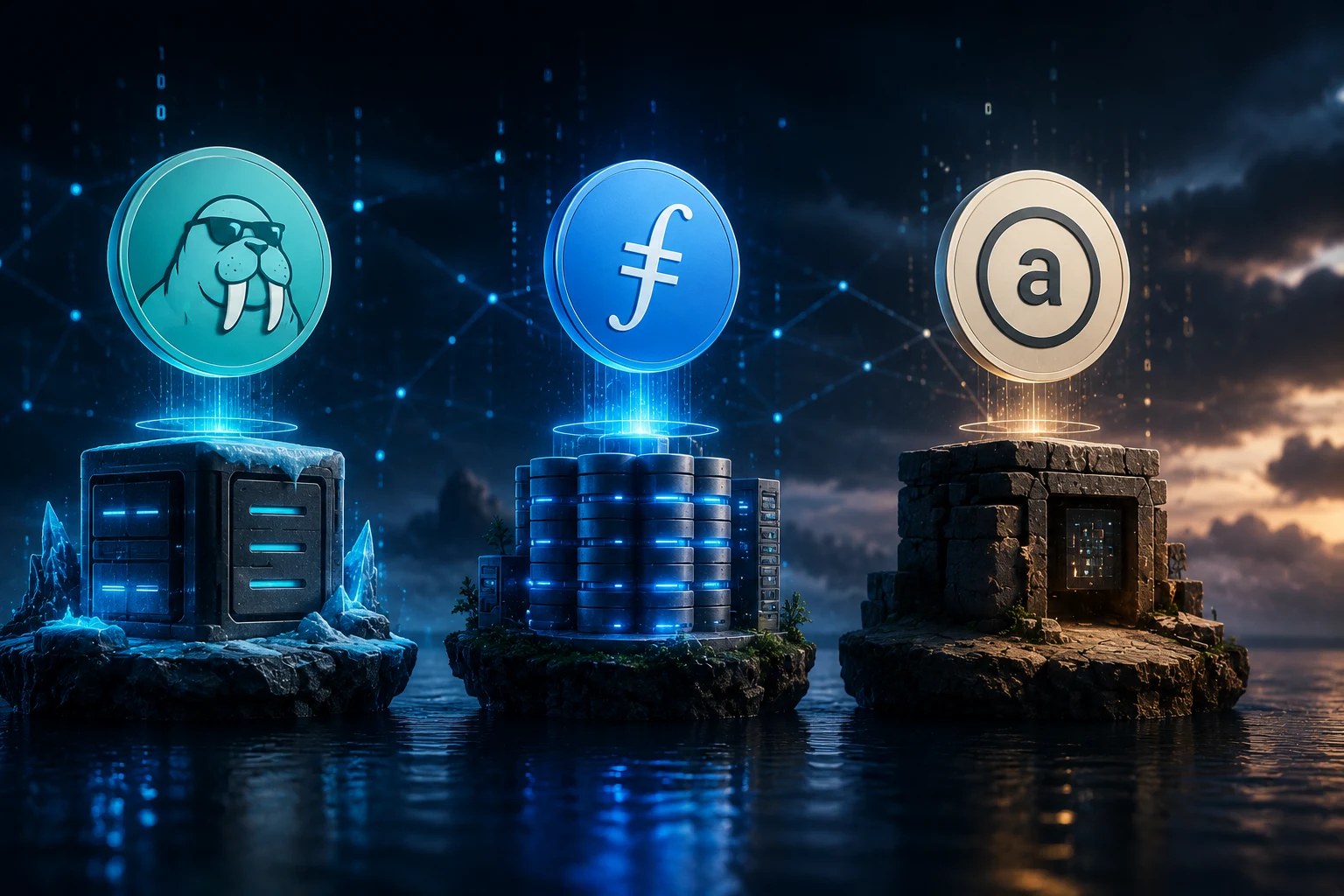
Decentralized storage is one of the cleanest crypto narratives. The pitch is simple: the world is generating more data every year, cloud storage is dominated by a handful of incumbents, and a token-incentivized network of independent nodes can offer a cheaper, censorship-resistant alternative. Walrus, Filecoin and Arweave each wrap that pitch in different technical and economic designs.
The danger is that the same narrative has been recycled since the early 2017 ICO era. Storage tokens routinely launch with multibillion-dollar FDMs, attract miners and node operators chasing subsidized rewards, and then struggle to translate node capacity into paying demand. When emissions slow, the marginal node leaves and fees stay thin. Anyone comparing Walrus WAL vs Filecoin or Arweave needs to look past marketing and ask a blunt question: who is actually paying to store and retrieve data on this network right now, and how much?
The biggest risk: storage tokens without retrievable data
Before the protocol tour, the risk-first view. Storage tokens have a recurring failure mode that does not show up in whitepapers.
Supply grows faster than demand
Storage networks tend to bootstrap with heavy block rewards. New node operators join because the reward per terabyte is attractive, not because customers are asking for storage. Over time, aggregate capacity rises, but the number of paying storage deals or uploads often grows much more slowly. The result is oversupply, low utilization, and a token whose value depends almost entirely on future emissions rather than fees.
Stored data may not be retrievable
Storing a blob and serving it on request are different problems. A network full of sealed storage deals tells you nothing about whether the data can actually be fetched quickly, or at all, when a client needs it. Retrieval speed, durability under node churn, and the incentives for keeping data live are all weak points in real-world decentralized storage.
Token unlocks and emissions overhang
Storage tokens have a habit of launching with multi-year emission schedules, team and investor unlocks, and foundation treasuries that release supply over time. Even strong demand can be absorbed by unlock-driven sell pressure. Reading the vesting schedule is as important as reading the protocol design.
Walrus: Sui-based erasure coding for blob storage
Walrus is a relatively new protocol built on Sui. Instead of competing with Filecoin on archival storage deals or with Arweave on permanent documents, it focuses on storing large binary blobs, things like NFT media, datasets, AI model weights, and rollup state, for moderate durations. The core technical idea is erasure coding: a blob is split into many slivers, distributed across nodes, and can be reconstructed even if a chunk of nodes go offline.
This design lets Walrus offer high availability and faster reads for big objects without requiring every node to hold a full copy. Storage on Walrus is sold in epochs, and clients pay in WAL for both storing blobs and reading them. Nodes stake WAL to participate and earn a share of storage and read fees plus protocol rewards.
The token-accrual story for WAL is therefore a mix of three flows: storage fees paid by clients, read fees when blobs are fetched, and staking rewards funded by emissions. As with most young protocols, the early numbers lean heavily on the third leg. The interesting question for Walrus is whether use cases like on-chain media, AI datasets, and Sui ecosystem apps generate enough recurring storage and read traffic to make fees meaningful as emissions taper.
Filecoin: proof-of-spacetime and storage deals
Filecoin launched in 2020 and remains the largest decentralized storage network by capacity. It separates two markets: storage and retrieval. Clients negotiate storage deals with miners, locking up FIL as collateral and paying recurring fees for the deal's duration. In exchange, miners must continuously submit cryptographic proofs, known as proof-of-spacetime, that they still hold the unique copy of the client's data.
The economic loop is clearer than in many storage tokens, because clients are explicitly paying for ongoing storage and miners are explicitly staking against misbehavior. Real customers include archival services, NFT projects, and a small set of enterprise and research users. Deal volume, active storage power, and FIL locked in deals are publicly observable on-chain.
That said, Filecoin's token accrual has a long-running tension. A meaningful share of miner revenue still comes from block rewards rather than client fees, and the ratio between utilized capacity and raw capacity has historically been modest. The FIL token is also used as collateral for deals and as gas, which gives it genuine utility, but does not by itself make FIL a high-throughput store of value. Anyone looking at Walrus WAL vs Filecoin should look at Filecoin's actual paid storage versus its total storage power, not just headlines about exabytes.
Arweave: one-time payment, permanent storage
Arweave takes a fundamentally different approach. Instead of recurring storage deals, users pay AR once to upload a file and the network is supposed to keep it forever. The economic engine behind that promise is an endowment: a portion of every upload fee is set aside in a pool that is meant to pay storage costs far into the future, with the assumption that hardware costs fall over time.
Under the hood, Arweave uses a blockweave structure where each new block references a random previous block, plus a suite of incentive mechanisms to reward miners for storing as much data as possible. The theory is that storage costs decline, so a one-time payment sized for today's cost is enough to fund storage indefinitely. In practice, the long-term math is highly sensitive to assumptions about hardware cost curves and to AR's price.
AR token accrual comes from upload fees (which flow into the endowment and to miners), plus secondary effects like gateway services, mirrors, and the AO compute layer that uses Arweave as a data layer. The risk profile is unusual: there is no recurring storage fee revenue stream by design, so AR's value depends heavily on continued upload demand and on the endowment actually covering real storage costs decades from now. That is a hard thing to verify, which is exactly why it is a risk.
How token accrual actually works in each network
Comparing WAL, FIL, and AR on token accrual requires separating real fee revenue from inflationary rewards.
Where the yield comes from
Across all three networks, node or miner yield is a blend of two sources: client-paid fees and protocol emissions. In Walrus and Filecoin, storage fees plus emissions share a similar pattern, while Arweave leans more on upload fees plus block rewards. The label 'yield' can hide the fact that a large share of returns come from new tokens being printed and sold by recipients.
What holders actually capture
None of the three tokens is a simple equity claim on network revenue. Token holders typically capture value indirectly through: fee burns or redistribution, governance over parameters, and the price action that comes from demand for the token's utility. Direct cashflow-style distributions to passive holders are rare and should be treated as bonuses, not base case.
Why 'data economy' is a story, not a number
Phrases like 'the data economy' or 'depin narrative' tend to obscure the underlying question: are clients paying these networks in dollars, and is that payment growing? If the answer is no, the token's value is largely a claim on future emissions and narrative, which is a fragile foundation.
What it means for developers and investors in practice
For developers choosing infrastructure, the decision should be driven by use case, not token price. If you need large, frequently read blobs for a Sui-based app, Walrus fits naturally. If you need archival storage with verifiable deals and integration with existing tooling, Filecoin is the mature option. If you need genuinely permanent, one-time-upload storage for documents, manifests, or permanent records, Arweave is the only one of the three designed for that.
For investors, the framework is simpler than it looks. First, track retrievable demand: paid deals, real uploads, recurring read traffic. Second, watch the ratio of fee revenue to emissions; if fees are a tiny share of rewards, the token is largely subsidized. Third, understand unlock schedules and treasury sales. Fourth, size any position for the possibility that the network never escapes the subsidized phase.
Education, not advice: storage tokens have produced meaningful returns for some holders and sharp drawdowns for others, often within the same year. Treat any comparison like Walrus WAL vs Filecoin as a starting point for your own research, not a recommendation.
Track storage tokens with Zippfeed
Storage networks move fast, and so does the news around them: protocol upgrades, miner economics changes, unlock cliffs, and shifting narratives like depin and AI data. Tracking Walrus, Filecoin and Arweave manually across X, Discord, governance forums and block explorers is a losing game. Zippfeed surfaces storage-token headlines with sentiment scoring (bullish, neutral, or bearish) and an importance rating, so you can separate real protocol progress from narrative noise and react before the market does.
 CoinDesk