What it really is
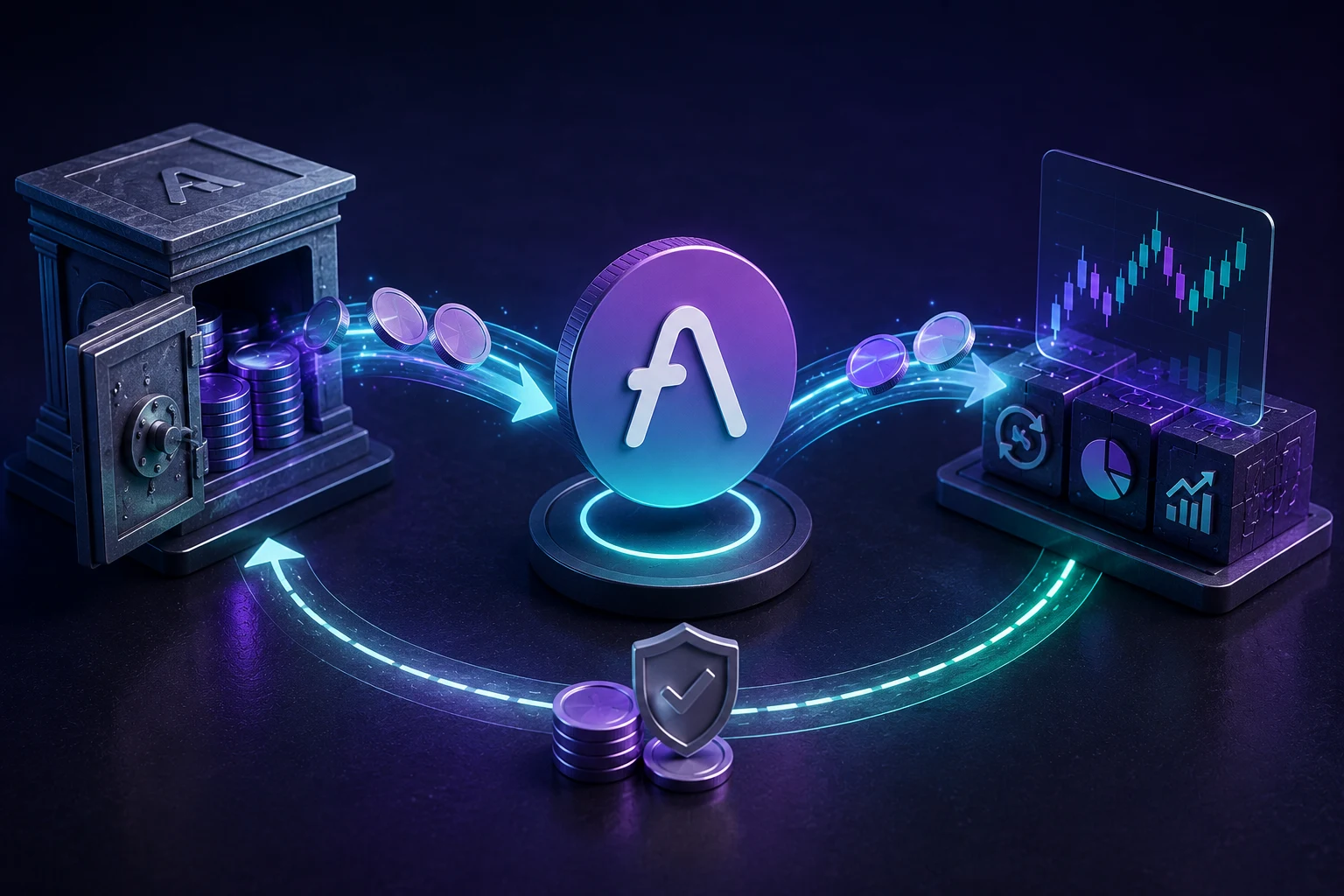
For most of crypto's history, the "safest" on-chain yield was a stablecoin sitting in a lending market — earning interest paid by leveraged borrowers, which spikes during euphoria and craters in bear markets. Tokenized treasuries changed that. They take what is, in traditional finance, the canonical risk-free instrument — short-dated US Treasury bills — and put it on-chain as a regulated token. You hold the token; the issuer holds the T-Bills; you earn the underlying yield (roughly the US short-term rate) net of management fees.
This is part of the broader RWA tokenization story, but treasuries are the category that has actually scaled. By late 2024, tokenized treasury assets crossed a few billion dollars in AUM and have grown steadily since, dominated by BlackRock's BUIDL and Ondo's offerings. It is the first RWA category that institutions actually use at meaningful size.
How it actually works
The basic structure is the same across issuers:
- A regulated entity (BlackRock, Ondo, Franklin, Mountain Protocol, Superstate, others) sets up a fund that holds short-dated US Treasury bills (and sometimes overnight repo).
- The fund issues a token on a blockchain — usually Ethereum, sometimes Solana, Polygon, Avalanche, Sui or others — that represents one share of the fund.
- Holders earn the underlying yield. Some tokens accrue value (the token price rises against USD); others rebase or pay interest in additional tokens (USDY accrues, USDM rebases, OUSG accrues, BUIDL distributes daily dividends).
- Eligible holders can redeem the token for the underlying value, either daily or on a defined schedule, through KYC'd channels.
The yield is whatever short-dated US Treasury bills are paying, minus a management fee (typically 20-50 basis points). When the Fed funds rate is 5%, holders see roughly 4.5-4.8% net. When the rate drops to 3%, the on-chain yield drops with it.
Simple example with numbers
Suppose you are a non-US qualified buyer holding $100,000 of USDC. You want T-Bill yield but want to stay on-chain.
- You complete KYC with Ondo and swap your USDC for USDY at $1.00. You now hold 100,000 USDY.
- USDY accrues value daily. After one year at a 4.5% net yield, your USDY trades at roughly $1.045 — so your 100,000 USDY is worth $104,500.
- You can hold USDY in your wallet, deposit it as collateral on certain DeFi protocols that accept it, transfer it to whitelisted addresses, or redeem it for USDC through Ondo at the prevailing rate.
The same logic applies to BlackRock's BUIDL (institutional, distributes daily dividends), Mountain Protocol's USDM (retail outside US, rebases daily), and Franklin's FOBXX (institutional, on multiple chains). Tax treatment is jurisdiction-specific and frequently treats the yield as ordinary interest income.
The mechanics behind
Why this took so long to work
Tokenized treasuries are conceptually obvious — "put a T-Bill on a blockchain" is not a hard idea. What was hard was the legal plumbing: which regulated wrapper holds the assets, who has redemption rights, how the on-chain token represents an off-chain ownership claim, and how transfer restrictions are enforced. The 2023-2024 wave of products solved this by using familiar US fund structures (Reg D 3(c)(7) private funds, Reg S offerings for non-US investors, money market fund wrappers) and bolting an on-chain token on top.
The token is essentially a transferable claim within a whitelisted set of holders. Most issuers run an allowlist contract — only KYC'd wallets can hold the token. This is what gives the issuer the regulatory cover to operate, and it is also what makes tokenized treasuries less "DeFi" than "TradFi with a blockchain settlement layer".
The major issuers and what they offer
- BlackRock BUIDL. Launched March 2024 on Ethereum. Institutional Reg D fund. Distributes daily dividends in additional BUIDL tokens. Crossed $500m AUM within months and continues to lead the category. Custody and admin via BNY Mellon and others.
- Ondo USDY. Available to non-US qualified individuals and institutions. Accrues value (yield bearing token, price rises). Bridged to Ethereum, Solana, Mantle, Sui and others. Designed to be usable as collateral in DeFi.
- Ondo OUSG. Institutional Reg D, US-eligible accredited investors. Backed primarily by BUIDL plus liquidity tokens. Used as a building block by other DeFi protocols.
- Mountain Protocol USDM. Rebasing token, retail-accessible outside the US, regulated by Bermuda Monetary Authority. Designed to look and feel like a regular ERC-20 dollar.
- Franklin Templeton FOBXX (BENJI). The first SEC-registered on-chain money market fund. Available on multiple chains.
- Superstate USTB. Aimed at US-accredited investors, ERC-20, daily NAV.
- Hashnote USYC, Maple cash, OpenEden TBILL. Several other competitors with various wrappers, custody arrangements, and target audiences.
The list is growing. The pattern is similar across all of them: short-dated T-Bill (or T-Bill money market) backing, KYC required, varying degrees of DeFi composability.
How yield is paid: accrual, rebase, distribution
Accrual tokens (USDY, OUSG): the token's price relative to USD rises over time as yield accrues. Cleanest for accounting and DeFi composability but means "1 USDY" is not always worth "1 USD".
Rebasing tokens (USDM): the token's price stays at $1 and your wallet balance increases as yield accrues. Feels like an interest-bearing dollar, but rebasing breaks some DeFi protocols and confuses some wallets.
Distribution tokens (BUIDL): yield is paid as additional tokens at a fixed cadence (daily, monthly). The base price stays flat. Familiar to anyone who has held a dividend-paying ETF.
The risks worth knowing
- Issuer risk. The token is ultimately a claim on the issuer's fund. If the issuer mismanages, freezes operations, or hits a regulatory snag, the token's value can detach from the underlying T-Bills until things resolve.
- Custody risk. The actual T-Bills sit with a custodian (BNY Mellon, State Street, others). A custody failure is rare but not impossible.
- Smart contract risk. The on-chain token contract — including allowlist, mint, burn, and rebase logic — can have bugs. The blast radius is smaller than a DeFi farm but it is not zero.
- Bridge risk. When a tokenized treasury exists on multiple chains, bridging carries the usual bridge risks. Native multichain issuance (e.g. via CCIP or similar) is safer than wrapped versions.
- Regulatory risk. Jurisdictions can change their stance. A tokenized treasury accessible to retail in country X today may be restricted tomorrow.
- Rate risk. The yield drops when short-term rates drop. If the Fed cuts aggressively, the "4.5% on-chain savings" pitch loses its shine fast.
- De-peg / slippage risk on secondary markets. If you exit by selling the token on a DEX rather than redeeming with the issuer, your fill price may diverge from NAV — usually by tens of basis points, occasionally more during stress.
The honest summary: tokenized treasuries are among the lower-risk yields in crypto today — by a meaningful margin compared to leveraged DeFi farming — but they are not risk-free, and "backed by T-Bills" does not mean "safe as T-Bills". The wrapper, the custodian, and the on-chain contract all add layers.
Who it actually suits
Suits: non-US accredited or qualified investors looking for on-chain dollar yield without taking DeFi protocol risk; institutions running treasuries on-chain (DAOs, crypto-native funds); stablecoin issuers using tokenized treasuries as reserves; DeFi protocols building yield products on top of T-Bill backing.
Does not suit: retail users in jurisdictions where these tokens cannot be held; users who want fully permissionless, non-KYC dollar yield (no such thing exists at this risk level); anyone uncomfortable with depending on a regulated centralized issuer.
For permissionless on-chain dollar holdings, USDC or USDT (see USDT vs USDC) is the more common choice; you give up the yield in exchange for permissionless transferability and no KYC. For permissionless yield, traditional lending markets and yield farming are the alternatives, with materially different risk profiles.
Watch the rates, watch the issuers
Tokenized treasury yields move with Fed rates, and the operational health of issuers can shift quickly with regulatory news or banking events. Zippfeed tracks macro, regulation, and major-token headlines with sentiment and importance scoring, so you can see Fed decisions, custody changes, or regulatory rulings early — useful whether you are holding meaningful balances in BUIDL, USDY or USDM, building a stablecoin-and-T-Bill ladder, or simply trying to understand why on-chain savings rates moved overnight.