Reimagining the organization
Every traditional organization — a company, a charity, a club — has a structure of authority. Someone, or some group, is in charge. They control the bank account, make the decisions, and answer to no code. A DAO asks a radical question: what if an organization could run on transparent rules and collective votes instead, with no central boss at all?
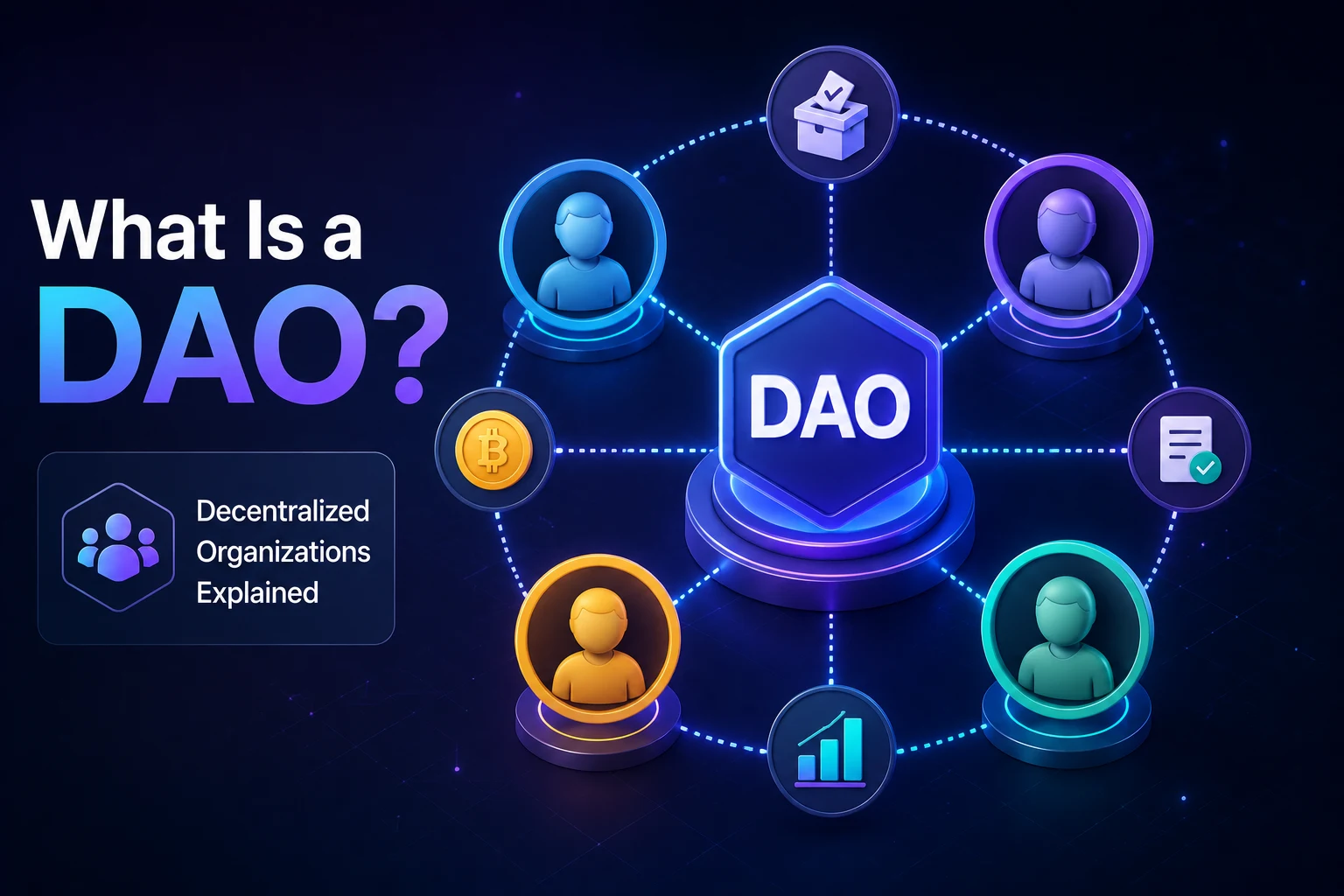
A DAO, or Decentralized Autonomous Organization, is an organization whose rules are written in smart contracts on a blockchain and whose decisions are made collectively by its members. Instead of executives issuing orders, members propose and vote on actions, and the code carries them out automatically.
How a DAO actually works
The mechanics are more concrete than the abstract idea suggests.
Governance by token
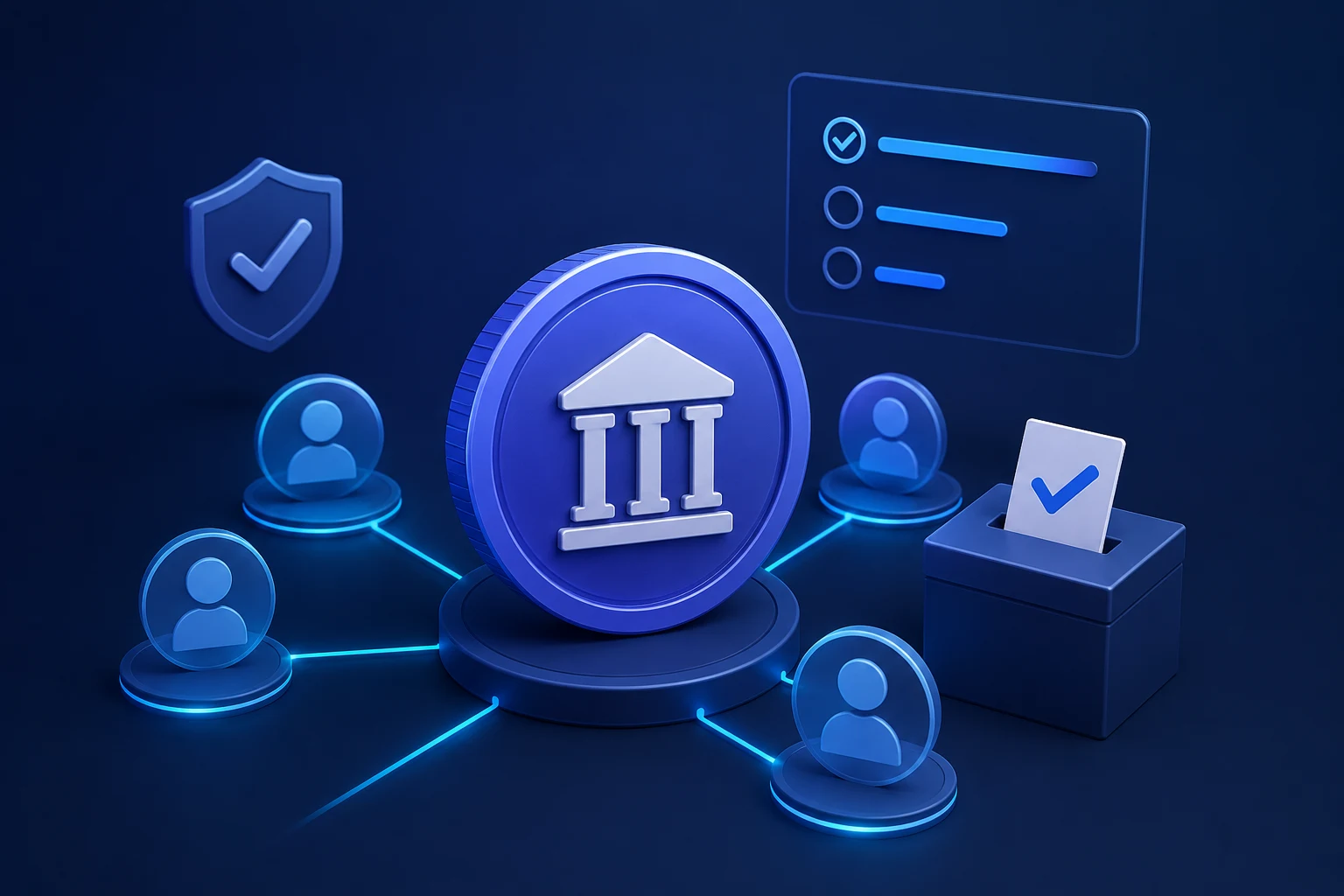
Most DAOs use governance tokens. Holding these tokens gives you voting power — often proportional to how many you hold. Members create proposals (fund this project, change this parameter, spend from the treasury), and token holders vote. If a proposal passes the rules encoded in the smart contract, it executes.
A transparent, on-chain treasury
A DAO typically controls a shared treasury — sometimes very large — held in smart contracts. Crucially, the rules for spending it are public and enforced by code, not by a person who could quietly misuse funds. Anyone can inspect the treasury and the rules governing it.
Rules as code
The DAO's core rules live in smart contracts. This is the "autonomous" part: once deployed, the organization runs according to its code, and changing the rules itself usually requires a vote. The aim is to replace "trust the management" with "verify the code."
What DAOs are used for
- Protocol governance. Many DeFi protocols are governed by DAOs, letting users steer the project's future.
- Investment. Groups pool capital and vote collectively on where to deploy it.
- Collecting and funding. DAOs have formed to buy assets, fund public goods, or back creative projects.
- Communities and social clubs. Membership organizations coordinated entirely on-chain.
The unifying idea is coordinating people and money transparently, without a trusted central operator.
The honest limitations
DAOs are an inspiring experiment, but they are genuinely hard, and the gap between the ideal and the reality is wide.
- Voter apathy. In practice, most token holders do not vote. Low participation can leave decisions to a small, active minority — undermining the "decentralized" promise.
- Wealth concentrates power. When votes scale with token holdings, large holders ("whales") can dominate, recreating the centralization DAOs aim to escape.
- Legal gray zones. What *is* a DAO legally? Who is liable if something goes wrong? Regulation is still catching up, and the uncertainty is real.
- Governance attacks. Attackers have exploited DAO mechanics — sometimes acquiring enough voting power to pass proposals that drain treasuries.
- Slow and clunky. Decision-making by proposal and vote can be far slower than a manager simply deciding.
None of this is investment advice, and governance tokens are volatile assets distinct from the success of the DAO itself. The point is that DAOs are a serious, still-maturing attempt to rebuild organizations — not a finished, frictionless utopia.
Watch governance in motion
DAO governance plays out in public, and consequential votes, proposals, and governance attacks unfold quickly. Zippfeed tracks DeFi and governance-related headlines with sentiment and importance scoring, so if you hold governance tokens or use DAO-run protocols, you can follow the decisions and risks that affect them as they happen rather than after the fact.