A gas fee in one sentence
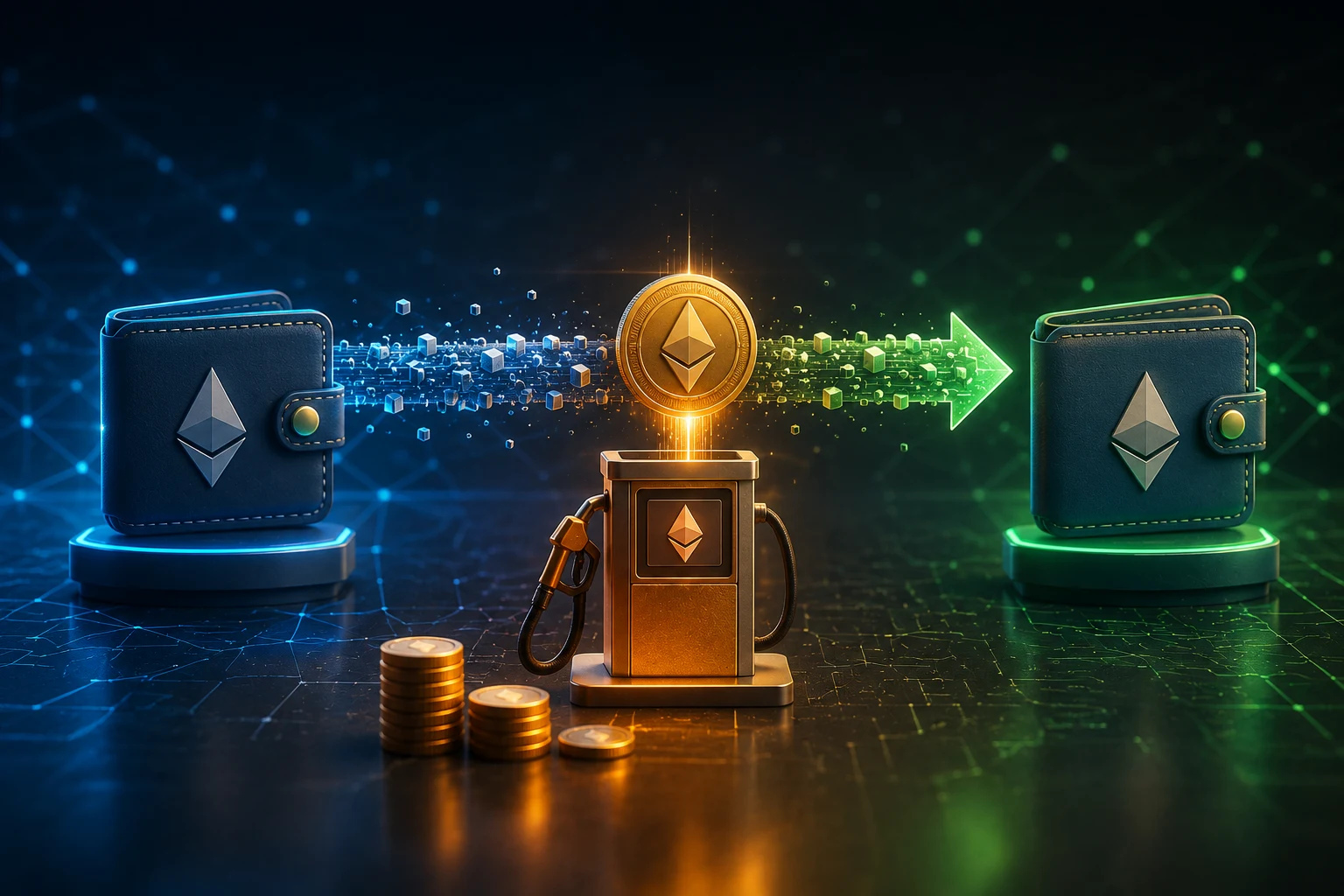
A gas fee is the price you pay to use blockchain compute and storage for a single transaction — a few cents to a few dollars for most things, sometimes much more during peak demand. Gas exists because public chains have no admin to stop spam; the price is what makes it economically irrational to flood the network. Without gas, a single attacker with a script could fill every block forever.
The mental model: imagine a global computer that runs anyone's code if they pay for the electricity. Gas is the electricity bill. Simple transfers use a little; complex smart-contract calls use a lot; the network is priced like a metered utility.
How gas is actually priced
Every transaction has two numbers behind its fee: gas used and gas price. The product is what you pay.
Gas units: how much work the transaction does
Each operation in a smart contract costs a fixed number of gas units, set by the protocol. A simple ETH transfer costs 21,000 gas. A token transfer costs around 65,000. A complex DeFi swap can be 200,000 to 500,000. An NFT mint with on-chain art can hit 1,000,000+. The harder the work, the more gas units.
Gas price: how much you pay per unit
Measured in gwei on Ethereum (one gwei is a billionth of an ETH). When the chain is calm, gas might be 5-20 gwei. When it is busy, 50-100. During panics or hype, several hundred. The price floats with demand, like an auction for limited block space.
The fee equals the product
If a swap uses 200,000 gas units at 30 gwei, the fee is 6,000,000 gwei — which is 0.006 ETH. If ETH is at $3,000, that swap costs $18 in gas. Drop gas to 10 gwei and the same swap costs $6. Push gas to 100 gwei and the same swap costs $60. The transaction is doing the same work; only the unit price changes.
EIP-1559: how Ethereum sets gas today
Before 2021, Ethereum ran a pure first-price auction — everyone guessed a fee and validators picked the highest. It worked but produced wild swings and made wallets bad at estimating. EIP-1559 changed the structure.
The base fee
The protocol now sets a base fee for each block, adjusted up or down based on how full the previous block was. A block that ran more than half full pushes the base fee up; an empty one pulls it down. This base fee is mandatory and is burned — destroyed, removed from circulation. It does not go to the validator.
The priority tip
You add a small priority tip on top of the base fee, which does go to the validator. The tip is your bid for faster inclusion when blocks are competitive; in quiet times it can be near zero. Most wallets handle this automatically and only show you the total.
What this changes in practice
Fee estimation got dramatically better — wallets can see the next base fee and just need to guess a tip. Spikes still happen during real demand, but the previous slow drift up has largely disappeared. The burn also has a subtle long-term effect: when the network is busy enough, more ETH is burned in fees than is issued in rewards, making the supply slightly deflationary during heavy use.
Why fees spike on busy days
This is the part that frustrates everyone. Yesterday a transaction cost $0.50; today the same transaction costs $40. What happened?
The answer is that block space is fixed. Each block on Ethereum can hold a target amount of gas (currently around 30 million units), and that ceiling does not rise as demand grows. When something attracts a wave of activity — an NFT mint, a major airdrop, an exchange listing, a liquidation cascade — many users compete for the same scarce space. Wallets bid the priority tip up to be included, the base fee rises automatically, and the result is fees that can climb 10x or more in an afternoon.
The spikes usually clear within hours. But while they last, paying fees in the new range or just waiting are the only options. Cancelling a stuck transaction itself costs gas. There is no manager to ask for a refund.
How Layer 2 networks change the equation
The main complaint about Ethereum is the fee. The solution the ecosystem converged on is Layer 2 (L2) networks: chains that process transactions off the main chain (Layer 1) and then post compressed proofs of the activity back to Ethereum. The security still comes from Ethereum; the throughput is much higher; the fees are a fraction of L1.
Major L2s — Arbitrum, Optimism, Base, zkSync, Polygon zkEVM — can process the same swap that costs $20 on Ethereum for $0.05 to $0.50. The user experience is nearly identical: you bridge a small amount of ETH to the L2 once, then transact on the L2 from then on with a normal wallet. Most modern DeFi activity has migrated to L2s for this reason.
L2s are not free of constraints. Bridging back to L1 has its own fee. Liquidity is split across networks. Some L2s have centralised sequencers that could theoretically reorder transactions. But for ordinary usage, an L2 cuts gas costs to the point that worrying about them mostly stops.
How to read a gas estimate in your wallet
When you click confirm on a transaction, your wallet shows a fee estimate. Knowing what each piece means makes the screen less scary.
Gas price (gwei). What you are willing to pay per unit of work. Most wallets pick a sensible number based on current network conditions; you can override it if you are in a hurry or trying to save.
Gas limit. The maximum number of gas units you authorise. If the transaction uses less, you pay less; if it tries to use more, it fails and you forfeit the gas used so far. Wallets set this automatically based on a simulation.
Estimated fee. Gas limit times gas price, expressed in the network's native coin (ETH on Ethereum, MATIC on Polygon, ETH on most L2s). Below it the wallet usually shows the same number in fiat.
If a wallet asks you to manually set gas, it is usually because the network is congested and the default seems wrong. Set the tip slightly above what others are paying for faster inclusion, or leave it low and wait.
When transactions fail and you still pay
This is the part newcomers find unfair: a transaction can fail and still cost gas. The reason is that the validators did the computational work before discovering the failure, and the chain has no way to refund effort that already happened.
The most common failures: slippage exceeded on a DeFi swap, an NFT mint that sold out one block before yours, a smart-contract revert from an unexpected condition. Each of these still costs the gas used up to the point of failure. The good news is that the failed transaction is recorded so you have evidence and a transaction hash. The bad news is that the gas is gone.
The defence: set sensible slippage settings, do not chase hyped mints in the final blocks, double-check parameters before signing, and prefer L2s where a failed transaction costs cents instead of dollars.
How to spend less on gas
Five habits cover most of the savings available to a normal user.
- Use a Layer 2. The biggest single thing you can do. A swap on an L2 is 10 to 100 times cheaper than on Ethereum mainnet.
- Transact during quiet hours. Network demand follows time zones. Late nights and weekends in the Americas are typically calmer.
- Batch your actions. Combine multiple steps into one transaction where the dApp supports it. Approvals, swaps, and adds in one click cost less gas in total than three separate signatures.
- Approve only what you need. An unlimited token approval costs about the same as a single-use one but exposes you forever. Some wallets now use single-use approvals by default; on those that do not, set the spending limit when prompted.
- Wait on big mints. The first hour of a popular launch is when fees and failure rates are worst. If you can wait, the same item often costs a fraction in fees later.
Tracking the news that moves gas prices
Gas prices spike for reasons — a major airdrop claim window, a liquidation cascade, a new viral protocol, a contentious upgrade. If you only see the spike after it has already cost you, you are reacting too late. Zippfeed surfaces the catalysts that move gas with a sentiment score (bullish, neutral or bearish) and an importance rating, so you know whether the chain is about to get expensive before you click confirm. This is education, not financial advice — but the people who pay reasonable fees consistently are the ones who notice the catalyst before everyone else does.

 WuBlockchain
 Crypto Capital Venture
 Lookonchain
 TheBlock