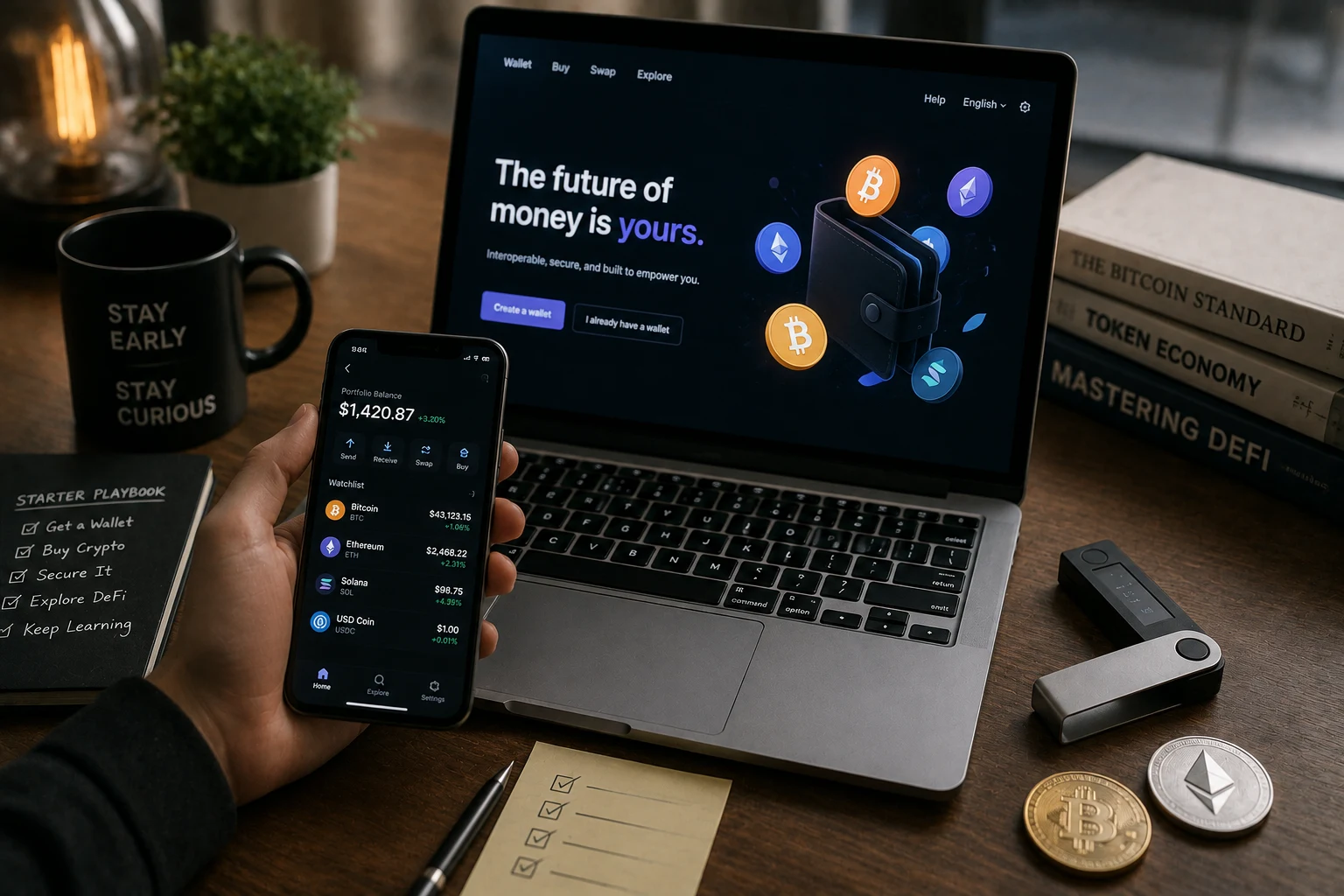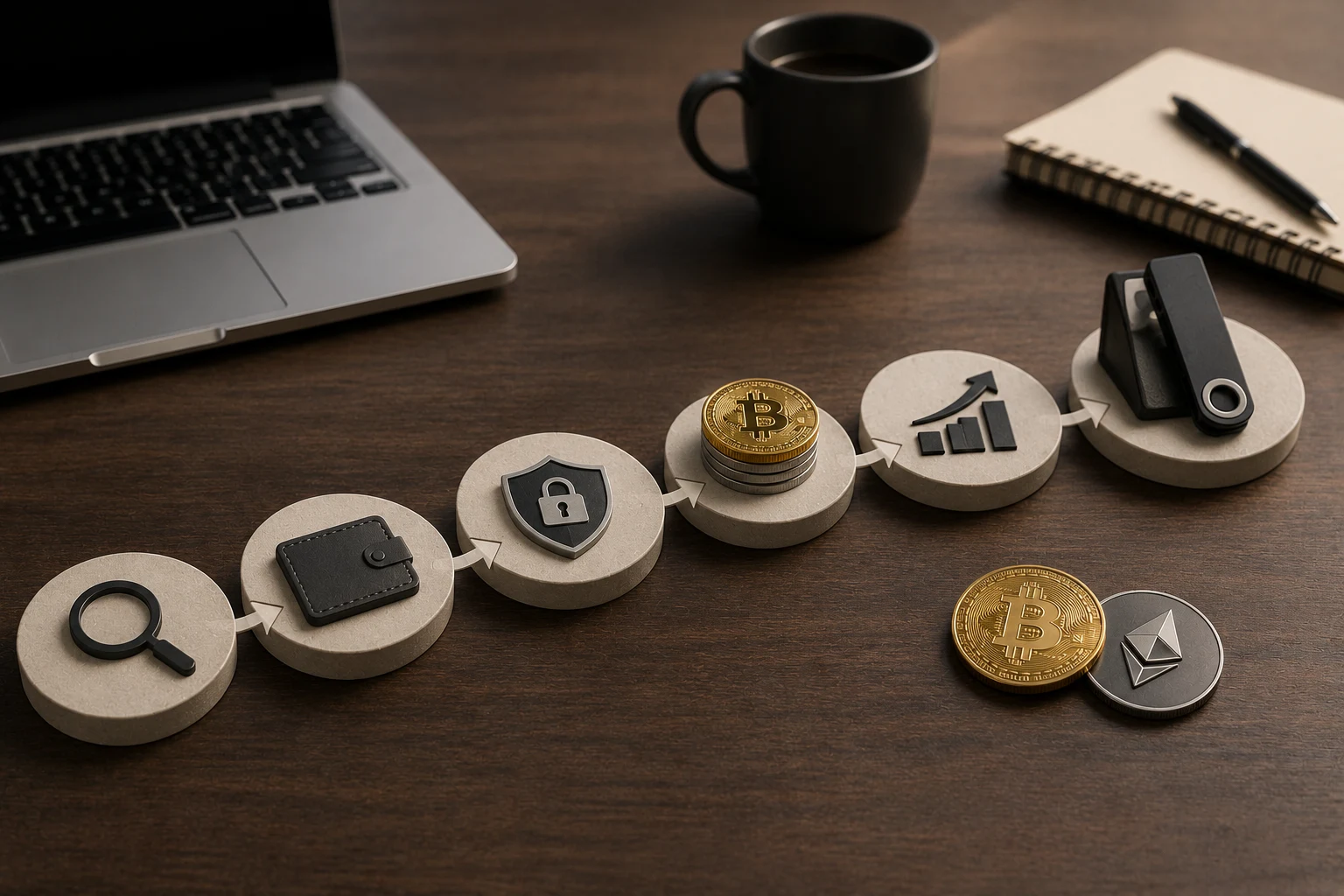
What buying crypto actually involves
Most beginners think of 'buying crypto' as a single action, the way you would click 'buy' on a stock. In practice it is a chain of decisions, and the chain is where mistakes happen. You pick a venue, prove your identity to that venue, deposit money, place an order, receive the asset in an account you do not control, and then decide whether to leave it there or move it somewhere you do control. Every link in that chain is a place where first-timers lose money that has nothing to do with market direction.
The good news is that almost all of those mistakes are boring, mechanical, and avoidable. You do not need to predict the next bull run, time the bottom, or understand tokenomics to buy your first fraction of BTC or ETH. You need a checklist. This article walks through that checklist in order, with the risk callouts placed where they matter, not buried at the end.
One thing to set expectations on: nothing you do here guarantees profit. Crypto prices can fall 50 percent or more in a quarter, and they have, many times. The goal of a careful first purchase is not to make money. It is to make sure that whatever you buy, you can actually hold, withdraw, and account for. After that, market risk is just market risk.
What can actually go wrong on a first purchase
Before the step-by-step, it helps to name the failure modes you are protecting against. Almost every first-time loss falls into one of these buckets.
Identity and account compromise
If you skip two-factor authentication, reuse passwords, or fall for a phishing email that looks like an exchange login page, an attacker can drain your account the moment funds arrive. Strong unique passwords plus an authenticator app are non-negotiable. SMS codes are better than nothing and worse than an app like Google Authenticator or Authy, because phone numbers can be SIM-swapped.
Wrong address or wrong network
Cryptocurrency transactions are irreversible. If you paste the wrong receive address, or if you send USDT on the ERC-20 network to an address that only supports TRC-20, the funds arrive at a destination that either does not exist, does not recognize that asset, or has no recovery path. The phrase 'permanent loss' in crypto almost always refers to this error, not to price drops.
Exchange counterparty risk
When you leave crypto on an exchange, you do not own it the way you own cash in a bank. You hold an IOU from a private company. History is full of exchanges that could not honor those IOUs: Mt. Gox in 2014, QuadrigaCX in 2019, FTX in 2022. The lesson is not 'all exchanges are scams.' The lesson is that self-custody is the only way to remove that specific risk, at the cost of taking on personal key-management responsibility.
Stuck transactions and the mempool
When you broadcast a transaction, it does not get added to the blockchain instantly. It sits in a waiting room called the mempool, alongside every other unconfirmed transaction. Miners or validators pick transactions, usually by fee. If your fee is too low during a busy period, your transaction can sit unconfirmed for hours or days, or be dropped entirely. Knowing this exists prevents the panic of staring at a 'pending' status for an hour.
Step 1: Pick a venue and pass KYC
For a first purchase, a centralized exchange is the practical entry point. It will match a fiat deposit (USD, EUR, GBP, and so on) to a crypto order, handle compliance, and give you a place to store the asset if you choose not to self-custody. Examples in the mainstream market include Coinbase, Kraken, Binance, and Crypto.com, though the right venue depends on your country, the fiat currency you hold, and which assets you want to buy. The article deliberately does not recommend a single brand, because availability, fees, and regulatory standing change constantly.
Once you pick a venue, you will go through KYC, which stands for Know Your Customer. The exchange collects your name, address, date of birth, government ID, and sometimes a selfie or a short video. This is the same process banks use, and the reason is the same: anti-money-laundering laws (AML) require financial institutions to verify who their customers are. It is not optional, and a legitimate exchange will not let you deposit fiat without it. If a 'crypto site' lets you skip KYC entirely, treat that as a red flag rather than a perk.
Beyond legal compliance, KYC also protects you. It means the exchange has verified it is dealing with a real person, and that if your account is ever hijacked, the recovery process is anchored to your identity. Complete the verification honestly, including any proof-of-address documents. Incomplete KYC is the most common reason new accounts get frozen right after a first deposit.
Step 2: Fund the account safely
Most exchanges accept bank transfers, debit cards, and sometimes credit cards. Bank transfers are almost always the cheapest option in fees, though they are slower. Card purchases are fast but can carry 2 to 4 percent in card-processing fees, and credit card issuers in several countries block crypto purchases outright. Start with the cheapest method that meets your time constraint.
Whichever method you choose, enable two-factor authentication on the exchange account before the deposit clears. An authenticator app is the standard. The deposit itself is a normal financial transfer. The risk layer that matters here is the exchange account itself: a strong unique password, an authenticator app code at login, and a withdrawal whitelist if the exchange offers one. Phishing is the main attack vector, not the bank transfer.
Be careful with name matching. Most exchanges will only accept deposits from a bank account in your own name, especially after KYC. Depositing from a spouse's account, a friend's account, or a third-party payment service can result in the deposit being held or reversed. If you are funding from a joint account, check the exchange's policy first.
Step 3: Place the order and understand what you bought
Once funded, the actual buy is the simplest part. You choose a market like BTC/USD or ETH/USDT, enter the amount, and place the order. There are two order types worth knowing on day one. A market order fills immediately at the current best price and costs a little more in spread. A limit order lets you set the price you are willing to pay and waits for the market to reach it, which is useful when you are not in a hurry and do not want to overpay by a fraction of a percent in a fast market.
For a first purchase, a market order is fine. The point of the first transaction is procedural, not strategic. You are learning how the rails work, not making a market call. Many exchanges also have a 'recurring buy' or 'auto-invest' feature, which is a clean way to set up dollar-cost averaging without thinking about timing each week.
You will also see two common pricing units: BTC priced in dollars, and ETH often priced against a stablecoin like USDT or USDC. A stablecoin is a token pegged to a fiat currency, usually 1 to 1 with the US dollar, designed to hold a steady value. USDT and USDC are the two largest. They are useful as a parking spot between trades but they are issued by private companies and carry their own counterparty and reserve risks. They are not the same as dollars in a bank account.
Step 4: Withdraw to self-custody the right way
If you plan to hold for more than a few weeks, withdrawing to a self-custody wallet is the standard advice. Self-custody means you hold the private keys, usually represented by a seed phrase, a list of 12 or 24 words that can regenerate your wallet. Anyone with that phrase controls the funds. No company, no support team, no password reset.
Choosing a wallet
Hot wallets are apps on your phone or browser, always connected to the internet, convenient for small balances. Cold wallets are hardware devices that keep keys offline, the standard for larger long-term holdings. Popular hot wallets include MetaMask, Trust Wallet, and Phantom for the Solana network. Popular hardware wallets include Ledger and Trezor. The right choice depends on the assets you hold and how often you transact.
Picking the right network
This is the single highest-stakes decision in the article. When you withdraw from an exchange, you will be asked to choose a network. The same token, say USDT, can move on Ethereum (ERC-20), Tron (TRC-20), Solana, Arbitrum, Polygon, and several others. The address formats and fees differ. If you send USDT on the ERC-20 network to an exchange or wallet that only credits TRC-20 deposits, the funds are not lost forever in every case, but recovery is slow, expensive, and sometimes impossible, especially if the receiving platform does not run a node on the source chain.
The rule is simple: match the network on the sending side to the network on the receiving side, exactly. If your wallet says 'receive USDT on Tron,' set the exchange withdrawal to USDT on TRC-20, not ERC-20, not Solana, not Polygon. The exchange will usually show a warning and a memo or tag field for some chains (a tag is an extra identifier the exchange uses to route the deposit to your account). Copy the tag exactly. Sending the right token on the right network with the wrong tag is a common way to lose access to a deposit until support manually credits it.
The test transaction
Before sending your full balance, send a small test amount. Move 5 to 10 dollars worth of the asset first, on the network you intend to use, to the address you copied. Wait for it to confirm on the receiving end. This is the part most beginners skip, and it is the part that would have saved the largest share of first-time losses. A test transaction costs you a few cents in fees and a few minutes of waiting. It costs you nothing compared to sending 1,000 dollars to a dead address by accident.
Verifying on a block explorer
Once the test arrives, open a block explorer for that network (Etherscan for Ethereum, Tronscan for Tron, Solscan for Solana, Blockchain.com or Mempool.space for Bitcoin) and paste the transaction ID, sometimes called a hash. The explorer will show the sending address, the receiving address, the amount, the fee, and the confirmation count. Confirmations are the number of blocks added on top of the block that includes your transaction. One confirmation is usually enough to be sure, though exchanges typically wait for several before crediting a deposit.
This is also where you can finally see what the mempool does. After you broadcast, the transaction will briefly show as 'pending' in the mempool view of the explorer. If your fee was adequate, it confirms within minutes. If it sits, the transaction has not been lost, it is just waiting, and most wallets let you 'speed up' by replacing it with a higher-fee version of the same transaction.
Dollar-cost averaging vs. lump sum
Once the mechanics are solid, the only investing question left is timing. Two approaches dominate beginner conversations.
Lump sum means putting all the money you have decided to allocate into the asset in one purchase. Historically, lump sum beats dollar-cost averaging most of the time, because markets trend up more than they trend down, and time in the market beats timing the market. The catch is the emotional cost. If you lump-sum and the price drops 30 percent the next week, you watch your balance shrink and you may panic-sell at the bottom. Many first-time buyers do exactly that.
Dollar-cost averaging (DCA) means splitting the same total amount into regular smaller purchases, weekly or monthly, regardless of price. You almost always end up with a slightly worse average entry than a lucky lump sum, but you almost never end up with the worst possible entry, and you remove the stress of trying to time the bottom. For a first purchase, DCA is a sensible default. The actual return difference between the two strategies over multi-year horizons is usually smaller than people expect, and the psychological difference is large.
A common hybrid is to take a small lump-sum first purchase to complete the learning loop described in this article, then set up a recurring buy for the rest of the allocation. That way you pay one set of withdrawal and test-transaction fees, learn the rails, and let automation handle the rest.
Practical implications for the reader
If you have read this far, the practical checklist is short. Pick a regulated exchange that serves your country, complete KYC honestly, enable an authenticator app, fund from a bank account in your own name, place a small market order or set up a recurring buy, and withdraw a test amount to a self-custody wallet on a network you have verified with the receiving platform. Confirm the test on a block explorer. Then move the rest.
Budget for fees at each step. Exchanges charge deposit, trading, and withdrawal fees, and networks charge variable gas fees that spike during congestion. For a first 200 dollar test, a 5 to 10 dollar fee stack is normal. For larger amounts, the percentage gets smaller, which is one argument for not dribbling the same total across many tiny orders.
Finally, keep records. Crypto tax treatment in most jurisdictions treats every swap, even crypto-to-crypto, as a taxable event. The exchange will give you a transaction history, and any wallet you use has one too. Save the CSVs somewhere outside the wallet. They are not glamorous, but they are the difference between a clean tax filing and a painful one.
How to follow the crypto market the smart way
Crypto markets move fast and so does the news around them. Tracking which headlines actually matter and which are noise is hard to do manually, and noise is expensive when real money is on the line. Zippfeed surfaces crypto headlines with sentiment scoring (bullish, neutral, or bearish) and an importance rating, so you can react to real signals instead of scrolling endless feeds.




 Crypto News
 Lookonchain
 CoinDesk
 CoinTelegraph
 TheBlock