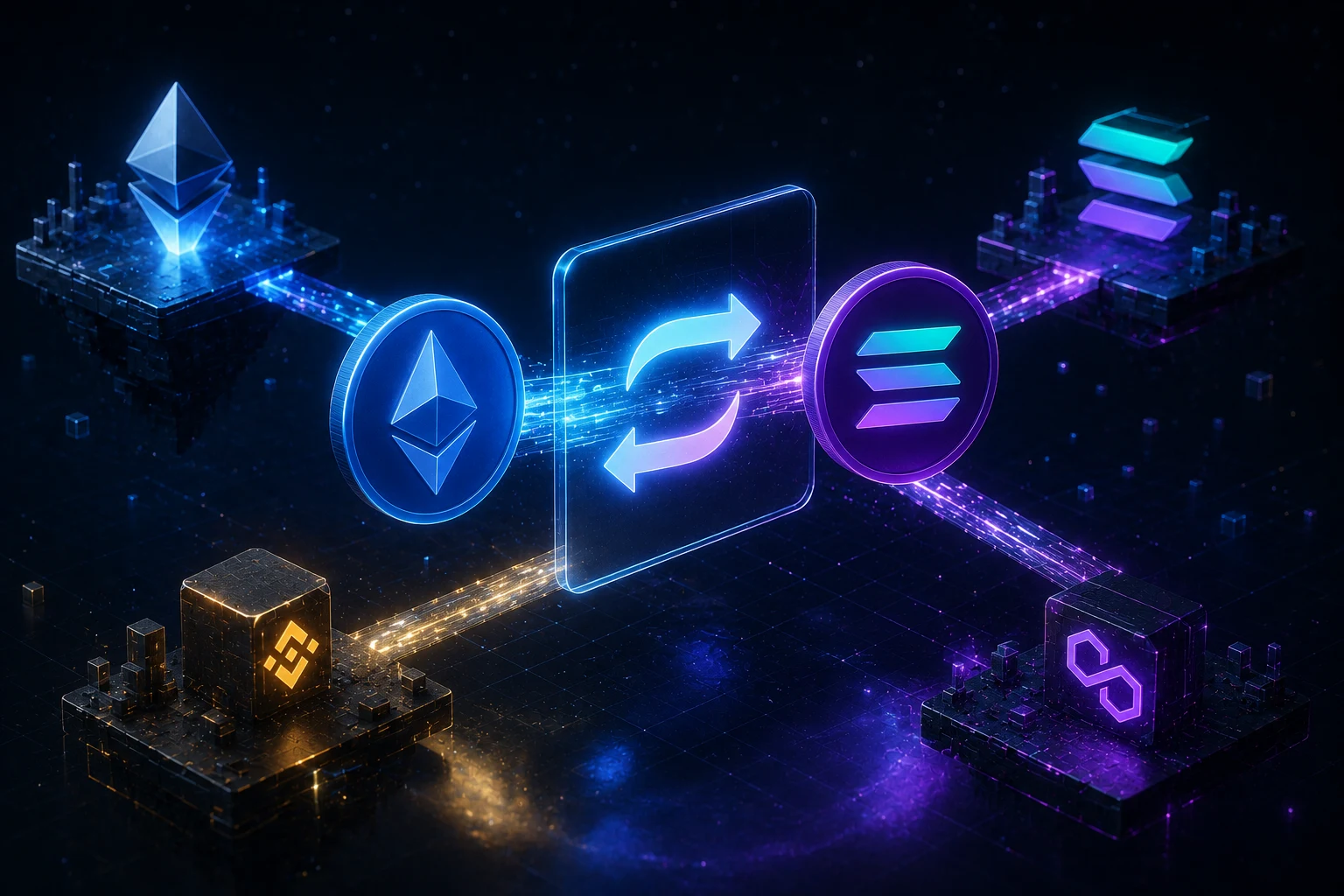
What is a crypto intent, in plain terms
A crypto intent is a signed message that says what you want to happen, not how to make it happen. Instead of approving a token, picking a router, approving another token, and signing a bridge transaction, you sign one statement such as: "I will pay 1 ETH on Ethereum mainnet, and I want at least 3,400 USDC delivered to my wallet on Base within 20 minutes." That signed statement is the intent.
Once an intent exists, it gets handed off to a marketplace of actors called solvers, fillers, or relayers. They look at your intent, look at current liquidity and prices across chains, and submit a transaction that fills it. Whoever delivers the best execution wins the fee the user built into the intent.
This feels small on paper, but it flips the mental model of DeFi. The transaction model asks the user to be a router operator. The intent model asks the user to be a buyer with a budget. Everything in between, including bridging, slippage, gas, and route selection, is delegated to professionals competing for the order.
Why this shift matters for DeFi users
The pitch is honest and the pain is real. A user trying to move USDC from Ethereum to Arbitrum to buy a token, then bridge back, currently signs four or five transactions, pays gas on two chains, and accepts slippage twice. Most beginners bounce off this wall and never return. Roughly half of all new wallets that interact with DeFi abandon after their first cross-chain attempt, according to onchain analytics firms that track wallet cohorts, though estimates vary by methodology.
Intents compress that into a single signature. The user trades execution uncertainty for cognitive simplicity. In practice, that often translates to better average fills because a solver with sophisticated routing can see deeper liquidity and pay gas in ways a human clicking buttons cannot.
There is a second-order effect that matters for the whole ecosystem. When solvers fill cross-chain intents, they take on inventory risk. They pay gas, lock capital, and hope to be reimbursed by your intent. That changes who earns the spread in DeFi. Instead of miners and validators capturing MEV, professional market makers compete for it. Whether that is a net win for users is one of the open questions in the field.
How solvers actually compete to fill your trade
Most intent systems work in three steps. First, your wallet publishes the intent to a public order book or a private auction run by a filler network. Second, solvers race to bid on the order, posting the best price they can guarantee plus the route they will use. Third, a winning solver executes the fill, which usually involves sending one transaction on the source chain, bridging through a chosen path, and delivering on the destination chain.
Auction designs vary. Some are sealed-bid, where solvers submit private quotes and the highest wins. Others are Dutch auctions, where the price starts generous and decays until a solver bites. A few systems, like Across and UniswapX, lean on a network of professional fillers who compete continuously, similar to how an equities market maker would. The user usually does not see this auction; the wallet interface just shows a quote and an estimated fill time.
Solvers earn through the spread they capture between the user's quoted minimum and the actual execution price. If you sign an intent for "at least 3,400 USDC," a solver might fill it for 3,420 USDC and pocket the difference. The competition among solvers is what keeps that spread small. In thin markets or during bridge congestion, the spread widens, and the user's realized price drops toward their stated minimum.
What ERC-7683 actually standardizes
ERC-7683 is an Ethereum Improvement Proposal co-authored by Uniswap Labs and Across Protocol in 2024, designed to create a shared format for cross-chain intents. Before the standard, every intent system invented its own message format, its own settlement primitive, and its own dispute rules. That fragmentation made it impossible for a wallet to plug into multiple intent networks at once.
The standard defines two things. It defines the structure of a cross-chain order, including the input token and amount, the output token and minimum, a deadline, a settlement contract address, and an array of supported chains. It also defines a common settlement contract that both the user's chain and the solver's chain can verify against, so a fill on one chain can be honored on the other without each project reinventing the trust assumptions.
In plain English, ERC-7683 is to cross-chain intents what ERC-20 was to tokens on Ethereum. It does not promise safety, it just promises that everyone agrees on the shape of the message. Solvers, bridges, and wallets can now build to one spec and expect interoperability. The standard was live in testnet form through 2024 and saw mainnet deployments in 2025, with UniswapX and deBridge among the early integrators.
UniswapX, Across, and deBridge in practice
UniswapX is Uniswap's intent-based order book, launched in 2023 and iterated through 2024. When you swap on a Uniswap-powered interface using UniswapX, you sign an intent, and a network of fillers called Dutch auction participants competes to fill it. UniswapX supports cross-chain swaps through partnerships with bridge providers, and it has been one of the proving grounds for the ERC-7683 settlement shape.
Across Protocol is a bridge and intent system that focuses on fast, capital-backed cross-chain transfers. Across operates with a network of relayers who front liquidity on the destination chain and get repaid on the source chain. The protocol has been a major proponent of the ERC-7683 standard because its design naturally fits the cross-chain order model.
deBridge is a cross-chain messaging and liquidity protocol that integrates ERC-7683 to settle intents between chains like Ethereum, Arbitrum, BNB Chain, and Solana. Together, these three projects illustrate the practical shape of intent-based DeFi in 2025 and 2026: shared standards, competing fillers, and bridges that handle the actual movement of funds.
Risks, scams, and failure modes to know about
Intents do not remove risk, they relocate it. The smart-contract risk you used to take by approving a router moves to the settlement contract defined in the ERC-7683 order. The bridge risk you used to take by trusting a custodial or wrapped-token bridge moves to the solver or relayer who fronts liquidity on the destination chain. The execution risk you used to manage by setting slippage now lives inside the auction dynamics, which the user usually cannot inspect.
The most common failure mode is the stuck fill. A solver wins an auction, posts a fill on the destination chain, and then the source-chain settlement does not finalize because of a bridge outage or a gas spike. The user may see a partial state where funds are locked on one side and have not arrived on the other. Reputable protocols include a dispute period and a refund mechanism, but those rely on the settlement contract working as designed.
A second risk is solver griefing. Because solvers compete in public order books or auctions, sophisticated actors can see your intent and try to extract MEV by moving prices against you. Cross-chain MEV is harder than on a single DEX, but it exists, and during periods of bridge congestion it can cost the user several percent of the trade.
A third risk is the trust placed in the solver network itself. Some intent systems rely on a small set of professional fillers. If that set becomes too small or too coordinated, the auction stops being competitive and spreads widen. The architecture is decentralized in name, but the economics can become centralized in practice, which is something users should weigh before treating intent systems as automatic.
Should you actually use intents, and when
Intents are a clear win for users who want simple cross-chain swaps and are willing to trade some transparency for convenience. For trades under a few thousand dollars where the alternative is signing four transactions and paying gas on two chains, intents usually deliver a better experience at a competitive price. The cognitive savings alone are worth the abstraction for most retail users.
Intents are a weaker choice for very large trades where you care about the exact execution path, for trades during periods of bridge stress, or for trades where you specifically need to interact with a custom contract on the destination chain. If you are a market maker or a treasury operator moving meaningful size, you probably still want manual control over the route and the timing.
The honest summary is that intents are a real UX improvement, not a magic trick. They push complexity into a layer where professionals can compete on your behalf, and ERC-7683 makes that layer interoperable. Read the settlement contract, look at the list of fillers for the protocol you use, and check whether the cross-chain path you want is actually supported. Treat the signed intent the way you would treat a limit order on a centralized exchange: as a useful tool with its own failure modes.
Stay ahead of intent-based crypto with sentiment-aware news
Intents, ERC-7683, and the broader shift to solver-based DeFi are moving fast, and so is the news around them. Tracking bridge outages, solver wins, and standards updates by hand is a losing game for most users. Zippfeed surfaces crypto headlines with sentiment scoring, bullish, neutral, or bearish, and an importance rating, so you can spot the protocol shifts and risk events that actually matter before they show up in your wallet.


 WuBlockchain
 Crypto Capital Venture
 Lookonchain
 TheBlock